Question
Why should the amplitude of the vibrating pendulum be small?

Answer

When amplitude of the vibrating pendulum is small, then angular displacement of the bob used in simple pendulum is small. Here the restoring force$\text{F}=\text{mg}\sin\theta=\text{mg}\theta=\frac{\text{mgx}}{\text{l}}$
Where x is the displacement of the bob and I is the length of pendulum . Hence $\text{F}\propto\text{x}$ Since F is directed towards mean position, therefore the motion of the bob of simple pendulum will be S. H. M.if $\theta$ is small.

Need a full question paper?

Generate a complete, print-ready paper with questions like this in minutes — across 16+ boards, with answer keys.
Start Generating Free

Similar questions

How many Joules of mechanical work is required to obtain one calorie of heat?
Write the dimensional formula corresponding to :
  1. Photon.
  2. Calorie.
Can an object be in pure translation as well as in pure rotation?
Science, like any knowledge, can be put to good or bad use, depending on the user. Given below are some of the applications of science. Formulate your views on whether the particular application is good, bad or something that cannot be so clearly categorised:
  1. Mass vaccination against small pox to curb and finally eradicate this disease from the population. $($This has already been successfully done in India$).$
  2. Television for eradication of illiteracy and for mass communication of news and ideas.
  3. Prenatal sex determination.
  4. Computers for increase in work efficiency.
  5. Putting artificial satellites into orbits around the Earth.
  6. Development of nuclear weapons.
  7. Development of new and powerful techniques of chemical and biological warfare.
  8. Purification of water for drinking.
  9. Plastic surgery.
  10. Cloning.
Do you expect the gas in a cooking gas cylinder to obey the ideal gas equation?
How many beats are formed when two sources vibrate in unison?
At which point on its path a projectile has the smallest speed?
What is the dimensional formula for torque?
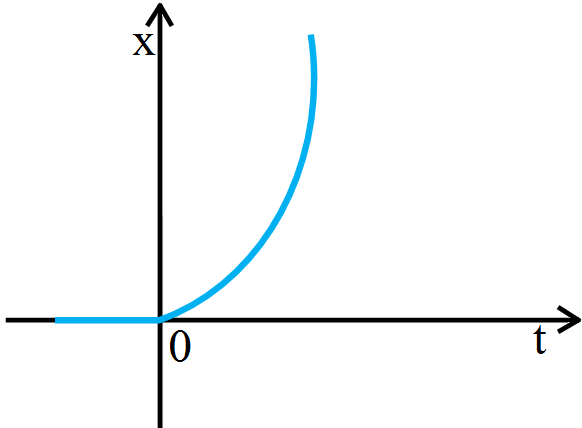
Shows the x-t plot of one-dimensional motion of a particle. Is it correct to say from the graph that the particle moves in a straight line for t < 0 and on a parabolic path for t > 0? If not, suggest a suitable physical context for this graph.
A wire increases by $10^{-3}$ of its length when a stress of $10^8Nm^{-2}$ is applied to it. What is the Young's modulus of the material of the wire?