Question
Why should we not rely only on facts in science?

Answer

While facts provide a foundation, science is fundamentally about inquiry and understanding. Over-reliance on facts can limit our ability to question, explore, and connect ideas, which are crucial for deeper learning and discovery. The true essence of science lies in the process of asking questions, conducting experiments, and thinking critically, allowing us to not only memorize information but also comprehend its underlying principles and applications.
Need a full question paper?

Generate a complete, print-ready paper with questions like this in minutes — across 16+ boards, with answer keys.

Start Generating Free

Similar questions

Discuss the position and number of molars in buccal cavity.
Explain migration.
A group of students noticed that a torch does not light up even though the batteries are new. They replaced the wire and it worked. What scientific approach did the students use to solve the problem? Explain the role of hypothesis and experiment in this scenario.
Last Sunday, Pooja on her week off entered in her kitchen to cook rice for her family in lunch time. The moment she put fry pan on the gas stove and lighted it through the matchstick, all of sudden her 5 years small daughter entered into the kitchen and tends to touch the hot fry pan. At the same time, Pooja saw her and pushed her away from the hot fry pan. In this way, she saved her child.
(i) Explain why are the fry pan provided with the plastic handles?
(ii) Mention the values represented by Pooja here towards her 5 years small daughter.
What will happen if the blood rich in oxygen and the blood rich in carbon dioxide mix with each other?
Why does only a small area experience a total solar eclipse while lunar eclipses are visible over a larger area?
Why do vessels have wooden handles despite being made of metal?
A goat eats away all the leaves of a small plant (balsam). However, in a few days, new leaves could be seen sprouting in the plant again. How did the plant survive without leaves?
Predict what will happen if all wires used in homes are made of plastic.
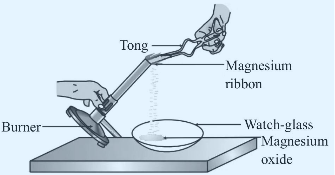
The image shows a piece of magnesium ribbon being burnt in the air.
Image

(a) Describe the changes that occur when magnesium is burnt in air. What type of change is involved, and what are the products formed?
(b) Explain the importance of such reactions in daily life. Where are these reactions used, and why are they significant?