MCQ
Wine (alcoholic beverages) contains
  • A
    $C{H_3}OH$
  • B
    Glycerol
  • ${C_2}{H_5}OH$
  • D
    $2-$ propanol

Answer

Correct option: C.
${C_2}{H_5}OH$
c
Alcoholic beverage, any fermented liquor, such as wine, beer, or distilled spirit, that contains ethyl alcohol, or ethanol $\left( CH _3 CH _2 OH \right)$, as an intoxicating agent.

Need a full question paper?

Generate a complete, print-ready paper with questions like this in minutes — across 16+ boards, with answer keys.

Start Generating Free

Similar questions

One among the following is the correct $IUPAC$ name of the compound 

$\begin{array}{*{20}{c}}
  {\,\,\,\,\,H} \\ 
  {\,\,\,\,\,\,|} \\ 
  {C{H_3}C{H_2} - N - CHO} 
\end{array}$

A hydrocarbon contains $10.5 \,gm$ carbon and $ 1\,gm$ hydrogen. Its $2.4 \,gm $ has $1 \,litre$ volume at $1 \,atm$ and ${127\,^o}C$, hydrocarbon is
For a $p -$ block element, its $3d, 3s, 3p$ and $4s$ orbitals are completely filled and the differentiating electron goes to the $4p$ orbital. The element should have its atomic number in the range
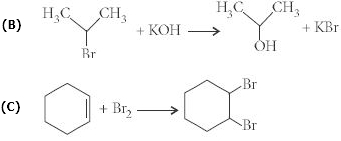
For the following reactions .  . .Which of the following statements is correct ?

$(A)\,\,CH_3CH_2CH_2Br + KOH  \rightarrow  CH_3CH CH_2 + KBr + H_2O$
The strongest $CO$ bond is present in
Reduction involves
The number of unpaired d-electrons in $\left[ Co \left( H _2 O \right)_6\right]^{3+}$ is __________
The strength of an aqueous solution of $I_2$ can be determined by titrating the solution with standard solution of:
Consider a $70 \%$ efficient hydrogen-oxygen fuel cell working under standard conditions at 1 bar and $298 K$. Its cell reaction is

$H _2( g )+\frac{1}{2} O _2( g ) \rightarrow H _2 O (\ell)$

The work derived from the cell on the consumption of $1.0 \times 10^{-3} mol$ of $H _2( g )$ is used to compress $1.00 mol$ of a monoatomic ideal gas in a thermally insulted container. What is the change in the temperature (in $K$ ) of the ideal gas ?

The standard reduction potentials for the two half-cells are given below.

$\left. O _2( g )+4 H ^{+} \text {(aq. }\right)+4 e ^{-} \rightarrow 2 H _2 O (\ell), E ^{\circ}=1.23 V,$

$\left.2 H ^{+} \text {(aq. }\right)+2 e ^{-} \rightarrow H _2( g ), E ^{\circ}=0.00 V.$

Use $F =96500 C mol ^{-1}, R =8.314 J mol ^{-1} K ^{-1}$
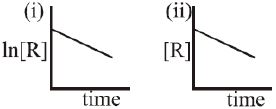
The given plots represent the variation of the concentration of a reactant $R$ with time for two different reactions $(i)$ and $(ii).$ The respective orders of the reactions are