Question
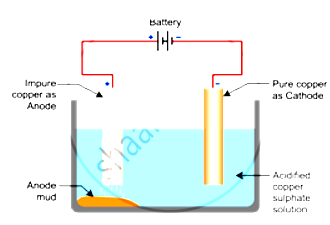
With a labelled diagram explain electro-refining of a particular metal.
Answer


The process of electrolytic refining of copper:
i. In this electrolytic refining, the electrolyte is a solution of copper sulphate.
ii. In this process, the anode is impure copper, whereas the cathode is a thin strip of pure copper.
iii. On passing the current through the electrolyte, the pure copper from the anode dissolves into the electrolyte.
iv. An equivalent amount of pure copper from the electrolyte is deposited at the cathode.
v. The insoluble impurities settle down at the bottom of the anode (the positively charged electrode) are known as anode mud.

Need a full question paper?

Generate a complete, print-ready paper with questions like this in minutes — across 16+ boards, with answer keys.

Start Generating Free

Similar questions

Copy and complete the following table
  Sodium Phosphorous
Formula of chloride    
Physical state of chloride at room temperature(i.e., Solid,Liquid or gas)    
Nature of bonding in chloride    
Write the observation, and balanced equation for the following reaction:
Moist starch iodide paper is placed at the mouth of a test tube containing chlorine gas.
You have collected (a) 2 litres of $CO _2$ (b) 3 litres of chlorine (c) 5 litres of hydrogen (d) 4 litres of nitrogen and (e) 1 litres of $SO _2$, under similar conditions of temperature and pressure. Which gas sample will have :
(a) the greatest number of molecules, and
(b) The least number of molecules?
Justify your answers.
Given that the relative molecular mass of copper oxide is $80,$ what volume of ammonia $($measured at $\text{STP})$ is required to completely reduce $120g$ of copper oxide? The equation for the reaction is :
$3CuO + 2NH_{3 }\rightarrow 3Cu + 3H_2O + N_2$
Write the difference between with examples:
Electrolytic dissociation and ionization
Calculate the percentage of nitrogen in aluminium nitride. $[Al = 27, N = 14]$
Write the observation and name of the product for the following
(i) When ethene is passed in bromine solution in $CCl_4.$
(ii) When Baeyers reagent reacts with ethene.
Write (a) molecular formula, (b) electron dot formula and (c) structural formula of ethene (Ethylene).
A mixture of hydrogen and chlorine occupying $36 \mathrm{~cm}^3$ was exploded. On shaking it with water, $4 \mathrm{~cm}^3$ of hydrogen was left behind. Find the composition of the mixture.
Commercial sodium hydroxide weighing $30g$ has some sodium chloride in it. The mixture on dissolving in water and subsequent treatment with excess silver nitrate solution formed a precipitate weighing $14.3g$. What is the percentage of sodium chloride in the commercial sample of sodium hydroxide? The equation for the reaction is:
$NaCl + AgNO_3\rightarrow AgCI + NaNO_3$
$[$Relative molecular mass $= 58, AgCI = 143]$