MCQ
With increase in frequency of an $A.C$. supply, the inductive reactance.
  • A
    decreases
  • increases directly with frequency
  • C
    increases as square of frequency
  • D
    decreases inversely with frequency

Answer

Correct option: B.
increases directly with frequency

The inductive reactance $\text{Xl}=\omega\text{L}$
Hence, $\text{X}_1\propto\omega$
As frequency increases $\rightarrow\omega$
Therefore, inductive reactance increases with frequency.

Need a full question paper?

Generate a complete, print-ready paper with questions like this in minutes — across 16+ boards, with answer keys.
Start Generating Free

Similar questions

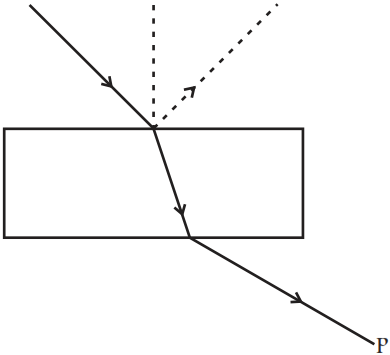
Consider a light beam incident from air to a glass slab at Brewster's angle as shown in Fig. A polaroid is placed in the path of the emergent ray at point $P$ and rotated about an axis passing through the centre and perpendicular to the plane of the polaroid.
In Bohr’s model, if the atomic radius of the first orbit is ${r_0}$, then the radius of the fourth orbit is
Four equal resistance dissipated $5 \,W$ of power together when connected in series to a battery of negligible internal resistance. The total power dissipated in these resistance when connected in parallel across the same battery would be ........... $W$
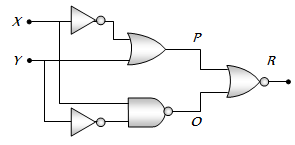
Figure gives a system of logic gates. From the study of truth table it can be found that to produce a high output (1) at R, we must have
In which of the following remote sensing technique is not used
Transformer is based on the principle of:
The plates of a capacitor are charged to potential difference of $V\, volts$ and then  connected across a resistor. The potential difference across the capacitor decreases  exponentially with respect to time. After one second, the potential difference between the  plates is $V/3$; then after two seconds from the start, the potential difference between the  plates is
Two charged parallel plate capacitors, each with separation between plates equal to $d$, are separated by a large distance $L >> d$. Then the force of interaction between them is proportional to
The rate of disintegration at a given instant, is directly proportional to the number of atoms present at that instant. This is the statement of:
In a transistor amplifier, $\beta = 62, R_L = 5000\, \Omega$ and internal resistance of the  transistor is $500\, \Omega$. The voltage amplification of the amplifier will be: