Question
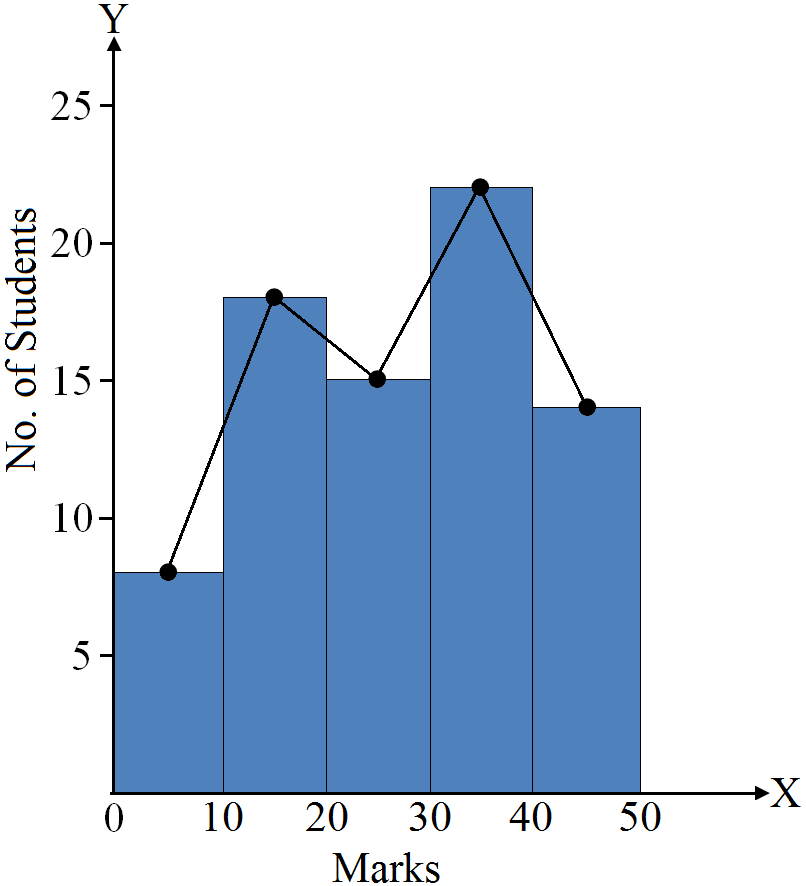
With the given data below, draw a histogram and a frequency polygon:
Marks
0-10
10-20
20-30
30-40
40-50
No. of Students
8
18
15
22
14

Answer

Histogram and Frequency Polygon

Need a full question paper?

Generate a complete, print-ready paper with questions like this in minutes — across 16+ boards, with answer keys.

Start Generating Free

Similar questions

At a given price, there is excess demand for a good. Explain how the equilibrium price will be reached. Use diagram.
If the arithmetic mean of the data given below is 28, find (a) the missing frequency, and (b) the median of the series:
Profit per retail shop (in ₹)
0-10
10-20
20-30
30-40
40-50
50-60
Number of retail shops
12
18
27
-
17
6
Find the standard deviation from the following data:
Marks: $0-10$ $10-20$ $20-30$ $30-40$ $40-50$
No. of Students: $10$ $15$ $10$ $10$ $5$
Use pie diagram to represent the following data.
Expenditure item Amount ₹
Salary and Wages 45,000
Rent 15,000
Interest Patment 8,000
Repair 20,000
Capital Formation 12,000
Draw 'less than' and 'more than' ogive curves from the following:
Weekly Wages
0-20
20-40
40-60
60-40
80-100
No. od Workers
10
20
40
20
10
Calculate coefficient of correlation from the following data and interpret the result:
No. of years of schooling of farmers $0$ $2$ $4$ $6$ $8$ $10$ $12$
Annual yield per acre in $‘000 (₹)$ $4$ $4$ $6$ $10$ $10$ $8$ $7$
Direction Read the following case study and answer questions 1 to 5 on the basis of the same.
Collection of data is an important step in statistics. However, raw data cannot be used unless organised in a meaningful way. Few examples of organisation are given below, observe these carefully and answer the questions.
  1. Production of wheat in India in 2001
Region
Production
(in million tonnes)
Rajasthan
5,000
UP
6,550
punjab
4,800
Haryana
4,200
  1. Marks of students in Statistics
Marks No. of students
01-09 05
10-19 08
20-39 02
40-69 06
70-79 05
  1. Table (a) shows which of the following methods of classification?
  1. Spatial classification
  2. Time series
  3. Quantitative classification
  4. None of the above
  1. In table (b), ......... series is used to arrange the data.
  1. Inclusive
  2. Exclusive
  3. Both(a) and (b)
  4. Neither (a) nor(b)
  1. Which of the following best describes the classification in table (b)?
  1. Unequal and exclusive
  2. Open - ended and exclusive
  3. Unequal and inclusive
  4. Open - ended and inclusive
  1. Which of the following is/are objective(s) of classification?
  1. It helps in summarising the data
  2. It enables further mathematical treatment
  3. It enhances human knowledge
  4. All of the above
  1. As per table (b), if a student has scored 19.5, it will be recorded in which class interval?
  1. 10 - 19
  2. 20 - 29
  3. Either (a) or (b)
  4. (d) None of these
Represent the following data of annual profits of a firm through a time series graph:
Years
2013
2014
2015
2016
2017
2018
Profits (in '000 ₹)
60
72
75
65
80
95
Define Median. Discuss its merits and demerits.
Explain the following features of perfect competition:
(i) Large number of buyers and sellers.
(ii) Homogeneous products.