Question
With the help of a suitable example, explain how ionic compounds are formed State any three general properties of ionic compounds.

Answer

Ionic compounds are formed when a metal and a non metal react with each other.ie, positive and negative charges. eg: Na(metal) + Cl(non memtal) - NaCl
Properties: Ionic compounds have a strong electrostatic force of attraction. They have high melting and boiling points. They can dissolve in other ionic compunds like water.

Need a full question paper?

Generate a complete, print-ready paper with questions like this in minutes — across 16+ boards, with answer keys.

Start Generating Free

Similar questions

Explain natural vegetative propagation by roots in plants.
  1. Name an instrument that measures electric current in a circuit. Define the unit of electric current.
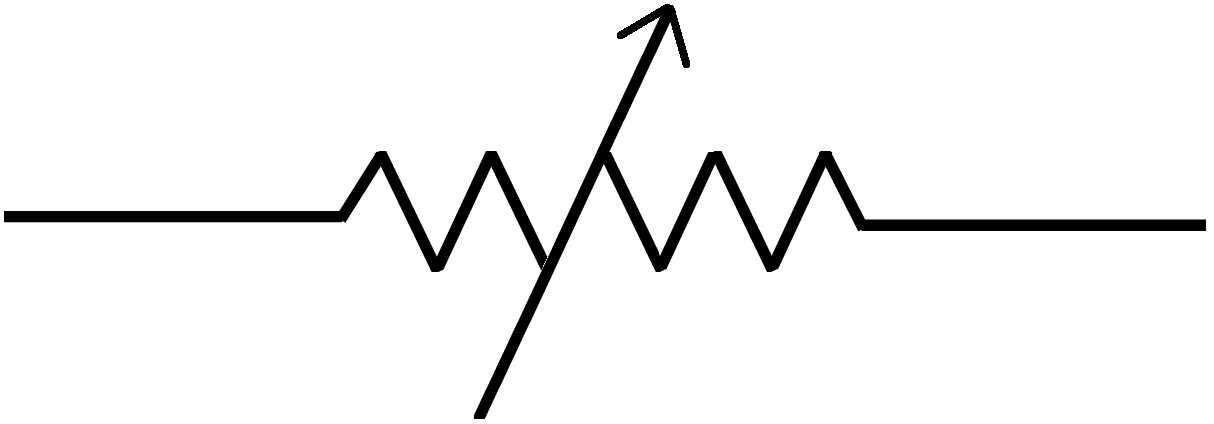
  2. What do the following symbols mean in circuit diagrams?
  1.  
  1.  
  1. An electric circuit consisting of a 0.5 m long nichrome wire XY, an ammeter, a voltmeter, four cells of 1.5 V each and a plug key was set up.
  1. Draw a diagram of this electric circuit to study the relation between the potential difference maintained between the points ‘X’ and ‘Y’ and the electric current flowing through XY.
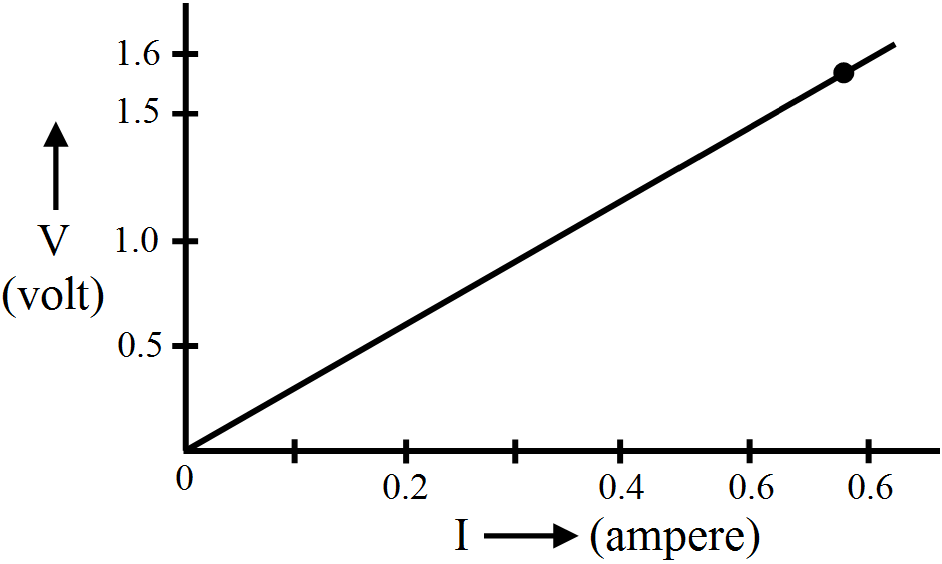
  2. Following graph was plotted between V and I values:

What would be the values $\frac{\text{V}}{\text{I}}$of ratios when the potential difference is 0.8 V, 1.2 V and 1.6 V respectively? What conclusion do you draw from these values?
Give one example each of a chemical reaction characterised by:
  1. Evolution of a gas.
  2. Change in colour.
  3. Formation of a precipitate.
  4. Change in temperature.
  5. Change in state.
State any five physical properties of metals and five physical properties of non-metals.
  1. Define the following terms in the context of spherical mirrors:
  1. Pole.
  2. Centre of curvature.
  3. Principal axis.
  4. Principal focus.
  1. Draw ray diagrams to show the principal focus of a:
  1. Concave mirror.
  2. Convex mirror.
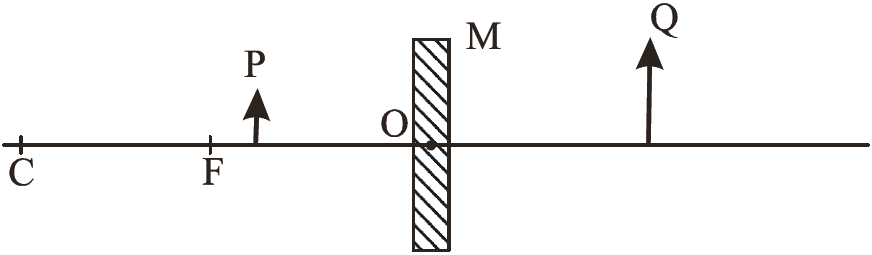
  1. Consider the following diagram in which M is a mirror and P is an object and Q is its magnified image formed by the mirror.


State the type of the mirror M and one characteristic property of the image Q.

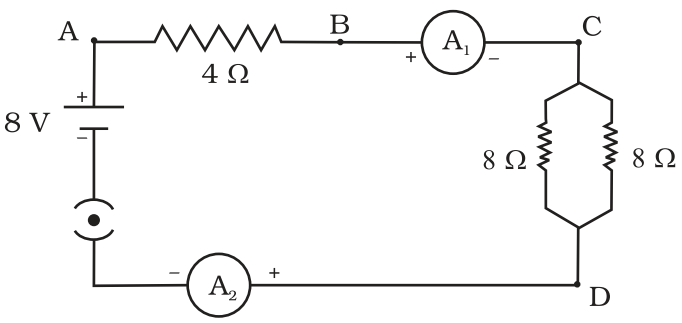
Find out the following in the electric circuit given in Figure.
  1. Effective resistance of two 8Ω resistors in the combination.
  2. Current flowing through 4Ω resistor.
  3. Potential difference across 4Ω resistance.
  4. Power dissipated in 4Ω resistor.
  5. Difference in ammeter readings, if any.
Given below is the experimental set-up to establish that one of the atmospheric gases is essential for photosynthesis in plants.
  1. Name the atmospheric gas which is essential for photosynthesis.
  2. What is kept in watch-glass in figure 'a' and why?
  3. Write the balanced chemical equation for the process of photosynthesis.
  4. When do the desert plants takeup carbon dioxide and perform photosynthesis?
The farmers have been cultivating a food plant X for over two thousand years and have produced as many as five entirely different looking vegetables A, B, C, D and E from it.
  1. What could the plant X be?
  2. What are A, B, C, D and E?
  3. What is the process of evolution involved in this example known as?
With the help of a labelled circuit diagram illustrate the pattern of field lines of the magnetic field around a current carrying straight long conducting wire. How is the right hand thumb rule useful to find direction of magnetic field associated with a current carrying conductor?
A metal X forms a water soluble salt $XNO _3$. When an aqueous solution of $XNO _3$ is added to common salt solution, then a white precipitate of compound Y is formed alongwith sodium nitrate solution. Metal X is said to be the best conductor of electricity and it does not evolve hydrogen when put in dilute hydrohloric acid.
a. What is metal X ?
b. What is salt $XNO _3$ ?
c. Name the compound Y .
d. Write the chemical equation of the reaction which takes place on reacting $XNO _3$ solution and common salt solution giving the physical states of all the reactants and products.
e. What type of chemical reaction is illustrated by the above equation?