Question
With the help of suitable diagram explain the real depth and apparent depth.

Answer

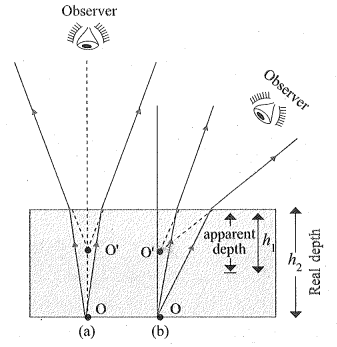
Image
→Generally, we experience that a tank filled with water appears to be raised when viewed vertically or close to vertical.
→As shown in figure object O is at the bottom of the tank. When it is viewed from air it observed at $O ^{\prime}$ which is virtual image.
→As shown in figure real depth of bottom is $h_2$ and apparent depth is $h_1$.
→For viewing near the normal direction, it can be shown that the apparent depth $\left(h_1\right)$ is equal to the ratio of the real depth $\left(h_2\right)$ to the refractive index $(n)$ of the medium.
$\begin{array}{l}\therefore \text { apparent depth }=\frac{\text { real depth }}{\text { refractive index }} \\ \therefore \quad h_1=\frac{h_2}{n} \\ \therefore \quad \frac{h_1}{h_2}=\frac{1}{n} \\\end{array}$

Need a full question paper?

Generate a complete, print-ready paper with questions like this in minutes — across 16+ boards, with answer keys.
Start Generating Free

Similar questions

Suppose you have three resistors of $20\Omega,50\Omega$ and $100\Omega.$ What minimum and maximum resistance can you obtain from these resistors?
What type of extrinsic semiconductor is formed when:
  1. Germanium is doped with indium?
  2. Silicon is doped with bismuth?
A 44 mH inductor is connected to $220 V, 50 Hz$ ac supply. Determine the mH value of the current in the circuit.
A parallel beam of monochromatic light is used in a Young's double slit experiment. The slits are separated by a distance d and the screen is placed parallel to the plane of the slits. Show that if the incident beam makes an angle $\theta=\sin^{-1}\Big(\frac{\lambda}{2\text{D}}\Big)$ with the normal to the plane of the slits, there will be a dark fringe at the centre P0 of the pattern.
Heat at the rate of 200W is produced in an X-ray tube operating at 20kV. Find the current in the circuit. Assume that only a small fraction of the kinetic energy of electrons is converted into X-rays.
The electric field E due to a point charge at any point near it is defined as $\text{E} = \DeclareMathOperator*{\median}{\text{lim}} \median_{\text{q}\rightarrow0}\frac{\text{F}}{\text{q}}$ where q is the test charge and F is the force acting on it. What is the physical significance of $\DeclareMathOperator*{\median}{\text{lim}} \median_{\text{q}\rightarrow0}$ in this expression? Draw the electric field lines of a point charge Q when (a) Q>0 and (b) Q<0. 
Two conductors $X$ and $Y$ of same diameters but different substances are joined in series with a battery. If electron density in X is double than that of Y , then find the ratio of drift velocities of electrons in these two wires.
A rigid wire consists of a semi-circular portion of radius R and two straight sections The wire is partially immersed in a perpendicular magnetic field B, as shown in the figure. Find the magnetic force on the wire if it carries a current i.

State Lenz’s Law.
A metallic rod held horizontally along east-west direction, is allowed to fall under gravity. Will there be an emf induced at its ends? Justify your answer.
State the conclusion of experiments about Iriction charge.