Question
With the help of two suitable examples, explain why certain experiences and traits earned by people during their lifetime are not passed on to their next generations. When can such traits be passed on?

Answer

He experiences and qualifications that a person earns during his/her lifetime are examples of acquired traits. These traits cannot be inherited, as they do not affect genetic makeup of an organism. In fact, these traits develop due to use and disuse of organs, or due to direct affect of environment. Thus, they are not passed on to the next generation. For example, a wrestler develops large muscles because of his training programme; it does not mean that his offspring will necessarily have large muscles. Similarly, if a lady pierces her nose, the children produced to her will not have pierced nose by birth.
Traits can be passed on to the next generation only when they have some direct effect on the genes. For example, if a mutation is caused in the germ cells of a person due to exposure to some harmful radiations, it is highly likely that the mutation caused will be passed on to the subsequent generations.
Need a full question paper?

Generate a complete, print-ready paper with questions like this in minutes — across 16+ boards, with answer keys.

Start Generating Free

Similar questions

  1. An object 3cm high is placed 24cm away from a convex lens of focal length 8cm. Find by calculations, the position, height and nature of the image.
  2. If the object is moved to a point only 3 cm away from the lens, what is the new position, height and nature of the image?
  3. Which of the above two cases illustrates the working of a magnifying glass?
How does the resistance of a wire change when:
  1. Its length is tripled?
  2. Its diameter is tripled?
  3. Its material is changed to one whose resistivity is three times?
What happens when a zinc strip is dipped into a copper sulphate solution?
  1. Write the equation for the reaction that takes place.
  2. Name the type of reaction involved.
A concave lens has focal length 15cm. At what distance should the object from the lens be placed so that it forms an image at 10cm from the lens? Also find the magnification produced by the lens.
A man stands 10m in front of a large plane mirror. How far must the walk before he is 5m away from his image?
Two elements X and Y have atomic numbers 12 and 16 respectively. Write the electronic configuration for these elements. To which period of the Modern Periodic Table do these two elements belong? What type of bond will be formed between them and why?
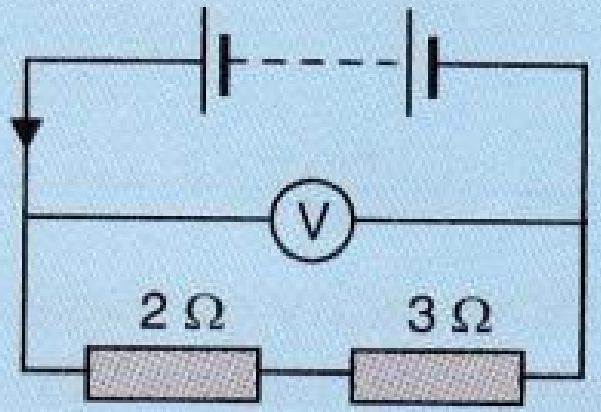
In the circuit shown below, the voltmeter reads 10V.
  1. What is the combined resistance?
  2. What current flows?
  3. What is the p.d. across $ 2 Ω$ resistor?
  4. What is the p.d. across $3 Ω$ resistor?
Explain Mendel's observation when he crossed a homozygous tall (TT) plant with homozygous dwarf (tt) plant followed by self-cross.
What are the differences between autotrophic nutrition and heterotrophic nutrition?
The electrical resistivities of five substances A, B, C, D and E are given below:$\begin{matrix}\text{B}&110\times10^{-8}\Omega\text{ m}\\\text{C}&2.60\times10^{-8}\Omega\text{ m}\\\text{D}&10.0\times10^{-8}\Omega\text{ m}\\\text{E}&1.70\times10^{-8}\Omega\text{ m}\end{matrix}$