Question
With the increase in principle quantum number, the energy difference between the two successive energy levels(a) Increases(b) Decreases(c) Remains constant(d) Sometimes increases and sometimes decreases


Answer

(b) Decreases

Need a full question paper?

Generate a complete, print-ready paper with questions like this in minutes — across 16+ boards, with answer keys.
Start Generating Free

Similar questions

The size of an object as perceived by an eye depends primarily on:
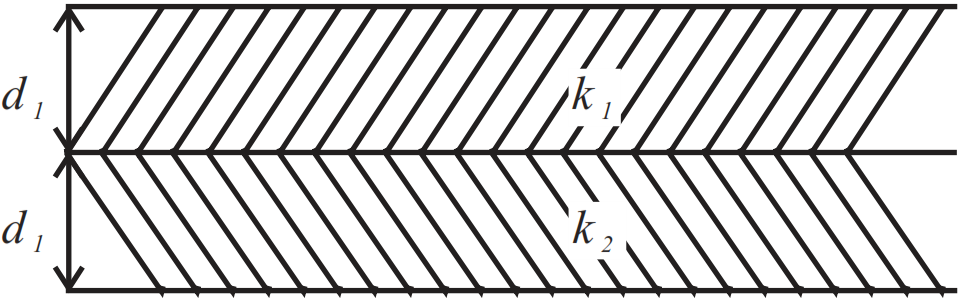
A parallel plate capacitor is made of two dielectric blocks in series. One of the blocks has thickness $d_1$ and dielectric constant $k_1$ and the other has thickness $d_2$ and dielectric constant $k_2$ as shown in Fig.

This arrangement can be thought as a dielectric slab of thickness $d (= d_1 + d_2)$ and effective dielectric constant $k$. The $k$ is
For nuclei with A > 100:
  1. The binding energy of the nucleus decreases on an average as A increases.
  2. The binding energy per nucleon decreases on an average as A increases.
  3. If the nucleus breaks into two roughly equal parts, energy is released.
  4. If two nuclei fuse to form a bigger nucleus, energy is released.
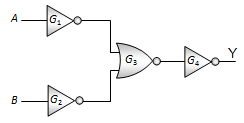
The combination of gates shown below produces
Lateral displacement of the emergent ray of light increases with:
Two metal plates having charges Q, -Q face each other at some separation and are dipped into an oil tank. If the oil is pumped out, the electric field between the plates will:
Which among the following can be used to analyze circuits?
It becomes possible to define potential at a point in an electric field because electric field:
Voltmeters $V_1$ and $V_2$ are connected in series across a $D.C.$ line. $V_1$ reads $80$ volts and has a per volt resistance of $200 \ \ce{ohms}.V_2$ has a total resistance of $32$ kilo ohms. The line voltage is
A convex lens of focal length 25 cm and a concave lens of focal length 10 cm are joined together.  The power of the combination will be(a) – 16 D (b) + 16 D(c) – 6 D   (d) + 6 D