Question
Without using the derivative show that the function f(x) = 7x - 3 is strictly increasing function on R.

Answer

Here,
$\text{f}(\text{x})=7\text{x}-3$
Let $\text{x}_1,\text{x}_2\in\text{R}$ such that $\text{x}_1<\text{x}_2.$ Then,
$\text{x}_1<\text{x}_2$
$\Rightarrow7\text{x}_1<7\text{x}_2$ $[\because\ 7>0]$
$\Rightarrow7\text{x}_1-3<7\text{x}_2-3$
$\Rightarrow\text{f}(\text{x}_1)<\text{f}(\text{x}_2)$
$\therefore\ \text{x}_1<\text{x}_2\Rightarrow\text{f}(\text{x}_1)<\text{f}(\text{x}_2),\forall\ \text{x}_1,\text{x}_2\in\text{R}$
So, f(x) is strictly increasing on R.

Need a full question paper?

Generate a complete, print-ready paper with questions like this in minutes — across 16+ boards, with answer keys.
Start Generating Free

Similar questions

Find the value of $x$ if the area of $\triangle$ is $35$ square cms with vertices $(x, 4), (2, -6)$ and $(5, 4).$
Evaluate $\int\frac{1}{\text{x}(1+\log\text{x})}\text{ dx}$
Show that if $A=\left[\begin{array}{ll} \cos \theta & \sin \theta \\ -\sin \theta & \cos \theta \end{array}\right], \text { then } A^{n}=\left[\begin{array}{cc} \cos n \theta & \sin n \theta \\ -\sin n \theta & \cos n \theta \end{array}\right]$
Show that the line through points $(1, -1, 2)$ and $(3, 4, -2)$ is perpendicular to the line throught the points $(0, 3, 2)$ and $(3, 5, 6)$.
Find the cartesian equation of the line which passes through the point (-2, 4, -5) and parallel to the line given by $\frac{\text{x}+3}{3}=\frac{\text{y}-4}{5}=\frac{\text{z}+8}{6}.$
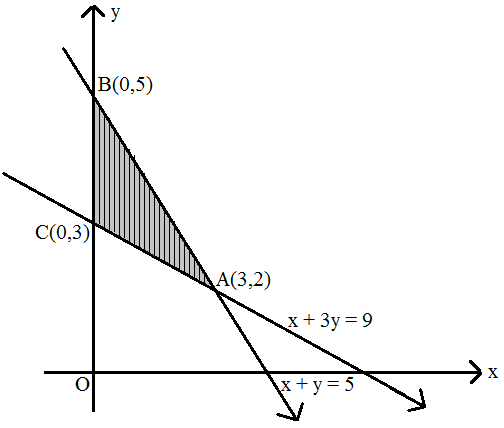
The feasible region for a LPP is shown in. Find the minimum value of Z = 11x + 7y.
construct a $2\times 2$ matrix $A = [a_{ij}]$ whose elemants $a_{ij} $ are given by $a_{ij} =\left\{\begin{array}{cl}\frac{|-3\text{i}+\text{j}|}{2} & ,\text{if i }\neq\text{j} \\ (\text{i}+\text{j})^2 & , \text{if i }=\text{j}\end{array}\right.$
  1. Is the binary operation $\ast,$ defined on set N, given by a$a^{\ast}b = \frac{a + b}{2}$ for all $a, b\varepsilon N,$ commutative?
  2. Is the above binary operation $\ast$ associative?
Find a particular solution of the differential equation $\frac{\text{dy}}{\text{dx}}+\text{y}\cot\text{x}=4\text{x}\ \text{cosec}\ \text{x}\ (\text{x}\neq0),$ $\text{given that y}=0\ \text{when x}=\frac{\pi}{2}.$
If $\text{A}=\begin{bmatrix}\cos\theta&\sin\theta\\-\sin\theta&\cos\theta \end{bmatrix},$ then for any natural number, find the value of Det $(A^n).$