MCQ
Work done in isothermal reversible process for ideal gas is-
- A$-nRT\ ln\ \frac{V_2}{V_1}$
- B$- P(V_2 - V_1)$
- C$\left( {\frac{{{P_2}{V_2} - {P_1}{V_1}}}{{\gamma - 1}}} \right)$
- D$0$
process of work done
$\int \mathrm{d} \mathrm{w}=-\int_{\mathrm{V}_{1}}^{\mathrm{V}_{2}} \mathrm{PdV}$
Generate a complete, print-ready paper with questions like this in minutes — across 16+ boards, with answer keys.
| List $- I$ Electronic configuration of elements |
List $- II$ $\Delta_{ i }$ in $kJ\, mol-1$ |
| $(a)$ $1 s ^{2} 2 s ^{2}$ | $(i)$ $801$ |
| $(b)$ $1 s ^{2} 2 s ^{2} 2 p ^{4}$ | $(ii)$ $899$ |
| $(c)$ $1 s^{2} 2 s^{2} 2 p^{3}$ | $(iii)$ $1314$ |
| $(d)$ $1 s ^{2} 2 s ^{2} 2 p ^{1}$ | $(iv)$ $1402$ |
Choose the most appropriate answer from the options given below
$(I)\,\,\,\,{N_2} + 2{O_2} \rightleftharpoons 2N{O_2}$
$(II)\,\,\,\,2N{O_2} \rightleftharpoons {N_2} + 2{O_2}$
$(III)\,\,\,\,N{O_2} \rightleftharpoons \frac{1}{2}{N_2} + 2{O_2}$
The correct relation from the following is
(image) $\frac{{conc.\,HN{O_3}}}{{conc.\,{H_2}S{O_4}}}X$
the structure of the major product $'X'$ is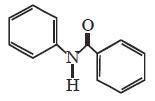
${O_3}(g)\, + \,C{l^ * }(g)\, \to \,{O_2}(g) + Cl{O^ * }(g)$ ..... $(i)$ $[{K_i} = 5.2 \times {10^9}\,\,L\,mo{l^{ - 1}}\,{s^{ - 1}}]$
$Cl{O^ * }(g) + {O^ * }(g)\, \to \,{O_2}(g) + \,C{l^ * }(g)$ ..... $(ii)$ $[{K_{ii}} = 2.6 \times {10^{10}}\,\,L\,mo{l^{ - 1}}\,{s^{ - 1}}]$
The closest rate constant for the overall reaction
${O_3}(g){\mkern 1mu} + {\mkern 1mu} {O^*}(g){\mkern 1mu} \to {\mkern 1mu} 2{O_2}(g)$ is ........... $L\,\,mo{l^{ - 1}}\,{s^{ - 1}}$