Question
Write a note on acidity of alcohols.

Answer

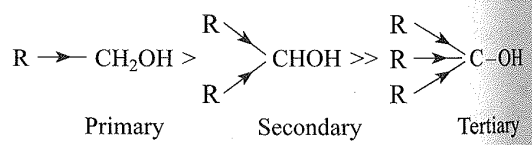
$\rightarrow$ Acidity of alcohols: The acidic character of alcohols is due to the polar nature of $O-H$ bond. An electron$-$releasing group $\ce{(-CH_3, C_2H_5) 2}$ increases electron density on oxygen tending to decrease the polarity of $O-H$ bond. This decreases the acid strength. For this reason, the acid strength of alcohols decreases in the following order :
Image
$\rightarrow $ Alcohols are, however, weaker acids than water. This can be illustrated by the reaction of water with an alkoxide.
Image
$\rightarrow$ This reaction shows that water is a better proton donor $($i.e., stronger acid$)$ than alcohol. Also, in the above reaction, we note that an alkoxide ion is a better proton acceptor than hydroxide ion, which suggests that alkoxides are stronger bases $($sodium ethoxide is a stronger base than sodium hydroxide$).$
$\rightarrow$ Alcohols can act as both bronsted bases as well as acids. It is due to the presence of unshared electron pairs on oxygen. which makes them proton acceptors.

Need a full question paper?

Generate a complete, print-ready paper with questions like this in minutes — across 16+ boards, with answer keys.

Start Generating Free

Similar questions

How can you convert?
  1. Toluene to Benzaldehyde.
  2. Ethanoic acid to 2-chloroethanoic acid.
  3. Acetone to Propane.
The decomposition of hydrocarbon follows the equation
$k =\left(4.5 \times 10^{11} s^{-1}\right) e ^{-28000 K / T }$ Calculate Ea.
The treatment of alkyl chlorides with aqueous KOH leads to the formation of alcohols but in the presence of alcoholic KOH , alkenes are major products. Explain.
Explain positive deviation from Raoult's law with an example.
Heptane and Octane form an ideal solution. At $373 K,$ the vapour pressures of the two liquid components are $105.2\ kPa$ and $46.8\ kPa$ respectively. What will be the vapour pressure of a mixture of $26.0\ g$ of heptane and $35\ g$ of octane $?$
Complte the following reaction : $\ce{C_6H_5 COOH + SOCI_2 \rightarrow}$
A 4% solution (w/w) of sucrose (M = 342 g $ mol^{-1} $) in water has a freezing point of 271.15 K. Calculate the freezing point of 5% glucose (M = 180 g $ mol^{-1} $) in water. (Given: Freezing point of pure water = 273.15 K)
How the following conversions can be carried out?
i. 2-Bromopropane to 1-bromopropane
ii. Chloroethane to butane
iii. Benzene to diphenyl
An organic compound $'A\ ’$ having molecular formula $\ce{C_3H_6}$ on treatment with aqueous $\ce{H_2SO4}$ gives $'B\ ’$ which on treatment with $\ce{HCl/ ZnCl_2}$ gives $'C\ ’.$ The compound $C$ on treatment with ethanolic $\ce{KOH}$ gives back the compound $'A\ ’.$ Identify the compounds $A, B, C.$
Differentiate between the following:
  1. Amylose and Amylopectin.
  2. Peptide linkage and Glycosidic linkage.
  3. Fibrous proteins and Globular proteins.