Question
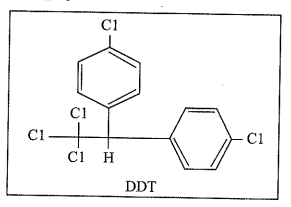
Write a note on DDT.

Answer

→ DDT, the first chlorinated organic insecticides, was originally prepared in 1873, but it was not until 1939 that Paul Muller of Geigy Pharmaceuticals in Switzerland discovered the effectiveness of DDT as an insecticide.
→ Paul Muller was awarded the Nobel Prize in Medicine and Physiology in 1948 for this discovery.
→ The use of DDT increased enormously on a worldwide basis after world war II, primarily because of its effectiveness against the mosquito that spreads malaria and lice that carry typhus.
→ However, problems related to extensive use of DDT began to appear in the late 1940s.
Image
→ Many species of insects developed resistance to DDT, and it was also discovered to have a high toxicity towards fish.
→ The chemical stability of DDT and its fat solubility compounded the problem.
→ DDT is not metabolised very rapidly by animals; instead, it is deposited and stored in the fatty tissues.
→ If ingestion continues at a steady rate, DDT builds up within the animal over time.
→The use of DDT was banned in the United States in 1973, although it is still in use in some other parts of the world.
Need a full question paper?

Generate a complete, print-ready paper with questions like this in minutes — across 16+ boards, with answer keys.

Start Generating Free

Similar questions

Write about oxidation states of transition series ?
$A\ 0.1539$ molal aqueous solution of cane sugar $($mol. mass $=342 \mathrm{~g} \mathrm{~mol}^{-1} )$ has a freezing point of $271\ K$ while the freezing point of pure water is $273.15\ K $. What will be the freezing point of an aqueous solution containing 5 g of glucose $\left(\mathrm{mol}^2\right.$ mass $\left.=180 \mathrm{~g} \mathrm{~mol}^{-1}\right)$ per $100\ g$ of solution?
Explain negative deviation from Raoult's law with an example.
Explain the following terms giving a suitable example in each case:
  1. Ambident ligand.
  2. Denticity of a ligand.
  3. Crystal field splitting in an octahedral field.
Give reasons for the following:
i. The transition metals generally form coloured compounds.
ii. $\mathrm{E}^{\circ}$ value for $\left(\mathrm{Mn}^{3+} \mid \mathrm{Mn}^{2+}\right)$ is highly positive than that for $\left(\mathrm{Cr}^{3+} \mid \mathrm{Cr}^{2+}\right)$ couple.
iii. The chemistry of actinoids elements is not so smooth as that of the lanthanoids.
Explain unimolecular nucleophilic substitution $(S_N1)$ reaction with mechanism.
What will be the amount of $H_2$ liberated at the cathode when a current of $1$ ampere is passed for $3000$ second in water acidified with $ \text{HCl}$ ?
Answer the following question: How would you account for the following:
  1. Aldehydes are more reactive than ketones towards nucleophiles.
  2. The boiling points of aldehydes and ketones are lower than of the corresponding acids.
  3. The aldehydes and ketones undergo a number of addition reactions.

Complete the following reactions:
  1.  
  1. $(\text{C}_6\text{H}_5\text{CH}_2)_2\text{Cd}+2\text{CH}_3\text{COCl}\xrightarrow{\ \ \ \ \ \ \ }$
  2. $\text{CH}_3-\text{CH}-\text{COOH}\xrightarrow[(\text{ii})\ \text{H}_2\text{O}]{\ \ \ \ \ \ {(\text{i})\ \text{Br}_2/ \text{ Red P}_4} \ \ \ \ \ \ \ }$
Silver crystallises in an fcc lattice. The edge length of its unit cell is $4.077 \times 10^{–8}\ cm$ and its density is $10.5\ g\ cm^{–3}.$ Calculate on this basis the atomic mass of silver. $(N_A = 6.02 \times 10^{23}\ mol^{–1}).$