Question
Write a note on Golgi apparatus and the functions it performs.

Answer

Golgi apparatus or Golgi bodies or Golgi complex is composed of membrane-bound fluid-filled vesicles, vacuoles and cisternae. In animal cells they are larger and only one or two in number, while in plants they are smaller and more in number. Also, in plant cells, they are distributed throughout the cytoplasm and are called dictyosomes.
Functions:
1. It is involved in the transport and modification of protein, lipids as well as carbohydrates.
2. It helps in the formation of cell plate during cell division.
3. It is also involved in the formation of lysosomes and peroxisomes.
4. The material synthesised near endoplasmic reticulum is packaged and dispatched to various targets and outside the cell through the Golgi apparatus.
Need a full question paper?

Generate a complete, print-ready paper with questions like this in minutes — across 16+ boards, with answer keys.

Start Generating Free

Similar questions

What is crystallisation? How can this technique be used to purify impure copper sulphate?
A liquid compound $X$ of molecular mass $18u$ can be obtained from a number of natural sources. All the animals and plants need liquid $X$ for their survival. When an electric current is passed through $200$ grams of pure liquid $X$ under suitable conditions, then $178$ grams of gas $Y$ and $22$ grams of gas $Z$ are produced. Gas $Y$ is produced at the positive electrode whereas gas $Z$ is obtained at the negative electrode. Moreover, gas $Y$ supports combustion whereas gas $Z$ burns itself causing explosions.
  1. Name $(i)$ liquid $X (ii)$ gas $Y,$ and $(iii)$ gas $Z$
  2. What is the ratio to the mass of element $Z$ to the mass of element $Y$ in the liquid $X?$
  3. Which law of chemical combination is illustrated by this example$?$
  4. Name two sources of liquid $X.$
  5. Gate an important use of $Y$ in our life.
There is a water reservoir (river) near a village. Due to insufficient rain, farmers are worried about their crops. Suggest and explain the irrigation practice that can be adopted to supply water to the entire agricultural land in the village.
Distinguish between fertilizer and manure. Give suitable examples. What are advantages and disadvantages of using fertilizer?
A liquid compound $X$ of molecular mass $18u$ can be obtained from a number of natural sources. All the animals and plants need liquid $X$ for their survival. When an electric current is passed through $200$ grams of pure liquid $X$ under suitable conditions, then $178$ grams of gas $Y$ and $22$ grams of gas $Z$ are produced. Gas $Y$ is produced at the positive electrode whereas gas $Z$ is obtained at the negative electrode. Moreover, gas $Y$ supports combustion whereas gas $Z$ burns itself causing explosions.
  1. Name $(i)$ liquid $X$ $(ii)$ gas $Y$, and $(iii)$ gas $Z$
  2. What is the ratio to the mass of element $Z$ to the mass of element $Y$ in the liquid $X$?
  3. Which law of chemical combination is illustrated by this example?
  4. Name two sources of liquid $X$.
  5. Gate an important use of $Y$ in our life.
What are the different means by which infectious diseases are spread?
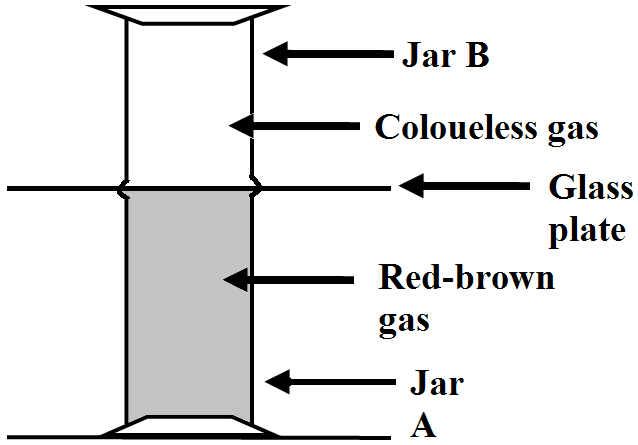
Look at the diagram on the right side. Jar $A$ contains are d-brown gas whereas Jar $B$ contains a colourless gas. The two gas jars are separated by a glass plate placed between them:
  1. What will happen when the glass plate between the two jars is pulled away$?$
  2. What name is given to the phenomenon which takes place$?$
  3. Name the brown gas which could be in jar $A.$
  4. Which is the colorless gas most likely to be present in jar $B?$
  5. Name one coloured solid and one colourless liquid which can show the same phenomenon.
Mention differences between light microscope and electron microscope.
Define motion. What do you understand by the terms ‘uniform motion’ and ‘non-uniform motion’? Explain with examples.
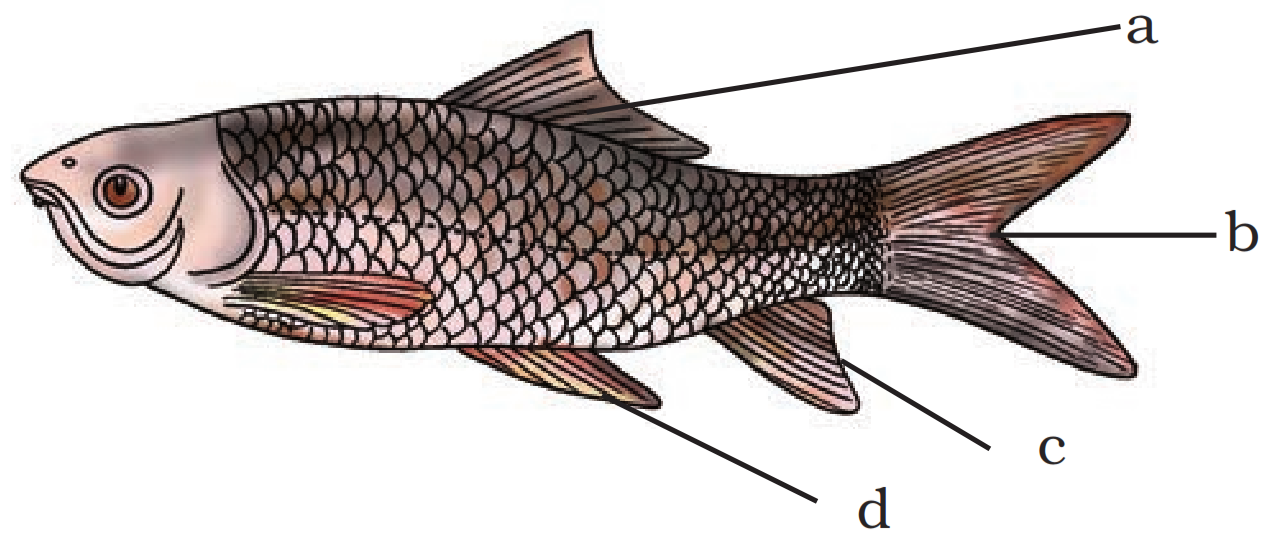
Label $a,b,c$ and $d. $ given in give the function of $(b).$