Question
Write a note on Indian National Congress (INC).

Answer

Indian National Congress is popularly known as the Congress Party. It is one of the oldest parties of the world. It was founded in 1885. It played an important role in Indian politics at the national and state levels after the independence. Under Nehru the party tried to build a modern secular democratic republic in India.
It remained in power till 1977 and then from 1980-1989 but after that its support declined. The party supports secularism and welfare of weaker sections and minorities. It supports new economic reforms with a human face. It emerged as a single largest party with 145 seats in 2004 elections and is currently leading the ruling United Progressive Alliance coalition government at the centre.

Need a full question paper?

Generate a complete, print-ready paper with questions like this in minutes — across 16+ boards, with answer keys.

Start Generating Free

Similar questions

“Democracies are not appearing to be very successful in reducing economic inequalities.” Analyse the statement.
What is the rational decentralisation of power? Describe the functions of rural local government.
Explain any three problems faced by the Indian cotton weavers by the turn of the 19$^{th}$ century.
OR
Explain the miserable conditions of Indian weavers during the East India Company's regime in the eighteenth century.

OR
What were the problems of Indian weavers at the early nineteenth century?

OR
Describe the impacts of Manchester imports on the cotton weavers of India.
How are multinational corporations (MNCs) controlling and spreading their productions across the world? Explain.
Read the following passage and answer the questions given below:
Muhammad Yunus is a famous economist of Bangladesh. He received several international honours for his efforts to promote economic and social development for the benefit of the poor. He and the Grameen Bank he started jointly, received the Nobel Peace Prize for the 2006. In February 2007, he decided to launch a political party and contest in the parliamentary elections. His objective was to foster proper leadership, good governance and build a new Bangladesh. He felt that only a political party different from the traditional ones would bring about new political culture. His party would be democratic from the grassroots level.
The launching of the new party, called Nagarik Shakti (Citizens’ Power), has caused a stir among the Bangladeshis. While many welcomed his decision, some did not like it. “Now I think Bangladesh will have a chance to choose between good and bad and eventually have a good government,” said Shahedul Islam, a government official. “That government, we hope, would not only keep itself away from corruption but also make fighting corruption and black money a top priority.”
But leaders of traditional political parties who dominated the country’s politics for decades were apprehensive. “There was no debate (over him) winning the Nobel, but politics is different – very challenging and often controversial,” said a senior leader of the Bangladesh Nationalist Party. Some others were highly critical. They asked why he was rushing into politics. “Is he being planted in politics by mentors from outside the country,” asked one political observer.
  1. Do you think Yunus made a right decision to float a new political party?
  2. Do you agree with the statements and fears expressed by various people? How do you want this new party organised to make it different from other parties? If you were the one to begin this political party how would you defend it?
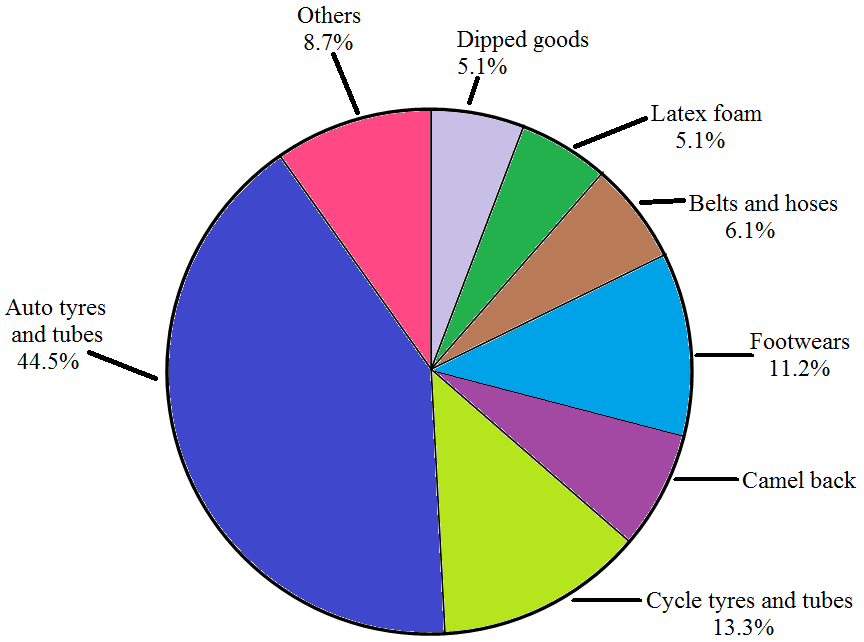
Look at the figure given below showing the consumption of natural rubber. Study the given figure carefully and answer the following questions in brief:
  1. Name the industry where the consumption of natural rubber is maximum.
  2. List any four items that are made of rubber and used by us.
What are the advantages of working in the organised sectors?
What were the steps taken by European employers to retain the Africa labours?
What is COPRA? Explain briefly the three-tier quasi-judicial machinery set up under the Consumer Protection Act of 1986.
OR
What are the institutions set up under COPRA for the redressal of grievances? Explain.

OR
Describe the provision made under Consumer Protection Act, 1986 (COPRA) for redressal of consumer disputes.

OR
COPRA has enabled the consumers to have the right to represent in the consumer courts. Explain with the help of an example how it benefits the consumers.
What was the objective of Treaty of Vienna?
OR
What was the main aim of Treaty of Vienna 1815?