Question
Write a note on Mechanism of DNA replication

Answer

→ In living cells, such as E.coli, the process of replication requires a set of catalysts (enzymes).
→ The main enzyme is referred to as DNA- dependent DNA polymerase, since it uses a DNA template to catalyse the polymerisation of deoxynucleotides.
→ These enzymes are highly efficient as they have to catalyse polymerisation of a large number of nucleotides in a very short time.
→ E.coli that has only 4.6 x 10⁶ bp (compare it 6 with human whose diploid content is 6.6 x 10⁹ bp), completes the process of replication within 18 minutes; that means the average rate of polymerisation has to be approximately 2000 bp per second.
Not only do these polymerases have to be fast, but they also have to catalyse the reaction with high degree of accuracy.
Any mistake during replication would result into mutations. Furthermore, energetically replication is a very expensive process.
→ Deoxyribonucleoside triphosphates serve dual purposes.
(i) act as a substrates.
(ii) provide energy for polymerisation reaction (the two terminal phosphates in a deoxynucleoside triphosphates are high- energy phosphates, same as in case of ATP).
→ DNA-dependent DNA polymerases:
→ In addition to DNA-dependent DNA polymerases, many additional enzymes are required to complete the process of replication with high degree of accuracy.
→ Replication fork:
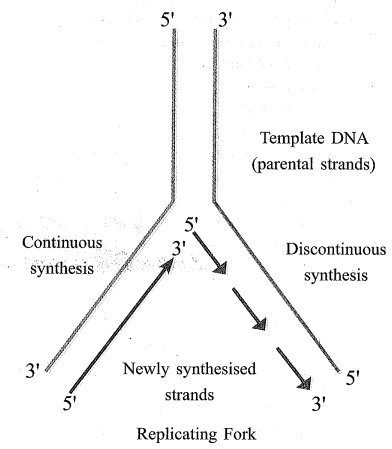
→ For long DNA molecules, since the two strands of DNA cannot be separated in its entire length (due to very high energy requirement), the replication occurs within a small opening of the DNA helix, referred to as replication fork.
→ Continuous, discontinuous. Strands:
→ The DNA-dependent DNA polymerases catalyse polymerisation only in one direction, that is 5' → 3'.
→ This creates some additional complications at the replicating fork.
→ Consequently, on one strand (the template with polarity 3' → 5'), the replication is continuous, while on the other (the template with polarity 5' → 3'), it is discontinuous.
→ The discontinuously synthesised fragments are later joined by the enzyme DNA ligase.
→ Origin of replication:
→ The DNA polymerases on their own cannot initiate the process of replication.
→ Also the replication does not initiate randomly at any place in DNA.
→ There is a definite region in E. coli DNA where the replication originates. Such regions are termed as origin of replication.
→ It is because of the requirement of the origin of replication that a piece of DNA if needed to be propagated during recombinant DNA procedures, requires a vector.
→ The vectors provide the origin of replication.
→ Cell division & DNA replication:
→ In eukaryotes, the replication of DNA takes place at S-phase of the cell-cycle.
→ The replication of DNA and cell division cycle should be highly coordinated.
→ A failure in cell division after DNA replication results into polyploidy (a chromosomal anomaly).
Image

Need a full question paper?

Generate a complete, print-ready paper with questions like this in minutes — across 16+ boards, with answer keys.

Start Generating Free

Similar questions

Match the terms in Column I with those in Column II.
S. No Column I S. No Column II
(i) Gene therapy 1. Human insulin.
(ii) Cotton bollworm 2. Biopiracy.
(iii) Eli Lilly 3. Emphysema.
(iv) Basmati Rice 4. ADA deficiency.
(v) $\alpha-1\text{ antitrypsin}$ 5. Lepidopteran.
Read the following and answer any four questions from (i) to (v) given below:

Embryo develops at the micropylar end of the embryo sac, where the zygote is situated. Most zygotes divided only after certain amount of endosperm is formed. The early stages of embryo development are similar in both monocotyledons and dicotyledons. The zygote gives rise to the proembryo and subsequently to the globular heart-shaped and mature embryo. A typical dicotyledonous embryo consists of an embryonal axis and two cotyledons. Embryo of monocotyledons possess only one cotyledon.

  1. True embryo develops as a result of fusion of:
  1. Two polar nuclei of embryo sac.
  2. An egg cell and a male gamete.
  3. Synergid and male gamete.
  4. A male gamete and antipodals.
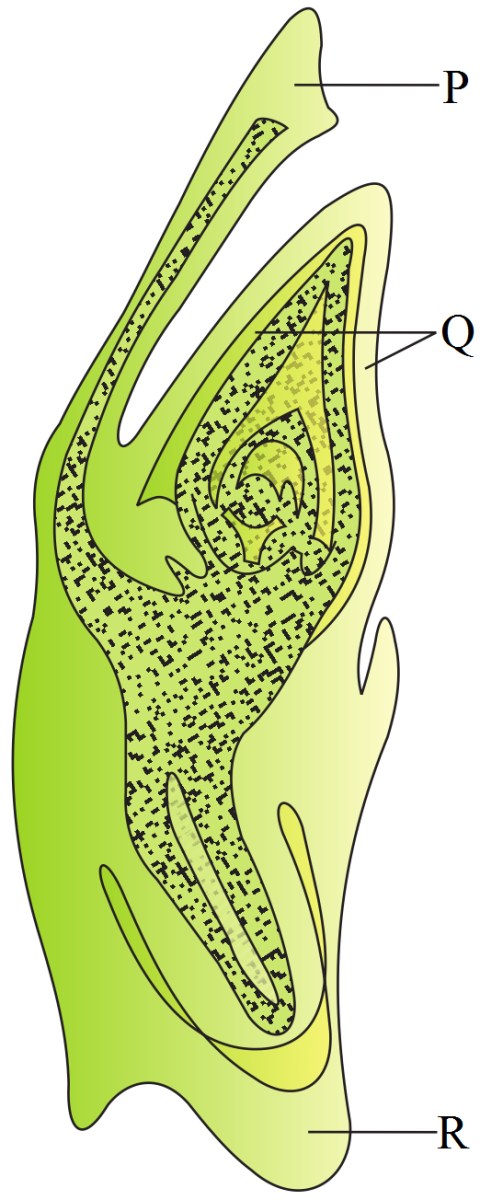
  1. Refer to the given diagram of the embryo of an angiospermous plant with parts labelled P, Q and R. Select the correct statement(s) regarding this.

  1. Part 'P' supplies nutrition to the developing embryo.
  2. Part 'Q' is the protective sheath of radicle and root cap.
  3. Part 'R' is the protective sheath of shoot apex and leaf primordia.
  4. The embryo shown in the diagram is present in members of Family Poaceae.
  1. (IV) only.
  2. (II) and (III) only.
  3. (I) and (IV) only.
  4. (I), (II), (III) and (IV).
  1. Which of the given statements are true?
  1. During the development of a dicot embryo, heart-shaped embryo is followed by globular embryo.
  2. The part of embryonal axis above the level of cotyledons is epicotyl, while the part below the level of cotyledons is hypocotyl.
  3. Monocot seeds possess a single cotyledon, represented by scutellum.
  1. (I) and (II).
  2. (II) and (III).
  3. (I) and (III).
  4. (I), (II) and (III).
  1. Consider the following parts of an embryonal axis of a dicot seed.
  1. Hypocotyl.
  2. Epicotyl.
  3. Radicle.
  4. Plumule.

In which of the following the above parts are correctly arranged from top to base?

  1. (III) → (I) → (II) → (IV).
  2. (II) → (I) → (III) → (IV).
  3. (IV) → (II) → (I) → (III).
  4. (III) → (IV) → (II) → (I).
  1. In grass family, the cotyledon, is called:
  1. Epiblast.
  2. Plumule.
  3. Scutellum.
  4. Perisperm.
Read the following and answer any four questions from (i) to (v) given below:
Wetlands are called Ramsar sites because the first international convention on their conservation was held in Ramsar in Iran in 1971. Wetlands or Ramsar sites are low lying marshy areas which get filled up during rains due to runoff and overflow from other water bodies. They are often considered to be waste lands which are used as dumping areas and filled up to recover land for various constructions activities. As a result, a large number of wetlands have disappeared.
  1. Select the incorrect match of wetland and its location.
 
Wetland
Location
(a)
Harike
Punjab
(b)
Chandra Tai
H.P.
(c)
Bhoj
M.P.
(d)
Ashtamudi
Odisha
  1. Migratory bird flamingo breeds in which of the following wetlands?
  1. Bhitarkanika Mangroves.
  2. Rann of Kutch.
  3. Harike.
  4. Chandra Tal.
  1. Which of the following is not an importance of wetlands?
  1. They are an important source of recharging groundwater.
  2. They provide protection from floods.
  3. They are good source of siltation and purification of water.
  4. None of these.
  1. Which of the following wetland ecosystem is highly acidic and has a accumulation of decomposed plants known as peat?
  1. Bog
  2. Mangrove
  3. Estuary
  4. Watershed
  1. The mangroves of Bhitarkanika are famous for:
  1. Rare migratory waterbirds.
  2. Nesting sites for endangered olive ridley turtles.
  3. Prawn cultivation.
  4. All of these.
Read the following and answer any four questions from (i) to (v) given below:
A group of teenagers was involved in drug abuse. 'They used syringes and needles to inject drugs. 'They indulged in this habit when they became adults. Administration of drug through needles became a piece of cake for them. Raj was the most active drug abuser amongst them and used to take drugs in high profile parties. In a span of time he started losing weight and suffered persistent diarrhoea. He developed constant low grade fever and used to catch opportunistic infection. When he consulted a doctor, he got himself tested for HIV in his blood and finally diagnosed with AIDS.
Based on the above information, answer the following questions.
  1. Select the incorrect statement.
  1. AIDS is a disorder of cell mediated immune system of the body.
  2. AIDS is caused by Human Immunodeficiency virus.
  3. AIDS infections were detected in India for the first time in prostitutes of Chennai, Tamil Nadu in 1986.
  4. December 10 is recalled as World AIDS Day.
  1. How do you think Raj got AIDS infection?
  1. Through transfusion of HIV infected blood
  2. Sexual intercourse with an infected partner
  3. Sharing towel with infected friend
  4. Use of contaminated needles and syringes to inject drugs
  1. How AIDS can be diagnosed?
  1. ELISA test
  2. Ames test
  3. Pap's test
  4. Wida! test
  1. How can AIDS be prevented?
  1. Blood tests of blood donor before transfusion to check for the presence of AIDS virus.
  2. Use of disposable needles and syringes for injecting medicines and vaccination
  3. Having protected sex by use of condoms
  4. All of these
  1. Select the correct statement for AIDS virus.
  1. It is rhomboid in shape with a diameter of 10-15 cm.
  2. Its genome consists of ds DNA.
  3. It consists of reverse transcriptase enzyme.
  4. Its envelope consists of lipid bilayer and three protein coats.
Read the following and answer any four questions from S(i) to S(v) given below:

Rajat is a student of biotechnology. His professor tells him that for transformation with recombinant DNA the bacterial cells must be made capable of taking up DNA as DNA do not pass through membrane. While doing experiment in the lab, Rajat noticed that bacterial cells were not taking up the foreign DNA even after treating it with sodium ion. He asked his professor, the reason behind this. His professor explained that he should check the valency and charge of the ion that he is using for the treatment.

  1. It is difficult for DNA to pass through the membrane as
  1. It is a hydrophilic molecule.
  2. It is a hydrophobic molecule.
  3. It is a circular molecule.
  4. It changes its shape when it comes in contact with host cell.
  1. What type of ions are used for DNA mediated gene transfers?
  1. Divalent anions.
  2. Divalent cations.
  3. Monovalent cations.
  4. Monovalent anions.
  1. rDNA stands for,
  1. reduced DNA
  2. red DNA
  3. recombinant DNA
  4. related DNA.
  1. Which of the following statements with regard to DNA is correct?
  1. DNA is a positively charged molecule having two polynucleotide chains.
  2. Nitrogen bases of two polynucleotide chain form complementary pairs, i.e., A opposite G and T opposite C.
  3. Backbone of DNA chain is built up of alternate deoxyribose sugar and phosphate group.
  4. Both (a) and (c)
  1. Assertion: Competent host is essential for transformation with rDNA.

Reason: Transfer of DNA in a prokaryotic cell is called transfection.

  1. Both assertion and reason are true and reason is the correct explanation of assertion.
  2. Both assertion and reason are true but reason is not the correct explanation of assertion.
  3. Assertion is true but reason is false.
  4. Both assertion and reason are false.
Explain the methods for making host cell competent to insert the r DNA.
Read the following and answer any four questions from (i) to (v) given below:
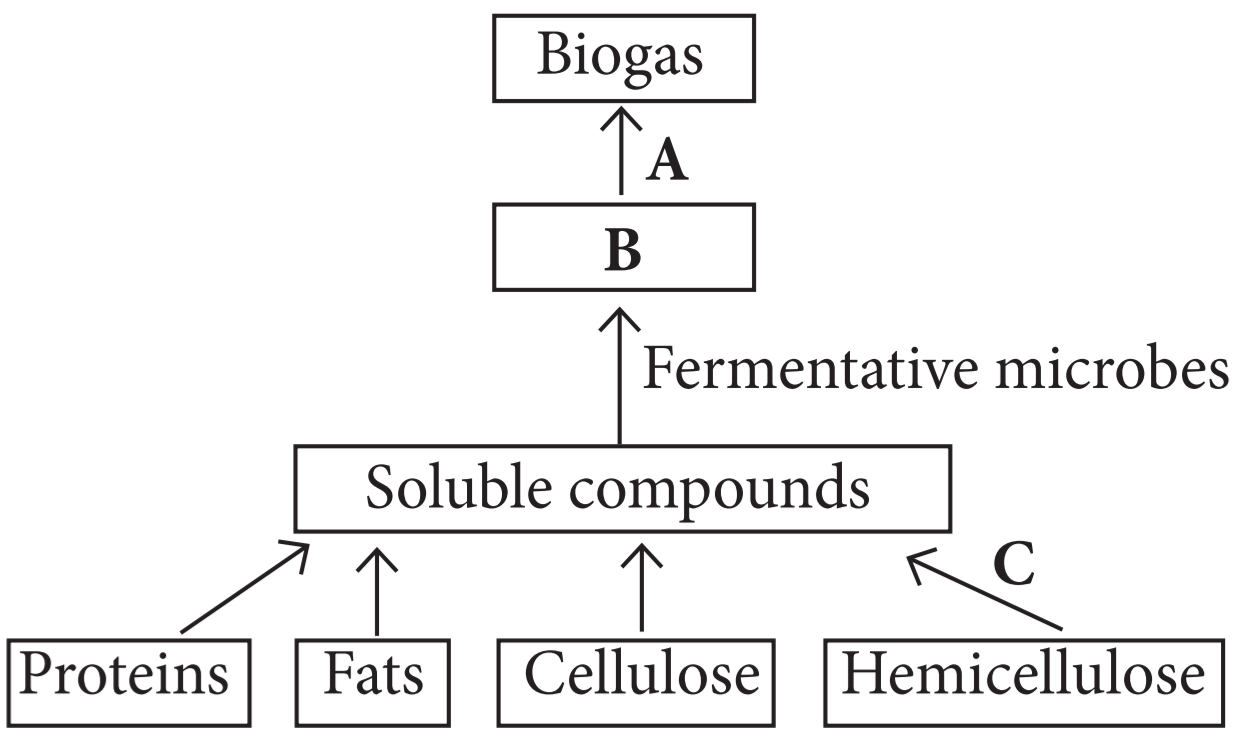
Villagers in a place near Chambur started planning to make power supply for agricultural purposes from cow dung. 'Tiley have started a biogas plant for the purpose. Study the flow chart for biogas production given below and answer the following questions.

  1. Biagas is composed of majorly:
  1. Methane, CO2 and O2
  2. CO2, H2S and H
  3. Methane, CO2
  4.  H2S, H and O2
  1. In the given flow chart, 'A' denotes:
  1. Aerobic bacteria.
  2. Methanogenic bacteria.
  3. Cellulose degrading bacteria.
  4. Yeast and protozoa.
  1. What is represented by 'B' in the flow chart?
  1. Carbohydrates.
  2. Protein polymers.
  3. Organic acids.
  4. Fat globules.
  1. 'C' in the given flow chart causes:
  1. Aerobic breakdown of complex organic compounds.
  2. Anaerobic digestion of complex organic compounds.
  3. Fermentation of organic compounds.
  4. Fermentation of monomers.
  1.  If 'A' is not added in the procedure.
  1. Methane will not be formed.
  2. CO2 will not be formed.
  3. Organic compounds will not be converted to H2S
  4. O2 will not be formed.
Why are vectors needed for replication of DNA during rDNA technology?
Read the following and answer any four questions from (i) to (v) given below:
DNA fingerprinting is a technique of determining nucleotide sequences of certain areas of DNA which are unique to each individual. Each person has a unique DNA fingerprint. Each fingerprint is the same for every cell, tissue and organ of a person. DNA fingerprinting is the basis of paternity testing in case of disputes.
  1. The technique developed to identify a person with the help of DNA restriction analysis is known as.
  1. DNA profiting
  2. DNA fingerprinting
  3. RFLP
  4. Both (a) and (b).
  1. For DNA fingerprinting, DNA is obtained from.
  1. Blood
  2. Hair root cells
  3. Semen
  4. All of these
  1. During DNA fingerprinting, the radioactive probes.
  1. Hybridise with DNA sample to form double stranded structure
  2. Egrade the DNA
  3. Create positive charge on DNA
  4. Cut the DNA sample at various sites.
  1. In India, DNA fingerprinting technique was developed by?
  1. Dr. Lalji Singh
  2. Alec Jeffreys
  3. Dr. Khorana
  4. None of these.
  1. Which of the following is true about DNA fingerprinting?
  1. VNTR is used as probe.
  2. DNA samples are loaded on agarose gel electrophoresis.
  3. It is based on identification of nucleotide sequence present on the DNA molecule.
  4. All of these
Give an account of energy flow in an ecosystem.