Question
Write a note on plasmolysis.

Answer

When a living plant cell is placed in hypertonic solution, it loses water by osmosis and shrinks away from the cell wall. This process is known as plasmolysis and the plant cell is said to be plasmolysed.

Need a full question paper?

Generate a complete, print-ready paper with questions like this in minutes — across 16+ boards, with answer keys.
Start Generating Free

Similar questions

Define relative density of a solid. State its unit. How is it related to its density? Write mathematical expression for relative density. What conclusion do you draw if relative density of a substance is (a) greater than 1, (b) less than 1 and (c) equal to 1?
Classify the following as chemical or physical changes:
  • Cutting of trees.
  • Melting of butter in a pan.
  • Rusting of almirah.
  • Boiling of water to form steam.
  • Passing of electric current, through water and the water breaking down into hydrogen and oxygen gases.
  • Dissolving common salt in water.
  • Making a fruit salad with raw fruits.
  • Burning of paper and wood.
What mass of nitrogen $N_2,$ will contain the same number of molecules as $1.8g$ of water, $H_2O?$
$($Atomic masses: $N = 14u; H = 1u; O = 16u)$
On a level road, a scooterist applies brakes to slow down from a speed of $10\ m/s$ to $5\ m/s.$ If the mass of the scooterist and the scooter be $150\ kg,$ calculate the work done by the brakes. $($Neglect air resistance and friction$)$
  1. How does a boat float in water?
  2. A piece of steel has a volume of $12\ cm^3,$ and a mass of $96g$. What is its density: $(i)$ in $g/cm^{3 }\ (ii)$ in $kg/m^3$?
What are ionic and molecular compounds? Give examples.
A truck of mass $500\ kg$ moving at $4\ m/s$ collides with another truck of mass $1500\ kg$ moving in the same direction at $2\ m/s.$ What is their common velocity just after the collision if they move off together?
A car is travelling along the road at $8\ ms^{-1}.$ It accelerates at $1\ ms^{-2}$ for a distance of $18m.$ How fast is it then travelling?
What mass of nitrogen $N_2,$ will contain the same number of molecules as $1.8g$ of water, $H_2O?$
$($Atomic masses: $N = 14u; H = 1u; O = 16u)$
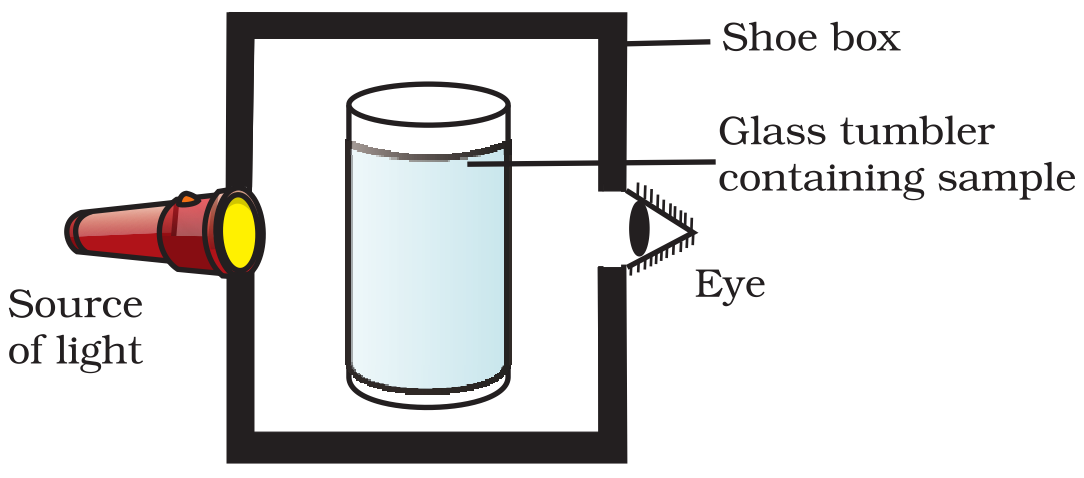
A group of students took an old shoe box and covered it with a black paper from all sides. They fixed a source of light $($a torch$)$ at one end of the box by making a hole in it and made another hole on the other side to view the light. They placed a milk sample contained in a beaker/ tumbler in the box as shown in the they were amazed to see that milk taken in the tumbler was illuminated. They tried the same activity by taking a salt solution but found that light simply passed through it?
  1. Explain why the milk sample was illuminated. Name the phenomenon involved.
  2. Same results were not observed with a salt solution. Explain.
  3. Can you suggest two more solutions which would show the same effect as shown by the milk solution?