Question
Write a note on structure of t-RNA

Answer

→ From the very beginning of the proposition of code, it was clear to Francis Crick that there has to be a mechanism to read the code and also to link it to the amino acids, because amino acids have no structural specialities to read the code uniquely.
→ He postulated the presence of an adapter molecule that would on one hand read the code and on other hand would bind to specific amino acids.
→ The tRNA, then called SRNA (soluble RNA), was known before the genetic code was postualated.
→ However, its role as an adapter molecule was assigned much later.
Image
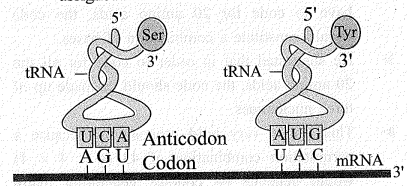
→ tRNA has an anticodon loop that has bases complementary to the code, and it also has an amino acid acceptor end to which it binds to amino acids.
→ tRNAs are specific for each amino acid
→ For initiation, there is another specific tRNA that is referred to as initiator tRNA. There are no tRNAs for stop codons.
→ The secondary structure of tRNA has been depicted that looks like a clover-leaf.
→ In actual structure, the tRNA is a compact molecule which looks like inverted L.
Need a full question paper?

Generate a complete, print-ready paper with questions like this in minutes — across 16+ boards, with answer keys.

Start Generating Free

Similar questions

Write any five common antibiotics with their sources.
Study the given pedigree chart and answer the questions that follow:
Is the trait recessive or dominant?
i. Compare the mechanism of sex determination in humans with that of honey bees, with respect to chromosome number.
ii. How is the gamete formation comparable in the above two cases?
The outline structure of a drug is given below,
  1. Which group of drugs does this represent?
  2. What are the modes of consumption of these drugs?
  3. Name the organ of the body which is affected by consumption of these drugs.
​​​​​​​
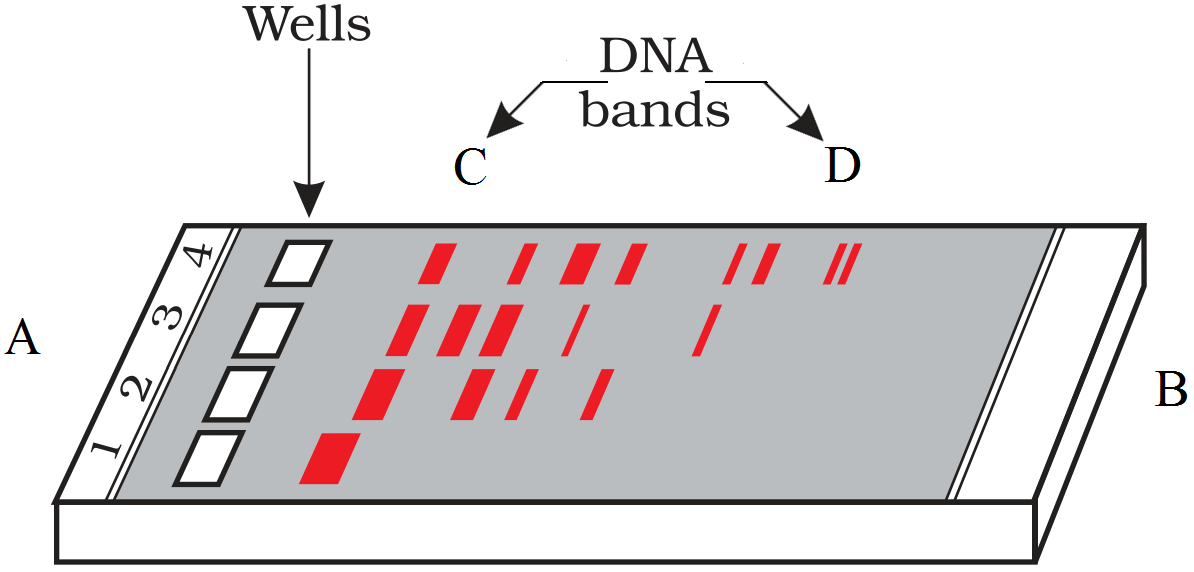
Rajesh was doing gel electrophoresis to purify DNA fragments. Given below is the sketch of the observations of the experiment performed by him.
  1. At which end he would have loaded the samples and where?
  2. Analyse the reason for different positions taken up by the DNA bands.
  3. Elaborate the step he would have followed to visualize DNA bands.
How many types of restriction endonucleases are found. Why they are called as molecular scissors?
Name the pest that destroys the cotton bolls. Explain the role of Bacillus thuringiensis in protecting the cotton crop against the pest to increase the yield.
Mention the six harmful effects of noise on human health.
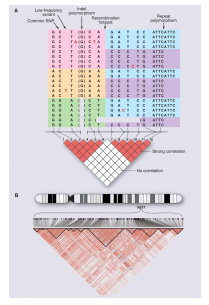
Observe the diagram for genetic mapping of human DNA and answer the following questions:
Image
i. Explain DNA polymorphism as the basis of genetic mapping of the human genome.
ii. State the role of VNTR in DNA fingerprinting.
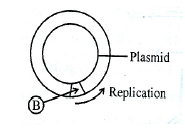
  1. Identify (A) and (B) illustrations in the following:
  1.  
  1.  
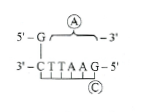
  1. Write the term given to (A) and (C) and why?
  2. Expand PCR. Mention its importance in biotechnology.