the human eye and the colourful world — Science STD 10 — Question
Gujarat BoardEnglish MediumSTD 10Sciencethe human eye and the colourful world3 Marks
Question
Write a note on twinkling of stars.
✓
Answer
Twinkling of stars is due to atmospheric refraction of starlight.
Starlight, on entering the earth’s atmosphere, undergoes refraction continuously before it reaches the earth.
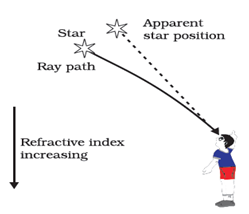
As the optical density of air increases towards surface of the earth, light from the star travels from rarer to denser layers, bending every time towards the normal.
On producing the final refracted ray backwards as shown in the following figure, we find that the apparent position $B$. of a star is higher than the actual position A. of the star as shown in figure.
[Apparent star position due to atmospheric refraction]
The star appears somewhat higher (above) than its actual position when viewed near the horizon.
Further, this apparent position of the star is not stationary, but keeps on changing slightly, since physical conditions of the earth’s atmosphere are not stationary.
Since the stars are very distant, they appear as point-sized sources of light.
Due to a continuous change in the direction of propagation of light, the apparent position of the star fluctuates all the time and the amount of starlight entering, the eye flickers, i.e., the brightness of the star changes continuously (the star sometimes appears brighter and at some other time fainter).
This is called the twinkling of a star.
Need a full question paper?
Generate a complete, print-ready paper with questions like this in minutes — across 16+ boards, with answer keys.