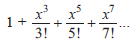
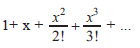
(a) Find the mean of the elements present in the list (without using sum() function)
(b) Find the mean of all those elements of the list which are more than the mean calculated in 5c (above part of the question)
Get the step-by-step solution for this question inside the Vidyadip app.
Get the answer in the appGenerate a complete, print-ready paper with questions like this in minutes — across 16+ boards, with answer keys.
Write a script to create two lists of 5 floating point values each and then
(a) Sort the first list using sort() method and display it without using any loop
(b) Reverse the second list using reverse() method and display it without using any loop
(c) Append the second list to the first list using extend() method
(d) Delete all the elements from the second list using clear() method
(e) Display the first list (after performing the above operations)
(f) Input an integer from the user and find how many times does it exist in the first list using count() method
Consider the following tables CARHUB and CUSTOMER and answer (a) and (b) parts of this question:
Table: CARHUB
| Vcode | VehicleName | Make | Color | Capacity | Charges |
| 100 | Innova | Toyota | WHITE | 7 | 15 |
| 102 | SX4 | Suzuki | BLUE | 4 | 14 |
| 104 | C Class | Mercedes | RED | 4 | 35 |
| 105 | A-Star | Suzuki | WHITE | 3 | 14 |
| 108 | Indigo | Tata | SILVER | 3 | 12 |
Table: CUSTOMER
| CCode | CName | VCode |
| 1 | Hemant Sahu | 101 |
| 2 | Raj Lal | 108 |
| 3 | Feroza Shah | 105 |
| 4 | Ketan Dhal | 104 |
(a) Write SQL commands for the following statements:
(i) To display the names of all white colored vehicles
(ii) To display name of vehicle, make and capacity of vehicles in ascending order of their sitting capacity
(iii) To display the highest charges at which a vehicle can be hired from CARHUB.
(iv) To display the customer name and the corresponding name of the vehicle hired by them.
(b) Give the output of the following SQL queries:
(i) Select count(distinct make) from cabhub;
(ii) Select max(charges), min(charges) from carhub;
(iii) Select count(*), make from carhub;
(Iv) Select vehiclename from carhub where capacity = 4;
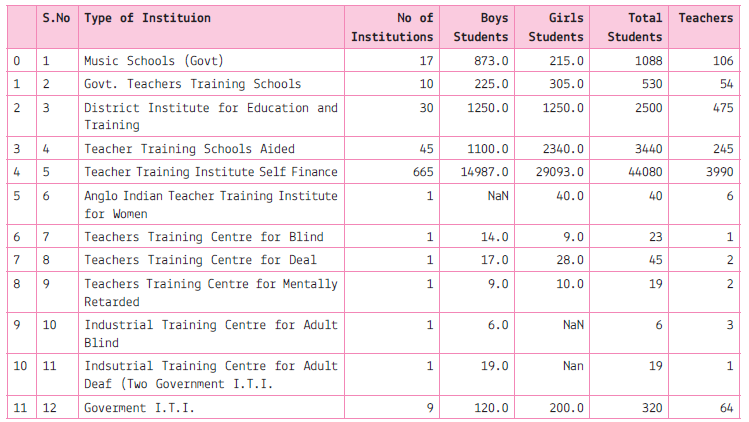
https://data.gov.in/catalog/statistical-hand-book-2009-education?filters%5Bfield_catalog_reference%5D=6690578& format=json&offset=6&limit=6&sort%5Bcreated%5D=desc
Schools for Professional Education 2007-08 : SHB 2009

(i) Write a python / statement to read the data frame.
(ii) Write a python code to plot the pie chart of all the institutions which have more than hundred teachers. Also display the values of portion.
(iii) Write a python code to plot the horizontal bar chart to plot the Type of institution and Total students.
(iv) Write a python code to plot the scatter diagram boys vs girls students.
(v) Write a python code to plot the histogram for no. of institution.
where n and x have to be input from the user. The function should have two parameter n and x and return the sum of the series.
Consider the following tables GAMES and PLAYER. Write SQL commands for the statements (a) to (d) and give outputs for SQL queries (e1) to (e4)
Relation: GAMES
| GCode | Game Name | Number | Prize Money | Schedule Date |
| 101 | Carom Board | 2 | 5000 | 23-Jan-2004 |
| 102 | Badminton | 2 | 12000 | 12-Dec-2003 |
| 103 | Table Tennis | 4 | 8000 | 14-Feb-2004 |
| 105 | Chess | 2 | 9000 | 01-Jan-2004 |
| 108 | Lawn Tennis | 4 | 25000 | 19-Mar-2004 |
Relation: PLAYER
| PCode | Name | Gcode |
| 1 | Nabi Ahmad | 101 |
| 2 | Ravi Sahai | 108 |
| 3 | Jatin | 101 |
| 4 | Nazneen | 103 |
(a) To display the name of all Games with their Gcodes
(b) To display details of those games which are having PrizeMoney more than 7000.
(c) To display the content of the GAMES table in ascending order of ScheduleDate.
(d) To display sum of PrizeMoney for each of the Number of participation groupings (as shown in column Number)
(e1) Select COUNT(DISTINCT Number) FROM GAMES;
(e2) Select MAX(ScheduleDate),MIN(ScheduleDate) FROM GAMES;
(e3) Select SUM(PrizeMoney) FROM GAMES;
(e4) Select DISTINCT Gcode FROM PLAYER;