Question
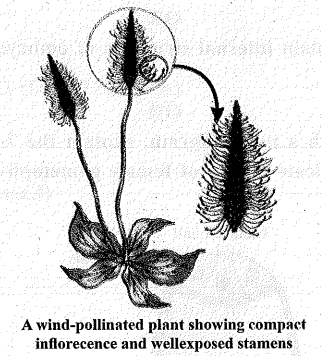
Write a short note on pollination by wind.
Answer

Image
→ Pollination by wind is more common amongst abiotic pollinations.
→ Wind pollination also requires that the pollen grains are light and non-sticky so that they can be transported in wind currents.
→ They often possess well-exposed stamens so that the pollens are easily dispersed into wind currents, and large often-feathery stigma to easily trap air-borne pollen grains.
→ Wind pollinated flowers often have a single ovule in each ovary and numerous flowers packed into an inflorescence.
→ A familiar example is the corn cob the - tassels you see are nothing but the stigma and style which wave in the wind to trap pollen grains.
→ Wind-pollination is quite common in grasses.

Need a full question paper?

Generate a complete, print-ready paper with questions like this in minutes — across 16+ boards, with answer keys.
Start Generating Free

Similar questions

Read the following and answer any four questions from 6(i) to 6(v) given below:
Rama lives in a society where a robbery occurred last night. Robbers came into the flat and murdered the old lady residing there. Police came and restricted the entry into the flat. They took samples from the room, where the dead body was found. While examining, they found that there is some blood and tissue in the nails of old lady. According to their observation, police filtered out their inspection to three suspects viz. servant, cook and milkman. Finally after two days of robbery, police caught the criminal. It was the old lady's cook. Rama was amazed to see that how quickly police completed and shut the case. She asked the inspector that how they did it? The police man told her that it become possible due to the sample collected from the victim, that lead them to the criminal. TI1e sample taken from nail scraping was amplified using PCR and then tested.
  1. What technique was used by the police to identify the criminal?
  1. DNA fingerprinting.
  2. Gel electrophoresis.
  3. Molecular diagnosis.
  4. Clonning.
  1. In PCR, the temperature used to denature the DNA is about:
  1. 76º
  2. 25º
  3. 95º
  4. 40º
  1. Which of the following statements regarding PCR is correct?
  1. Taq polymerase, which is isolated from bacterium Thermus aquaticus is stable at low temperature only.
  2. With the help of DNA ligase, the complementary sticky ends of the DNA are joined to produce a rDNA.
  3. Since the sequence of primers are complementary to 5' end of the template DNA, they anneal to it.
  4. DNA purified from the cell is precipitated by adding hot ethanol.
  1. Taq polymerase synthesises DNA region between the primers using:
  1. $Mg^{2+}$
  2. dNTPs
  3. DNA ligase
  4. Both (a) and (b).
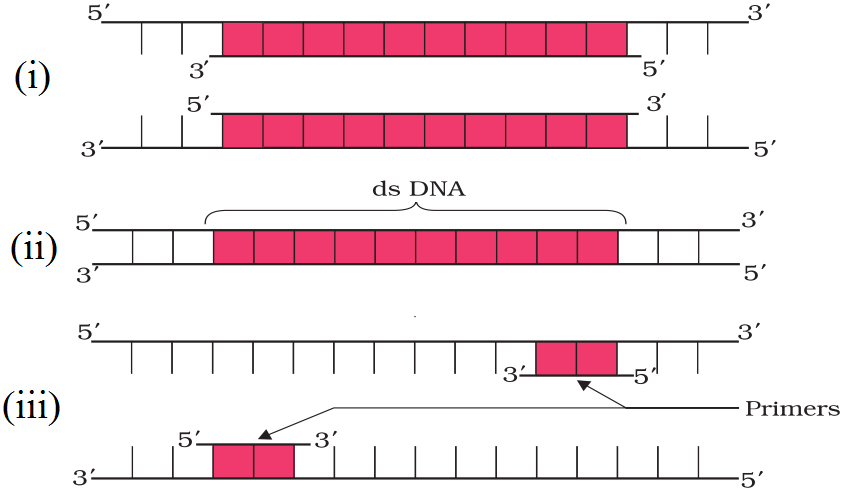
  1. Given below are steps of polymerase chain reaction.


Select the option that correctly mention the sequence in which they occur.
  1. (ii) → (iii) → (i)
  2. (i) → (ii) → (iii)
  3. (iii) → (i) → (ii)
  4. (ii) → (i) → (iii)
Explain Predation as population interaction with different example.
Polymerase chain reaction:
Read the following and answer any four questions from 9(i) to 9(v) given below:
Bioreactors are considered as vessels in which raw materials are biologically converted into specific products by microbes, plant and animal cells or their enzymes. They are used for large scale production as they provide optimum growth conditions such as temperature, pH, substrate, vitamins, oxygen and salts for obtaining desired product. Most commonly used bioreactors are of stirring type which include simple stirred tank bioreactor and sparged stirred-tank bioreactor.
  1. Bioreactor are useful in:
  1. Amplifying a gene.
  2. Isolation of genetic material.
  3. Processing large volume of culture.
  4. Infecting DNA in a cell.
  1. Which of the following is essential to obtain desired product in a bioreactor?
  1. Size of the bioreactor.
  2. Sterile condition.
  3. Quantity of the raw material.
  4. All of these.
  1. Assertion: The stirred-tank is well suited for large scale production of microorganisms under aseptic conditions.
Reason: In sparged stirred tank bioreactor, surface area for oxygen transfer is increased.
  1. Both assertion and reason are true and reason is the correct explanation of assertion.
  2. Both assertion and reason are true but reason is not the correct explanation of assertion.
  3. Assertion is true but reason is false.
  4. Both assertion and reason are false.
  1. Growth condition that could affect the quality of obtained product in a bioreactor are:
  1. Temperature and pH only.
  2. pH and oxygen supply only.
  3. Temperature and oxygen supply only.
  4. Temperature, pH and oxygen supply.
  1. Vessels in which raw materials are biologically converted into specific products are.
  1. Bioreactors.
  2. Fermentors.
  3. Gene guns.
  4. Both (a) and (b).
Read the following text carefully and answer the questions that follow:
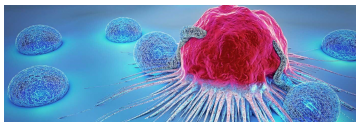
Cancer refers to any one of a large number of diseases characterized by the development of abnormal cells that divide uncontrollably and have the ability to infiltrate and destroy normal body tissue. Cancer often has the ability to spread throughout your body. Cancer is the second-leading cause of death in the world.
Image
i. How does a cancerous cell differ from a normal cell? (1)
ii. Benign tumor is less dangerous than malignant tumor. Why? (1)
iii. Describe causes of cancer. (2)
OR
Mention two methods of treatment of the disease. (2)
Explain Linkage & Recombination.
Read the following and answer any four questions front (i) to (v) given below:
Gene regulation is the mechanism of switching off and switching on of the genes depending upon the requirement of cells and the state of development. Gene regulation is of two types : negative and positive. In negative generegulation the genes continue expressing their effect till their activity is suppressed. Positive gene regulation is the one in which the genes remain non-expressed unless and until they are induced to do it. Operon model is a co-ordinated group of genes such as structural gene, operator gene, promoter gene, regulator gene which function together and regulate a metabolic pathway as a unit, e.g., lac operon, trp operon, ara operon, etc.
  1. Regulation of gene expression occurs at the level of.
  1. Transcription
  2. Processing/splicing
  3. Translation
  4. All of these.
  1. Inducible operon system usually occurs in A pathways. Nutrient molecules serve as B to stimulate production of the enzymes necessary for their breakdown. Genes for inducible operon are usually switched C and the repressor is synthesised in an D form.
S.no
A
B
C
D
(a)
anabolic
corepressor
on
inactive
(b)
anabolic
inducer
off
active
(c)
catabolic
inducer
off
active
(d)
catabolic
corepressor
on
inactive
  1. An mRNA molecule transcribed from the lac operon contains nucleotide sequences complementary to.
  1. Structural genes coding for the enzymes.
  2. the operator region
  3. the promotor region
  4. the repressor gene.
  1. Which statement correctly describes the control of transcription of the genes involved in the breakdown of lactose in Estherichia coli?
  1. A repressor protein binds to the operator and the genes are switched on.
  2. A repressor protein binds to the operator and the genes are switched off.
  3. A transcription factor binds to the promoter and the genes are switched on.
  4. A transcription factor binds to the promoter and the genes are switched off.
  1. Function of catabolic activator protein in lac operon is.
  1. To form mRNA
  2. Help to bind RNA polymerase
  3. Code for repressor
  4. To activates lac gene when glucose is absent.
Define ecological pyramids and describe with examples, pyramids of number and biomass.
Read the following and answer any four questions from (i) to (v) given below:
In today's world, more than 25% of human population is suffering from hunger and malnutrition. Scientists have developed techniques where microbes are grown on industrial scale as a source of good protein which can be grown from waste water, animal manure and even sewage. Single cell proteins are such products. TI1e biomass or protein is extracted from pure or mixed cultures of algae, yeasts, fungi or bacteria. These are a very good source of food for human consumption.
  1. Why the name single cell protein is applied?
  1. It contains only one type of protein.
  2. It is obtained from unicellular edible microbes.
  3. It contains only one type of microorganism.
  4. All of these.
  1. Which of the following is considered under single cell protein?
  1. Algae.
  2. Fungi.
  3. Cyanobacteria.
  4. All of these.
  1. Microorganisms can be a useful food resource for increasing human population because:
  1. These are easy to harvest.
  2. These can grow in water system.
  3. They have a high rate of multiplication thus producing huge biomass.
  4. They have high level of nucleic acid.
  1. Single cell protein can be grown from:
  1. Waste water.
  2. Animal manure.
  3. Sewage.
  4. All of these.
  1. Assertion: Production of single cell protein reduces pollution.
Reason: Single cell protein can be grown from waste water and even sewage.
  1. Both assertion and reason are true and reason is the correct explanation of assertion.
  2. Both assertion and reason are true but reason is not the correct explanation of assertion.
  3. Assertion is true but reason is false.
  4. Both assertion and reason are false.
Read the following and answer any four questions from (i) to (v) given below:
Green manuring is the fanning practice where a leguminous plant which has derived enough benefits from its association with appropriate species of Rhizobium, is ploughed into the field soil and then a non-legume is sown and allowed to get benefitted from the already present nitrogen fixer. Some legumes, such as, Crotolaria juncea, Sesbania rostrata, Lencaena leucocephala, etc. are used as green manure. Rhizobia, that fix atmospheric nitrogen in the form of nitrate, live in the roots ofleguminous plants. These nutrients are used by non-leguminous plants through the practice of green manuring.
  1. Green manures mainly provide nutrient enriched in:
  1. Magnesium.
  2. Sulphur.
  3. Nitrogen.
  4. Both (a) and (b).
  1. Which of the following plants is used as green manure in crop fields?
  1. Saccharum.
  2. Dichanthium.
  3. Phyllonthus.
  4. Crotolaria.
  1. Green manure plants belong to the Family:
  1. Lamiaceae.
  2. Papilionaceae.
  3. Liliaceae.
  4. Poaceae.
  1. Due to excess use of chemical fertilisers rich in nitrate, ________ disease occurred in children.
  1. Jaundice.
  2. Septicemia.
  3. Methemoglobinemia.
  4. Botulism.
  1. A green manure is:
  1. Rice.
  2. Maize.
  3. Sorghum.
  4. Sesbania.