Question
Write a short note on sex determination in man.
Answer

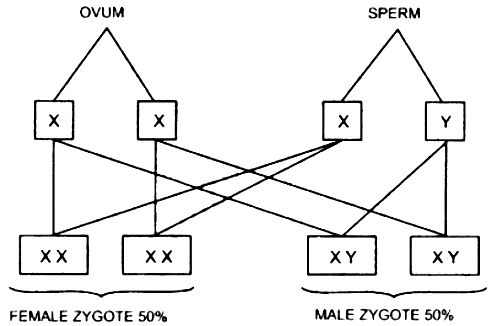
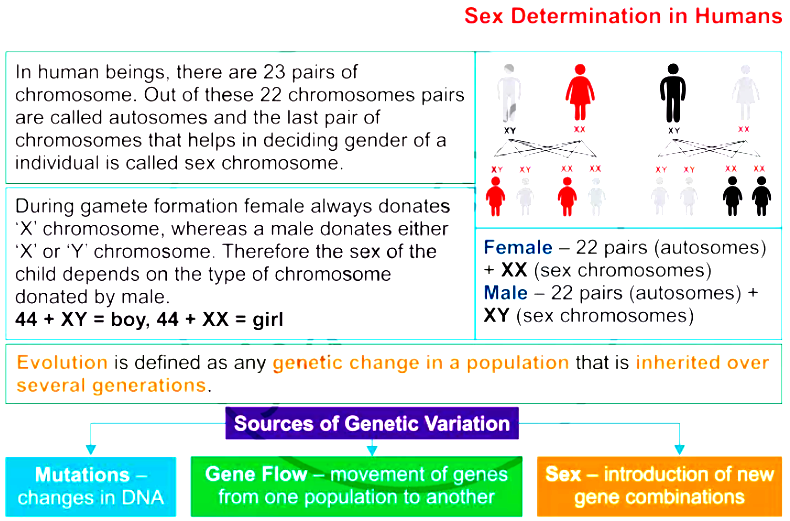
The difference between two individuals of the same species with respect to heredity is known as sex. So, an individual can either be a male or female in normal circumstances. Scientists have discovered that sex is transmitted by definite sex determination, also called heterosomes. The human body cells have two sex- chromosomes. A woman has two X- chromosomes while a man has one X- chromosome and one Y-chromosome.

Therefore, an egg cell has one X- chromosome and a sperm cell have either an X- or a Y-chromosome. This means that the sex of a baby is determined by the type of sperm cell fertilizing the egg. If an egg, fused with a sperm having Y-chromosome, then the male zygote will develop and when fused with a sperm having an X-chromosome then a female zygote will develop.

Need a full question paper?

Generate a complete, print-ready paper with questions like this in minutes — across 16+ boards, with answer keys.

Start Generating Free

Similar questions

Match the items in column I with those in column II and write down the matching pairs (some may not match)
Column I Column II
aAcrosome1An embryo which looks likehuman baby
bGestation2Luteinizing hormone
cMenopause3ovum producing cells
dFoetus4complete stoppage of menstrualcycle
eOogenesis5spermatozoa
fOvulation6Complete stoppage of menstrualcycle.
7Time taken by a fertilized egg tillthe delivery of baby
 
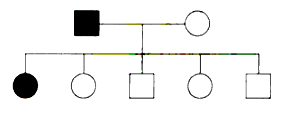
A family consists of two parents and their five children and the pedigree chart below shows the inheritance of the trait colour blindness .

(i) Who is colour blind in parents - Father or Mother?
(ii) How many daughters and sons have beeen born in the family?
(iii) What does the child 1 indicate about this trait?
(iv) Complete the depiction of all probabilities of the trait among the children 2-5 in the chart.
(v) On which chromosome is the gene of this trait located?
(vi) Name one other trait in humans which follows the similar mode of inheritance.
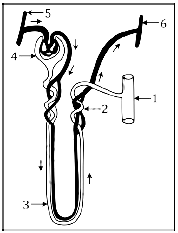
The given diagram represents a nephron and its blood supply. Study the diagram and answer the following questions:
(i) Label parts 1, 2, 3 and 4.
(ii) State the reason for the high hydrostatic pressure in the glomerulus.
(iii) Name the blood vessel which contains the least amount of urea in this diagram.
(iv) Name the two main stages of urine formation.
(v) Name the part of the nephron which lies in the renal medulla.
Column 1Column 2
1SPMaRelease of methane
2Ozone holebAdd to greenhouse effect
3Melting of polar icecAffects oxygen transport by blood
4Acid raindRise in sea level
5Green house effecteBronchitis & inflammation of the lungs
6Melting of permafrostfErosion of buildings
7Carbon monoxidegChlorofluorocarbons
Draw labeled diagram of different steps of mitosis.
Differentiate between:
Red blood cells and White blood cells
How does carbon dioxide return to the atmosphere? Explain.
A student in order to study the importance of certain factors of photosynthesis took a potted plant and kept it in the dark for over 24 hours. Then in the early hours of the morning the student covered one of the leaves with black paper in the centre only. Student placed the potted plant in the sunlight for a few hours, and then tested the leaf which was covered with black paper for starch.
(i) What aspect of photosynthesis was being investigated?
(ii) Is there any control in this experiment? If so, state the name.
(iii) Why was the plant kept in the dark before the experiment?
(iv) Describe step by step how the candidate proceeded to test the leaf for the presence of starch.
Is ozone depletion related to global warming?
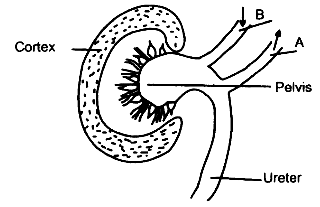
Given below is a simple diagram of the human kidney cut open longitudinally. Answer the following questions:
c
(v) Write two differences in the composition of the blood flowing through blood vessels A and B.
Name and describe very briefly the stages in the development of human embryo.