Question
Write a short note on slow speed and fast speed reactions.

Answer

Slow speed reaction:
The reaction which requires long time for completion i.e. occurs slowly is called slow speed reaction.
Examples:
(1) On heating potassium chlorate $\left( KClO _3\right)$ it decomposes slowly into potassium chloride and oxygen gas.
Image

This reaction requires long time for completion, therefore it is slow speed reaction.

(2) Rusting of iron is a slow speed reaction. In this reaction iron reacts with oxygen from air to form iron oxide.
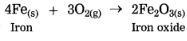
Image

This reaction requires long time for completion.
Fast speed reaction:
The reaction which is completed in short time i.e., occurs rapidly is called fast speed reaction.
Examples:
(1) The reaction between sodium hydroxide $( NaOH )$ and hydrochloric acid $( HCl )$ is a neutralization reaction and it is fast speed reaction.
$
NaOH _{( aq )}+ HCl _{( aq )} \rightarrow NaCl _{( aq )}+ H _2 O _{(1)}
$
This neutralizaton reaction is completed in short time, therefore it is fast speed reaction.
(2) Aqueous solution of sodium chloride reacts with silver nitrate solution to form white precipitate of silver chloride $( NaCl )$ and sodium nitrate.

Image
This reaction is completed in short time, therefore it is fast reaction.

Need a full question paper?

Generate a complete, print-ready paper with questions like this in minutes — across 16+ boards, with answer keys.

Start Generating Free

Similar questions

A person first crossed pure-bred pea plants having round-yellow seeds with pure-bred pea plants having wrinkled-green seeds and found that only $A-B$ type of seeds were produced in the $F_1$ generation. When $F_1$ generation pea plants having $A-B$ type of seeds were cross-bred by self-pollination, then in addition to the original round-yellow and wrinkled-green seeds, two new varieties $A-D$ and $C-B$ type of seeds were also obtained.
  1. What are $A-B$ type of seeds$?$
  2. State whether $A$ and $B$ are dominant traits or recessive traits.
  3. What are $A-D$ type of seeds$?$
  4. What are $C-B$ type of seeds$?$
  5. Out of $A-B$ and $A-D$ types of seeds, which one will be produced in $(i)$ minimum numbers, and $(ii)$ maximum numbers, in the $F_2$ generation?
Generally the ionic compounds have high melting points.
There are two similar glands P which are located on top of two similar organs Q in the human body. P are often called the emergency glands and they secrete a hormone R into the blood stream. R is secreted in large amounts when a person is frightened. It brings about temporary changes in the body which allow a lot of substance S from the liver to go into the blood to provide a lot of energy in a very short time. This helps a person to fight back or run away from the frightening situation.
What are P, Q, R and S?
Which different aspects of disaster management would you check for your school? Why?
Explain details on happening about blue whale game.
What is menstrual cycle? Describe it in brief.
Identify the type of the following reaction of carbon compounds.
1. $\left.\mathrm{CH}_3-\mathrm{CH}_2-\mathrm{CH}_2-\mathrm{OH}+\mathrm{O}\right) \rightarrow \mathrm{CH}_3-\mathrm{CH}_2-\mathrm{COOH}$
2. $\mathrm{CH}_3-\mathrm{CH}_2-\mathrm{CH}_3+\mathrm{O}_2 \rightarrow 3 \mathrm{CO}_2+4 \mathrm{H}_2 \mathrm{O}$
3. $\mathrm{CH}_3-\mathrm{CH}=\mathrm{CH}-\mathrm{CH}_3+\mathrm{Br}_2 \rightarrow \mathrm{CH}_3-\mathrm{CHBr}-\mathrm{CHBr}-\mathrm{CH}_3$
4. $\mathrm{CH}_3-\mathrm{CH}_3+\mathrm{Cl}_2 \rightarrow \mathrm{CH}_3-\mathrm{CH}_2-\mathrm{Cl}+\mathrm{HCl}$
5. $\mathrm{CH}_3-\mathrm{CH}_2-\mathrm{CH}_2-\mathrm{CH}_2-\mathrm{OH} \rightarrow \mathrm{CH}_3-\mathrm{CH}_2-\mathrm{CH}=\mathrm{CH}_2+\mathrm{H}_2 \mathrm{O}$
6. $\mathrm{CH}_3-\mathrm{CH}_2-\mathrm{COOH}+\mathrm{NaOH} \rightarrow \mathrm{CH}_3-\mathrm{CH}_2-\mathrm{COONa}^{+}+\mathrm{H}_2 \mathrm{O}$
7. $\mathrm{CH}_3-\mathrm{COOH}+\mathrm{CH}_3-\mathrm{OH} \rightarrow \mathrm{CH}_3-\mathrm{COO}-\mathrm{CH}_3+\mathrm{H}_2 \mathrm{O}$
Explain the need and importance of space missions.
An object is placed 15cm from (a) a converging mirror, and (b) a diverging mirror, of radius of curvature 20cm. Calculate the image position and magnification in each case.
A liquid X of colour Y circulates in the human body only in one direction: from body tissues to the heart. Among other things, liquid X contains germs from cells and dead cells. The liquid X is cleaned of germs and dead cells by a special type of white blood cells called Z. This cleaned liquid is then put into blood circulatory system in subclavian veins.
  1. What is (i) liquid X and (ii) colour Y?
  2. What are Z.
  3. The liquid X is somewhat similar to a component of blood. Name this component.
  4. Why is liquid X not red?