Question
Write a short note on 'Valves' in electronics.

Answer

Before the discovery of transistors in 1948, valves (vacuum tubes) were widely used in electronic circuits.
Types of valves are as follows:
(i) Vacuum diode : which has two electrodes Anode (often called plate), and cathode.
(ii) Vacuum triode : which has three electrodes - cathode, plate and grid.
(iii) Vacuum tetrode : which has anode, cathode and 2 grids, so total four electrodes.
(iv) Vacuum pentode : which has 5 electrodes.
In a vacuum tube, the electrons are supplied by a heated cathode (current is passed through the filament kept very close to the cathode and by heating the cathode, electrons are emitted by Thermionic emission process.)
Controlled flow of electrons in vacuum is obtained by varying the voltage between its different electrodes. Vacuum is required in the inter-electrode region (/space). Otherwise the moving electrons may lose their energy on collision with the air molecules in their path.
In these devices, the electrons can flow only from cathode to the anode (i.e. only in one direction). Therefore such devices are generally referred to as valves.
These vacuum tube devices are bulky, consume high power, operate generally at high voltages ( $\sim 100 V$ ) and have limited life and low reliability.

Need a full question paper?

Generate a complete, print-ready paper with questions like this in minutes — across 16+ boards, with answer keys.
Start Generating Free

Similar questions

Find the fundamental, first overtone and second overtone frequencies of an open organ pipe of length 20cm. Speed of sound in air is 340m/s.
What is interference ? Write the types of interference.
Gravitational force or spring force is conservative force - explain.
A simple microscope is rated 5 for a normal relaxed eye. What will be its magnifying power for a relaxed farsighted eye whose near point is 40cm?
Derive the formula for the magnetic fieid produced by a current-carrying circular coil as a magnetic dipole on its axis and equator. (Perpendicular bisector.)
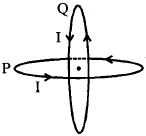
Two identical circular wires P and Q each of radius R and carrying current 'I' are kept in perpendicular planes such that they have a common centre as shown in the figure. Find the magnitude and direction of the net magnetic field at the common centre of the two coils.

The temperatures of the junctions of a bismuth-silver thermocouple are maintained at 0°C and 0.001°C. Find the thermo-emf (Seebeck emf) developed. For bismuth-silver, a = -46 × 10-6V°C-1 and b = -0.48 × 10⁻⁶V°C-2.
The two rails of a railway track, insulated from each other and from the ground, are connected to a millivoltmeter. What will be the reading of the millivoltmeter when a train travels on the track at a speed of 180km/h-1? The vertical component of earth's magnetic field is 0.2 × 10⁻⁴ T and the rails are separated by 1m.
Find the dimensions of:
  1. Electric dipole moment p.
  2. Magnetic dipole moment M.
The defining equations are p = q.d and M = IA, where d is distance, A is area, q is charge and I is current.
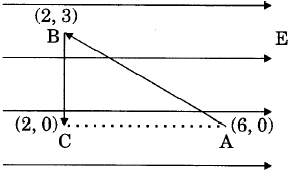
A test charge 'q' is moved without acceleration from A to C along the path from A to B and then from B to C in electric field E as shown in the figure. (i) Calculate the potential difference between A and C. (ii) At which point (of the two) is the electric potentialmore and why?