Question
Write all the unit vectors in $XY-$plane.

Answer

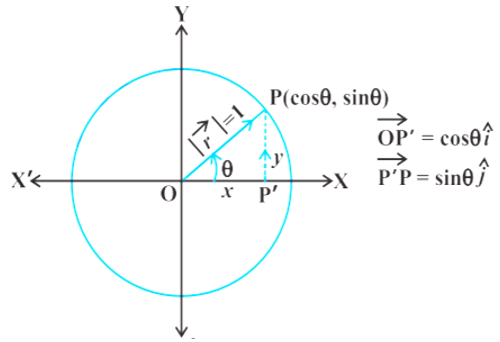
Let $\vec{r}=x \hat{i}+y \hat{j}$ be a unit vector in $XY-$plane.
Then, from the figure below, we have $x = \cos \theta$ and $y = \sin \theta ($since $|\vec r| = 1).$
So, we may write the vector $\vec r$ as
$\vec{r}(=\vec{\mathrm{OP}})=\cos \theta ~ \hat{i}+\sin \theta ~\hat{j} .........(i)$
Clearly, $|\vec{r}|=\sqrt{\cos ^{2} \theta+\sin ^{2} \theta}=1$ 
 
Also, as $\theta$ varies from $0 ~to ~2\pi$,
the point $P$ traces the circle $x^2 + y^2 = 1$ counterclockwise, and this covers all possible directions.
i,e $\vec{r}=\cos \theta \hat{i}+\sin \theta \hat{j} ; \theta \in(0,2 \pi)$, represents all the unit vectors in a plane.

Need a full question paper?

Generate a complete, print-ready paper with questions like this in minutes — across 16+ boards, with answer keys.
Start Generating Free

Similar questions

Evaluate the following integrals as limit of sum:
$\int\limits^{2}_{0}\big(\text{x}^2+2\text{x}+1\big)\text{dx}$
Evaluate: $\int(\text{x} - 3 )\sqrt{\text{x}^{2} + 3 \text{x}- 18 }\text{ dx}.$
Prove that the volume of the largest cone that can be inscribed in a sphere of radius $R$ is $\frac{8}{27}$ of the volume of the sphere
For what value of x the matrix A is singular?
$\text{A}=\begin{vmatrix}1+\text{x}&7\\3-\text{x}&8 \end{vmatrix}$
Without expanding, show that the values of the following determinant are zero: $\begin{vmatrix}\text{a}+\text{b}&2\text{a}+\text{b}&3\text{a}+\text{b}\\2\text{a}+\text{b}&3\text{a}+\text{b}&4\text{a}+\text{b}\\4\text{a}+\text{b}&5\text{a}+\text{b}&6\text{a}+\text{b} \end{vmatrix}$
Using properties of determinants, prove that
$\begin{vmatrix} \text{b + c } & \text{c + a} & \text{a + b} \\ \text{q } + \text{r} & \text{r + p} & \text{p + q} \\ \text{y + z} & \text{z + x} &\text{x + y} \end{vmatrix}= \text{2}\begin{vmatrix} \text{a } & \text{b} & \text{c} \\ \text{p} & \text{q} & \text{r} \\ \text{x} & \text{y} &\text{z} \end{vmatrix}$
If $\text{y}=\log\sqrt{\text{x}+1}+\sqrt{\text{x}-1},$ show that $\sqrt{\text{x}^2-1}\frac{\text{dy}}{\text{dx}}=\frac{1}{2}\text{y}.$
Differentiate the following functions with respect to x:
$\cos^{-1}\Big(\frac{\text{x}+\sqrt{1-\text{x}^2}}{\sqrt{2}}\Big),-1<\text{x}<1$
If $\sqrt{1-\text{x}^2}+\sqrt{1-\text{y}^2}=\text{a}(\text{x}-\text{y}),$ prove that $\frac{\text{dy}}{\text{dx}}=\sqrt{\frac{1-\text{y}^2}{1-\text{x}^2}}.$
Find the equation of the plane passing through (a, b, c) and parallel to the plane $\vec{\text{r}}\cdot(\hat{\text{i}}+\hat{\text{j}}+\hat{\text{k}})=2.$