Question
Write an account on modes of respiration in animals with examples.

Answer

Different modes of respiration in animals are given in the table below:
Respiratory Organ
Mode of Respiration
Examples
Body surface
Body surface respiration
Sponges and coelenterate
Gills
Branchial respiration
Fishes
Book gills
Book gill respiration
Limulus (king crab)
Skin
Cutaneous respiration
Annelids and amphibians
Trachea
Tracheal respiration
Insects
Lungs
Pulmonary respiration
Most of the tetrapods
Book lungs
Book lungs respiration
Arachnids (spiders and scorpion)
 

Need a full question paper?

Generate a complete, print-ready paper with questions like this in minutes — across 16+ boards, with answer keys.
Start Generating Free

Similar questions

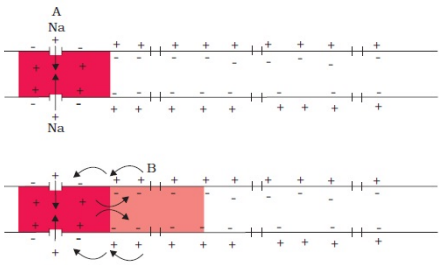
Examine the following diagram and answer the following questions:

Image
i. What is the diagram representing?
ii. When point A becomes permeable to Na¹, what change occurs in the polarity of the membrane.
iii. What is the potential difference at point A called ?
What is periderm? How does periderm formation take place in the dicot stems?
What is erythropoiesis? Write the functions of erythrocytes and thrombocytes.
Suppose there were plants that had a high concentration of Chlorophyll b, but lacked chlorophyll a, would it carry out photosynthesis? Then why do plants have chlorophyll b and other accessory pigments?
Is it correct to say that photosynthesis occurs only in leaves of a plant? Besides leaves, what are the other parts that may be capable of carrying out photosynthesis? Justify.
Neurospora- an ascomycetes fungus has been used as a biological tool to understand the mechanism of plant genetics much in the same way as Drosophila has been used to study animal genetics. What makes Neurospora so important as a genetic tool?
Cyclic photophosphorylation results in the production of ATPs and not NADPH. Give reasons.
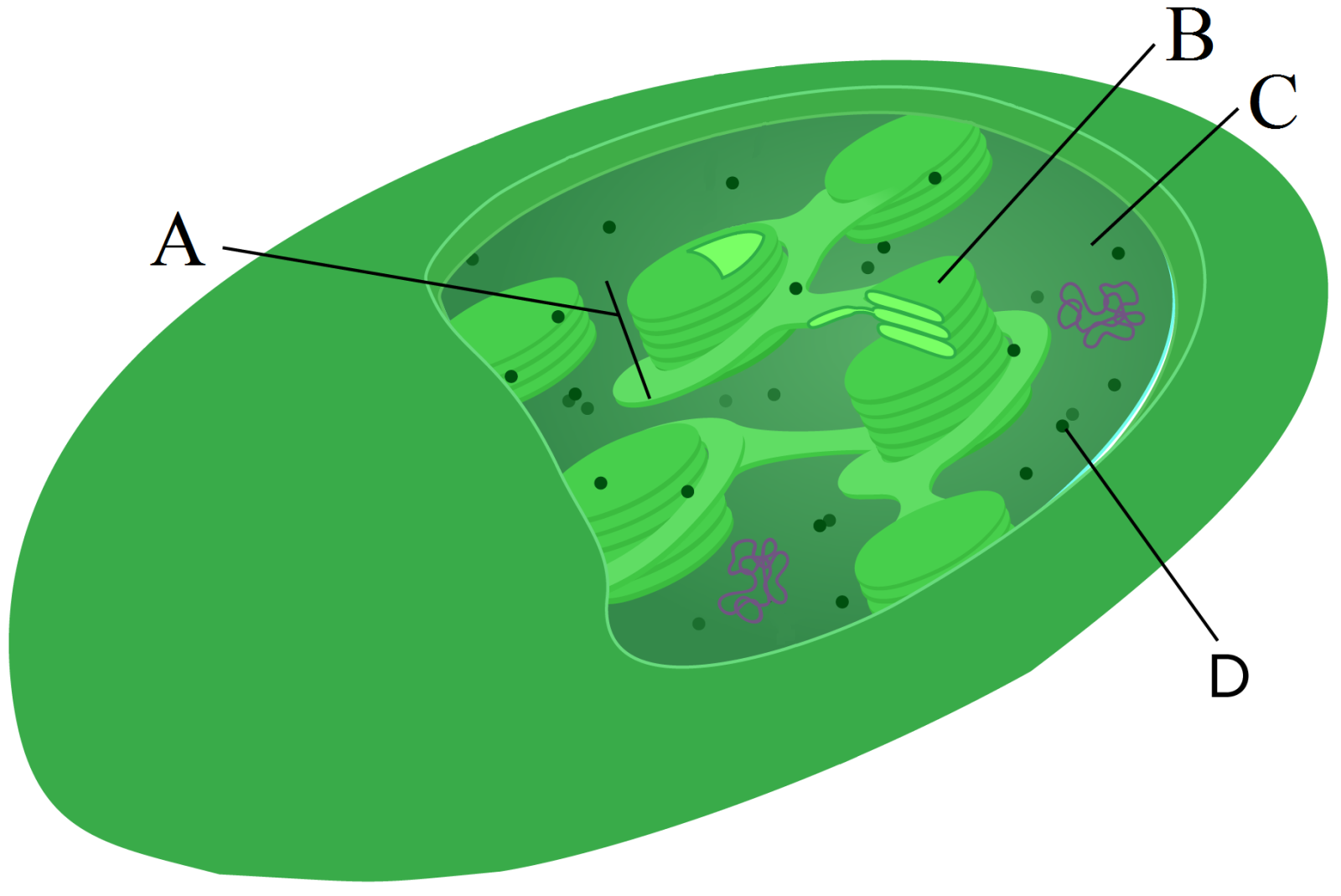
Fill in the blanks at (A), (B), (C) and (D) as shown in diagram. Name the chemical present in its (D) part which is also present in mitochondria.
Explain classification of enzymes.
There is a myth that immediately after heavy rains in forest, mushrooms appear in large number and make a very large ring or circle, which may be several metres in diameter. These are called as ‘Fairy rings’. Can you explain this myth of fairy rings in biological terms?