Question
Write an A.P. whose first term is a and common difference is d in each of the following.
$a = – 1.25, d = 3$

Answer

$a = – 1.25, d = 3$
Let $a_1 = a = – 1.25$
Since, the common difference $d = 3$
Using formula $a_{n + 1} = a_n + d$
Thus, $a_2 = a_1 + d = – 1.25 + 3 = 1.75$
$a_{3 =} a_2 + d = 1.75 + 3 = 4.75$
$a_4 = a_3 + d = 4.75 + 3 = 7.7$5
Hence, An A.P with common difference $3$ is $– 1.25, 1.75, 4.75, 7.75$

Need a full question paper?

Generate a complete, print-ready paper with questions like this in minutes — across 16+ boards, with answer keys.
Start Generating Free

Similar questions

Write the quadratic equations in $a x^2+b x+c=0$ form and find the values of a, b, c.
$x-\frac{6}{x}=5$
The radii of internal and external surfaces of a hollow spherical shell are $3\ cm$ and $5\ cm$, respectively. It is melted and recast into a solid cylinder of diameter $14\ cm$. Find the height of the cylinder.
Show that the point (0, 9) is equidistant from the point (-4, 1) and (4, 1)
Without actually performing the long division, state whether state whether the following rational numbers will have a terminating decimal expansion or a non terminating repeating decimal expansion.
$\frac{35}{50}$
solve :$3 x-y=2 ; 5 x-2 y=1$
Write sample space ‘S’ and number of sample point n(S) for each of the following experiments. Also write events A, B, C in the set form and write n(A), n(B), n(C).
Two digit numbers are formed using digits 0, 1, 2, 3, 4, 5 without repetition of the digits.
Condition for event A : The number formed is even
Condition for event B : The number formed is divisible by 3.
Condition for event C : The number formed is greater than 50.

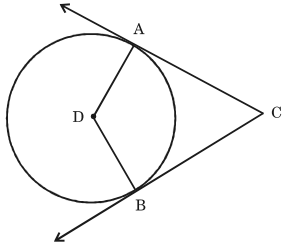
In the following figure, circle with centre D touches the sides of $\angle ACB$ at A and B. If $\angle ACB=52^{\circ}$, find measure of $\angle ADB$.
Image
What is the area of a square inscribed in a circle of diameter $p\ cm$?
Show that the line joining the points A(4, 8) and B(5, 5) is parallel to the linejoining the points C(2,4) and D(1,7).
Which of the following are quadratic equations?
$16x^2 - 3 = (2x + 5)(5x - 3)$