Question
Write and explain Ampere's circuital law.

Answer

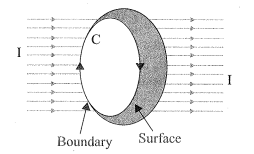
As shown in the figure, Ampere's circuital law considers an open (free) surface with a boundary line.
Image
An electric current is passing through this open surface.
Consider the surface boundary divided into small elements of length dl . At this element, the tangential component of the magnetic field is $B _t$ $(= B \cos \theta)$
The integral of the product of the length element (dl) and the tangential component of the magnetic field is equal to $\mu_0$ times the total current passing through the surface.
$\begin{aligned}
& \oint B _t d l=\mu_0 I \\
\therefore \quad & \oint( B \cos \theta) d l=\mu_0 I \\
\therefore \quad & \oint \overrightarrow{ B } \cdot d \vec{l}=\mu_0 I
\end{aligned}$
Here, the integral is taken over the closed loop coinciding with the boundary C of the surface.
Here, the right hand thumb rule is used for sign - convention of electric currents enclosed by a closed loop.
Fingers of the right hand be curled in the sense the boundary is traversed in the loop then the direction of the thumb gives the sense in which the current is considered as positive and current in the opposite direction is considered negative.
To simplify Ampere's circuital law, the loop is assumed, which is called an amperian loop.
The loop is chosen in such a way that for each point of it, either
(i) $\vec{B}$ is tangential to the loop and B is a nonzero constant.
(ii) $\vec{B}$ is perpendicular (or normal) to the loop
(iii) $\overrightarrow{ B }$ is eliminated (or vanishes)
Now, suppose $L$ is the length of the loop for which $\vec{B}$ is tangential and the current enclosed
by the loop is $I _e$ then equation (1) becomes.
$BL =\mu_0 I _e$
This equation is a special representation of Ampere's circuital law.

Need a full question paper?

Generate a complete, print-ready paper with questions like this in minutes — across 16+ boards, with answer keys.
Start Generating Free

Similar questions

On a cold winter night you are asked to sit on a chair. Would you like to choose a metal chair or a wooden chair? Both are kept in the same lawn and are at the same temperature.
The objective of a telescope is large and the eyepiece is small, whereas the objective of a microscope is small and the eyepiece is large. If a telescope is turned upside down, can it be used like a microscope? Can a microscope be used like a telescope in the same way?
The torque of a force $\overrightarrow{\text{F}}$ about a point is defined as $\overrightarrow{\text{r}}=\overrightarrow{\text{r}}\times\overrightarrow{\text{F}}.$ Suppose $\overrightarrow{\text{r}}, \overrightarrow{\text{F}}$and $\overrightarrow{\text{r}}$ are all nonzero. Is $\text{r}\times\overrightarrow{\text{r}}\Bigg|\Bigg|\overrightarrow{\text{F}}$ always true? Is it ever true?
Explain the physical effect of displacement current.
Is work-energy theorem valid in non-inertial frames?
Suppose, we think of fission of a $^{56}_{26}\text{Fe}$ nucleus into two equal fragments, $^{28}_{13}\text{Al}.$ Is the fission energetically possible? Argue by working out Q of the process. Given $\text{m}(^{56}_{26}\text{Fe})=55.93494\text{ u and m }(^{28}_{13}\text{Al})=27.98191\text{ u}.$
A plate of thickness t made of a material of refractive index $\mu$ is placed in front of one of the slits in a double slit experiment.
  1. Find the change in the optical path due to introduction of the plate.
  2. What should be the minimum thickness t which will make the intensity at the centre of the fringe pattern zero? Wavelength of the light used is $\lambda$. Neglect any absorption of light in the plate.
An electric bulb marked 220V, 100W will get fused if it is made to consume 150W or more. What voltage fluctuation will the bulb withstand?
The potential difference across the terminals of a battery of emf 12V and internal resistance $2\Omega$ drops to 10V when it is connected to a silver voltameter. Find the silver deposited at the cathode in half an hour. Atomic weight of silver is 107.9g/mole.
Derive $D_m=A\left(n_{21}-1\right)$ for thin lens.