Question
Write and explain the sequence of steps in processing of wool.

Answer

Following are the steps involved in processing of wool:
  1. Shearing, scouring, Sorting, fiber spinning, fiber dying, rolling into Silk yarn.Rearing is raising livestock like goat, cows, sheep etc. for commercial purpose by taking them out in herds for grazing , feeding them on a mixture of pulses, corn, jowar, oil cakes (material left after taking out oil from seeds) and minerals for better growth and yield of produce like meat, milk, wool. Beside this in extreme climatic condition like winter these are also provided shelter and fed on leaves, grain and dry fodder.
  2. Shearing is the process in which fleece of the sheep along with a thin layer of skin is removed from its body. Machines similar to those used by barbers are used to shave off hair. Generally, the hair is removed during the hot weather which enables the sheep to survive without their protective coat of hair. The hair provides woollen fibres. Woollen fibres are then processed to obtain woollen yarn. Shearing does not hurt the sheep as the uppermost layer of the skin is dead.
  3. Sericulture is the rearing, breeding and management of silkworms for the production of raw silk. For obtaining silk, silk worm moths are reared and their cocoons are collected to get silk threads. Silk yarns come from the cocoon of the silkworm. The caterpillar hatches from a very small egg and is an eating machine. Their diet of continually eating mulberry leaves results in a semi-liquid protein called fibroin. When the silkworms start its spinning process in the cocoon, the worm's head is coated with a gummy protein called sericin. The silkworm rotates its body thousands of times extruding one continuous strand of silk the length of 12 football fields. The silk adheres to itself, forming the cocoon.

Need a full question paper?

Generate a complete, print-ready paper with questions like this in minutes — across 16+ boards, with answer keys.

Start Generating Free

Similar questions

The distances travelled by a car at various time intervals are given as follow
Distance (m)0510152025
Time (s)0246810
(a) Draw the distance-time graph for the car.
(b) What conclusion do you get from this graph about the nature of motion of the car?
Discuss the importance of hollow bricks used in construction of outer walls of houses in temperature control.
In the figure of a flower given in Figure, label the parts whose functions are given below and give their names.
  1. The part which contains pollen grains.
  2. The part where the female gamete is formed.
  3. The female reproductive part where pollen grains germinate.
  4. The colourful part of flower which attracts insects.
Draw a labelled diagram of human digestive system.
What are the safety precautions while working with electricity?
Draw in your notebook the symbols to represent the following components of electrical circuits: connecting wires, switch in the ‘OFF’ position, bulb, cell, switch in the ‘ON’ position, and battery
What is regular and irregular reflection?
What are permanent tissues? Describe the different types of simple permanent tissues.
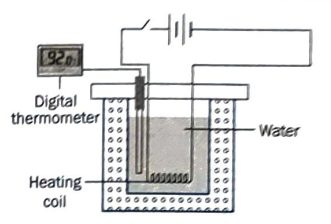
A student performs an experiment where he uses a heating coil to heat the water as shown in the figure. The initial temperature of the water is measured as $10^{\circ} C$. After switching it ON for 5 min, the student records the temperature of the water as $18^{\circ} C$.
Image

The water is allowed to return back to its initial temperature. The activity is then repeated with another heating coil having half the length of the original heating coil. He notices that after 5 min, the temperature of the water reads $14^{\circ} C$. Which statement can be concluded based on the activity?
(a) Reading on thermometer reduces with time.
(b) Temperature of water drops with every repetition.
(c) Length of the material affects the amount of heating.
(d) Temperature of the water increases after a certain period of time.
Take three test-tubes. Fill $\frac{3}{4}\text{th}$ of each with water. Label them $A, B$ and $C$. Keep a snail in test-tube A, a water plant in test-tube $B$ and in $C$, keep snail and plant both. Which test-tube would have the highest concentration of $\mathrm{CO}_2$?