Question
Write Bohr's postulates of hydrogen atom.

Answer

Bohr's Postulates : (i) An atom consists of a very tiny positively charged nucleus. Nearly the entire mass of the atom is concentrated in the nucleus.
(ii) The electrons in an atom revolve around the nucleus in certain permitted circular orbits. The electrostatic force of attraction between the electron and the nucleus provides the necessary centripetal force.
(iii) An electron can revolve only in those orbits for which its orbital angular momentum is an integral multiple of $\frac{h}{2 \pi}$. Here, h is a universal constant known as Planck's constant $=6.63 \times 10^{-34} Js$
If $r$ is the radius of a permitted orbit, $m$ is the mass of the electron and $v$ is the velocity of the electron in that orbit, then
$m v r=n\left(\frac{h}{2 \pi}\right)$
where $n$ is an integer known as principle quantum number and has integral values 1, 2, 3, ...This relation is regarded as a quantisation condition for the angu-lar momentum of the electron
(iv) An electron revolving in a permitted orbit does not radiate energy though it is accelerating. So, the total energy of the electron remains constant. The permitted orbits are called stationary or non-radiating orbits. By introducing the concept of stationery orbit, Bohr could explain the stability of the atomic structure.
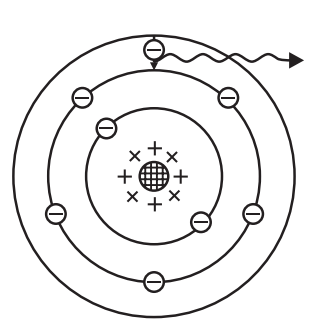
(v) When an electron jumps from higher orbit to lower orbit, electromagnetic radiation is emitted.
Image
On the other hand, there is absorption of energy when an electron jumps from lower orbit to higher orbit. Consider two orbits of principle quantum numbers n1 and n2 Let En1 and En2 be the energies associated with respective orbits. The frequency of the emitted radiation is given by
$h \nu= E _{n_2}- E _{n_1}$
$\Rightarrow \quad v=\left(\frac{E_{n_2}-E_{n_1}}{h}\right)$
It is obvious that emission of energy from a atom takes place only when an electron jumps from higher energy level to any lower level. Hence in the energy emitted by an atom has only some definite frequency waves. If the spectrum of this energy it taken it is obtained as a line spectrum, in which there are many sharp lines.

Need a full question paper?

Generate a complete, print-ready paper with questions like this in minutes — across 16+ boards, with answer keys.
Start Generating Free

Similar questions

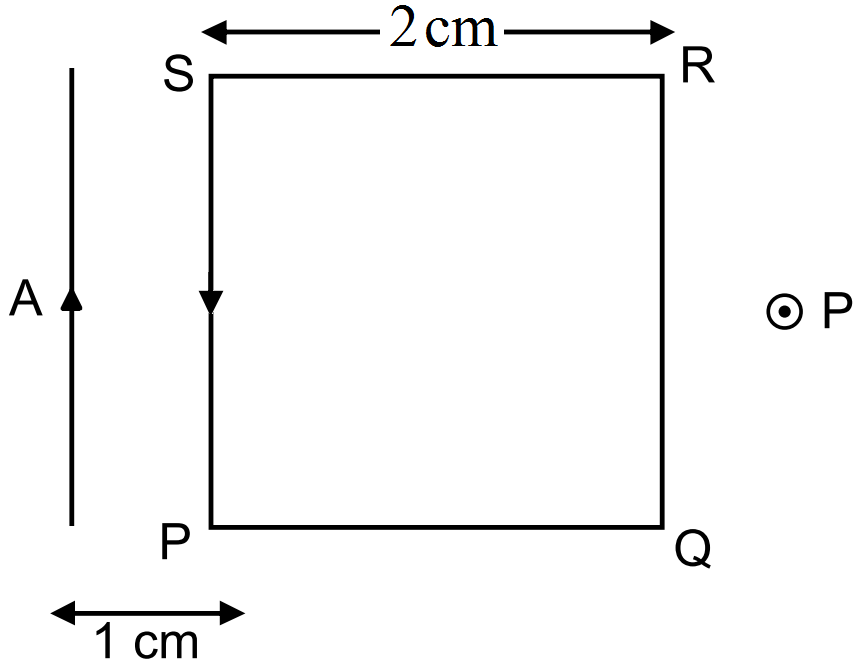
A square loop PQRS carrying a current of 6.0A is placed near a long wire carrying 10A as shown in figure.

  1. Show that the magnetic force acting on the part PQ is equal and opposite to that on the part RS. 
  2. Find the magnetic force on the square loop.

A horizontal cesium plate ($\phi$ = 1.9eV) is moved vertically downward at a constant speed u in a room full of radiation of wavelength 250 run and above. What should be the minimum value of u so that the vertically upward component of velocity is nonpositive for each photoelectron?
Write the upper and lower limits of interference in terms of path difference.
Explain the vector form of Coulomb's law and write its important facts.
Answer the following question:
If the earth did not have an atmosphere, would its average surface temperature be higher or lower than what it is now?
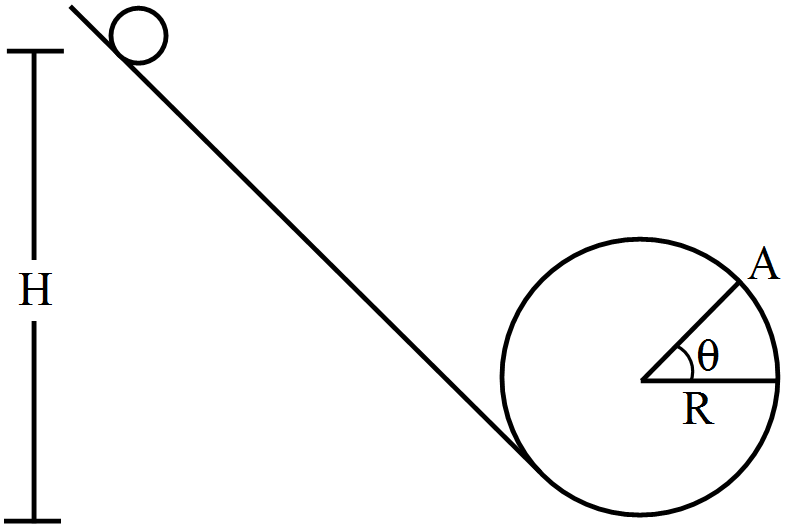
Figure shows a small spherical ball of mass m rolling down the loop track. The ball is released on the linear portion at a vertical height H from the lowest point. The circular part shown has a radius R.
  1. Find the kinetic energy of the ball when it is at a point A where the radius makes an angle $\theta$ with the horizontal.
  2. Find the radial and the tangential accelerations of the centre when the ball is at A.
  3. Find the normal force and the frictional force acting on the ball if H = 60cm, R = 10cm, $\theta=0 $ and m = 70g.

Two identical balls, each having a charge of 2.00 × 10-7C and a mass of 100g, are suspended from a common point by two insulating strings each 50cm long. The balls are held at a separation 5.0cm apart and then released. Find,
  1. The electric force on one of the charged balls.
  2. The components of the resultant force on it along and perpendicular to the string.
  3. The tension in the string.
  4. The acceleration of one of the balls. Answers are to be obtained only for the instant just after the release.
Consider a circular ring of radius r, uniformly charged with linear charge density $\lambda.$ Find the electric potential at a point on the axis at a distance x from the centre of the ring. Using this expression for the potential, find the electric field at this point.
A wave travelling on a string, at a speed of 10m/s causes each particle of the string to oscillate with a time period of 20ms.
  1. What is the wavelength of the wave?
  2. If the displacement of a particle is 1.5mm at a certain instant, what will be the displacement of a particle 10cm away from it at the same instant?
A piano wire A vibrates at a fundamental frequency of 600Hz. A second identical wire B produces 6 beats per second with it when the tension in A is slightly increased. Find the ratio of the tension in A to the tension in B.