Question
Write characteristics of different components of electromagnetic waves and describe them.
Answer

SELF

Need a full question paper?

Generate a complete, print-ready paper with questions like this in minutes — across 16+ boards, with answer keys.

Start Generating Free

Similar questions

A wave propagates on a string in the positive $x-$direction at a velocity v. The shape of the string at $t =$ to is given by $\text{g}(\text{x},\text{t}_0)=\text{A}\sin\big(\frac{\text{x}}{\text{a}}\big).$ Write the wave equation for a general time t.
Suppose the second charge in the previous problem is $-1.0 \times 10^{-6}C.$ Locate the position where a third charge will not experience a net force.
Write the definition of electric flux.Obtain the expression for the electric field intensity at any point due to a uniformly charged straight wire of infinite extension using Gauss'law. Draw the necessary diagram.
  1. With the help of a labelled diagram, explain the working of a step $-$ up transformer. Give reasons to explain the following:
  1. Find:
  2. External force required to move the rod with uniform velocity $v = 10\ cm/ s,$
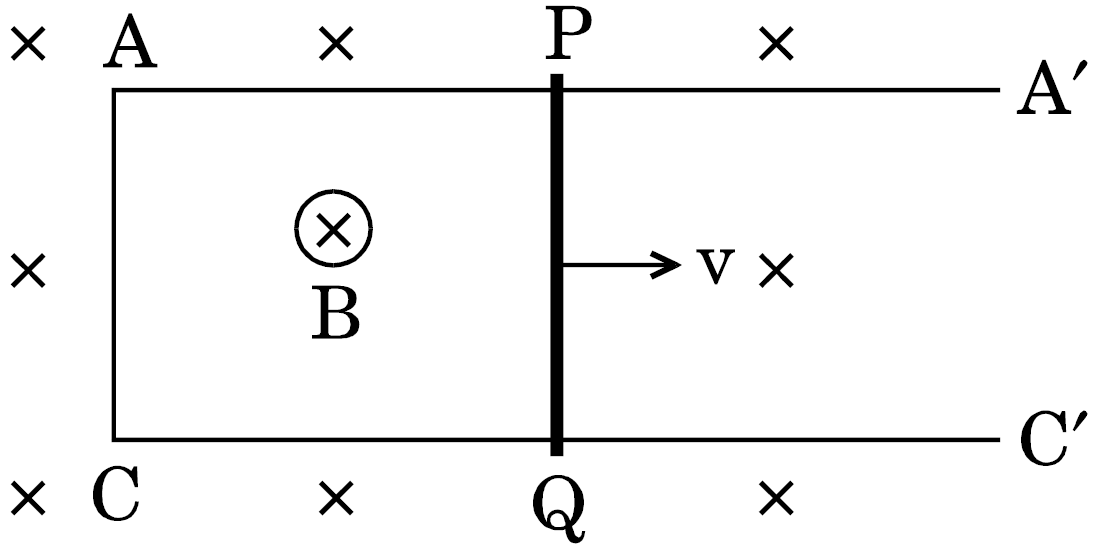
  3. A conducting rod $PQ$ of length $20\ cm$ and resistance $0.1\Omega$ rests on two smooth parallel rails of negligible resistance $AA\ '$ and $CC\ '.$ It can slide on the rails and the arrangement is positioned between the poles of a permanent magnet producing uniform magnetic field $B = 0.4T$. The rails, the rod and the magnetic field are in three mutually perpendicular directions as shown in the figure. If the ends $A$ and $C$ of the rails are short circuited,
  4. The core of the transformer is laminated.
  5. Thick copper wire is used in windings.
  6. Power required to do so.
Explain end-on position and broad side-on position of a bar magnet.
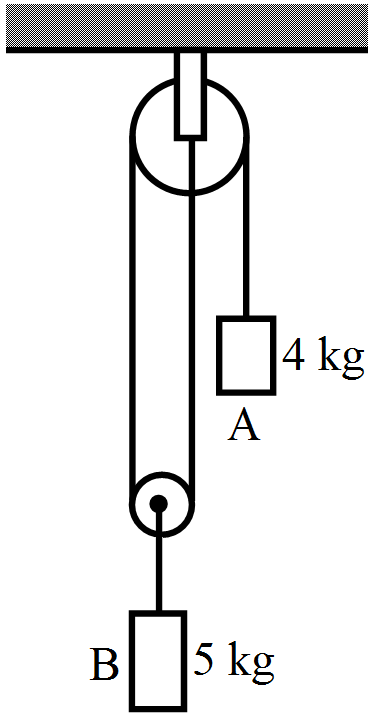
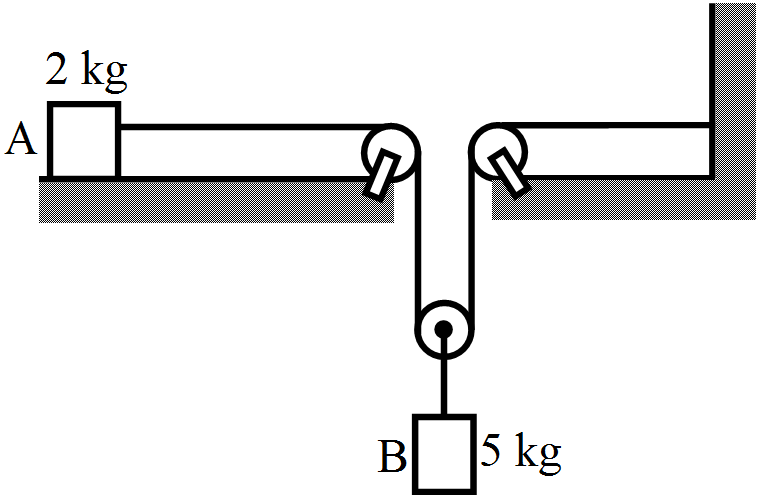
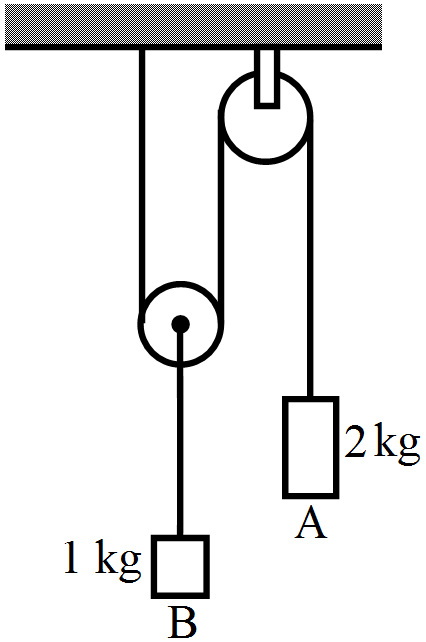
Find the acceleration of the blocks A and B in the three situations shown in figure.


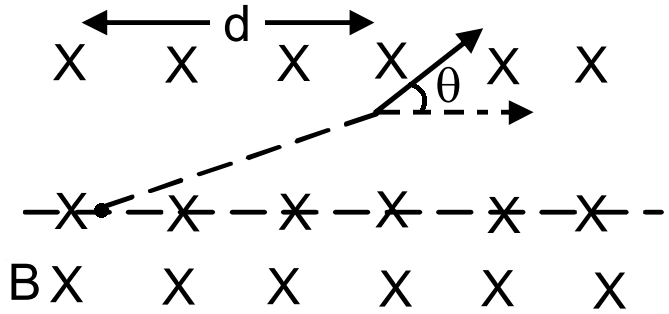
A particle of mass $m$ and charge $q$ is projected into a region that has a perpendicular magnetic field $B$. Find the angle of deviation of the particle as it comes out of the magnetic field if the width $d$ of the region is very slightly smaller than
  1. $\frac{\text{mv}}{\text{qB}}$
  2. $\frac{\text{mv}}{2\text{qB}}$
  3. $\frac{2\text{mv}}{\text{qB}}.$
The current in a conductor and the potential difference across its ends are measured by an ammeter and a voltmeter. The meters draw negligible currents. The ammeter is accurate but the voltmeter has a zero error (that is, it does not read zero when no potential difference is applied). Calculate the zero error if the readings for two different conditions are 1.75A, 14.4V and 2.75A, 22.4V.
A rectangular loop of sides $20\ cm$ and $10\ cm$ carries a current of $5.0A.$ A uniform magnetic field of magnitude $0.20T$ exists parallel to the longer side of the loop.
  1. What is the force acting on the loop?
  2. What is the torque acting on the loop?
The plates of a capacitor of capacitance $10\mu\text{F},$ charged to $60\mu\text{C},$ are joined together by a wire of resistance $10\Omega$ at t = 0. Find the charge on the capacitor in the circuit at (a) t = 0 (b) $\text{t}=30\mu\text{s}$ (c) $\text{t}=120\mu\text{s}$ and (d) t = 1.0ms.