Question
Write conclusion of Oersted's experiment.

Answer

A current carrying conductor produces magnetic field around it whose magnitude and direction depends on the magnitude and direction of current flowing in the conductor.

Need a full question paper?

Generate a complete, print-ready paper with questions like this in minutes — across 16+ boards, with answer keys.
Start Generating Free

Similar questions

Power $P$ is to be delivered to a device via transmission cables having resistance $R_C.$ If $V$ is the voltage across $R$ and $I$ the current through it, find the power wasted and how can it be reduced.
Explain the refraction of light from a denser medium to a rarer medium, using Huygen's principle.
Two trains are travelling towards each other both at a speed of $90\ km/h.$ If one of the trains sounds a whistle at $500\ Hz,$ what will be the apparent frequency heard in the other train? Speed of sound in air $= 350\ m/s.$
What is Rectifier?
Two bar magnets are placed close to each other with their opposite poles facing each other. In absence of other force the magnets are pulled towards each other and their kinetic energy increases. Does it contradict our earher knowledge that magnetic forces cannot do any work and hence cannot increase kinetic energy of a system?
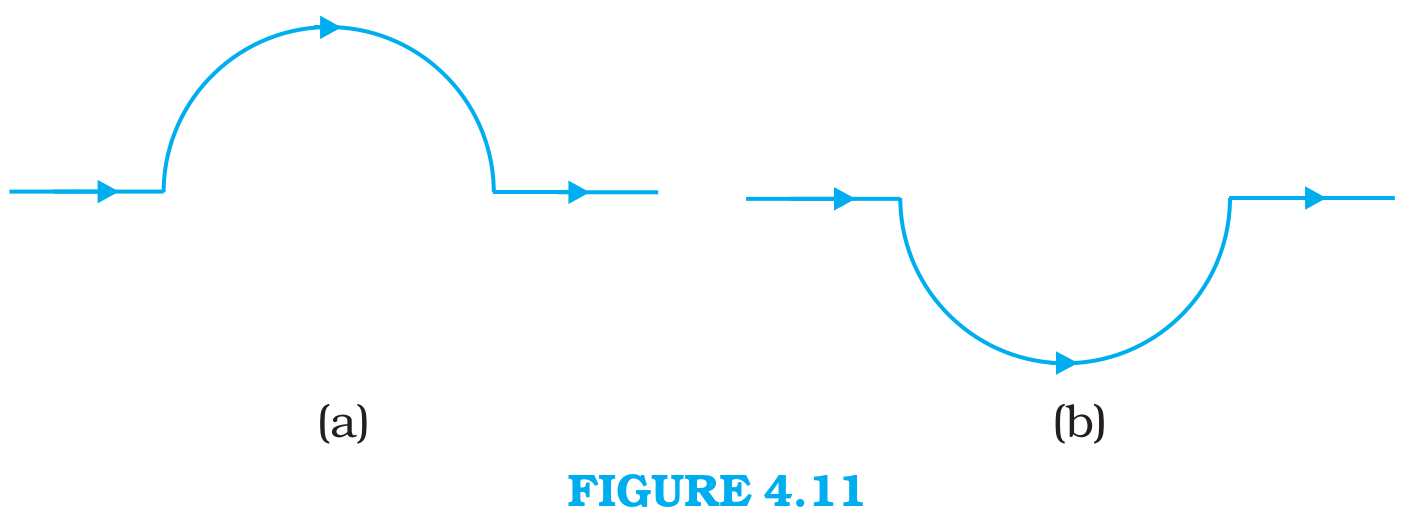
A straight wire carrying a current of $12 A$ is bent into a semi-circular arc of radius $2.0 cm$ as shown in Fig. 4.11 (a). Consider the magnetic field $B$ at the centre of the arc. (a) What is the magnetic field due to the straight segments? (b) In what way the contribution to $B$ from the semicircle differs from that of a circular loop and in what way does it resemble? (c) Would your answer be different if the wire were bent into a semi-circular arc of the same radius but in the opposite way as shown in Fig. 4.11(b)?
Image
A 100Ω resistor is connected to a 220V, 50Hz ac supply.
  1. What is the rms value of current in the circuit?
  2. What is the net power consumed over a full cycle?
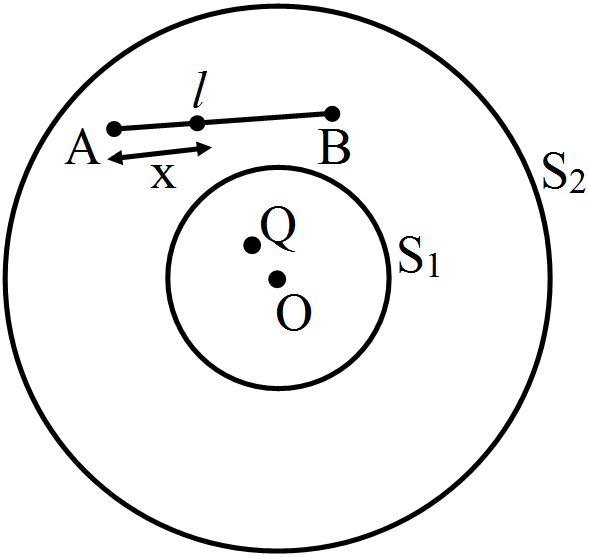
In the figure shown, calculate the total flux of the electrostatic field through the spheres $S_1$ and $S_2.$ The wire $AB$ shown here has a linear charge density $\lambda$ given by $\lambda=\text{kx}$ where $x$ is distance measured along the wire, from the end $A.$
State factors on which the resistance of a conductor depends.
Can the dispersive power $\omega=\frac{\mu_\text{v}-\mu\text{r}}{\mu-1}$ be negative? What is the sign of co if a hollow prism is immersed into water?