Question
Write differences between Heterochromatin and Euchromatin.

Answer

S.No.HeterochromatinEuchromatin
1.The replication of their DNA may be delayed during interphase.The DNA found in these gets replicated first.
2.These are deeply stained.These are lightly stained.
3.They are genetically inactive.These are genetically active.
4.These are more condensed and coiled.These are less condensed and coiled.
5.pH, temperature, hormones, poisons etc. have little effect on it.It has a special effect on pH, temperature, hormones, poisons etc.
6.It is of condensed nature.Whereas it is of diffused nature.
7.It is granular in nature and has a thickness of 250 A or more.It is a narrow fibrous material of 30-80 Å thickness.
8.It presence inhibits crossing over.This shows normal crossing over.

Need a full question paper?

Generate a complete, print-ready paper with questions like this in minutes — across 16+ boards, with answer keys.
Start Generating Free

Similar questions

What is the scientific name of frog? Describe its external morphology by drawing a picture.
Differentiate between the striated, non-striated and cardiac muscles.
Correct the statement given below by choosing the right option shown in the bracket against them.
  1. Absorption of amino acids and glycerol takes place in the (small intestine/ large intestine).
  2. The faeces in the rectum initiate a reflex causing an urge for its removal (neural/ hormonal).
  3. Skin and eyes turn yellow in infection (liver/ stomach).
  4. Rennin is a proteolytic enzyme found in gastric juice in (infants/ adults).
  5. Pancreatic juice and bile are released through (intestine pancreatic/ hepato-pancreatic duct)
Formation of enzyme-substrate complex (ES) is the first step in catalysed reactions. Describe the other steps till the formation of product.
In which segment does the following structures lies in the earthworm's body?
  1. Spermathecae.
  2. Pharynx.
  3. Gizzard.
  4. Intestine.
  5. Septal nephridia.
  6. Ovary.
  7. Testes.
  8. Typhlosole.
  9. Lateral heart.
  10. Pharyngeal nephridia.
Describe the structure of mitochondria by making a labelled diagram of its longitudinal section and write its four functions.
Write short note on retina.
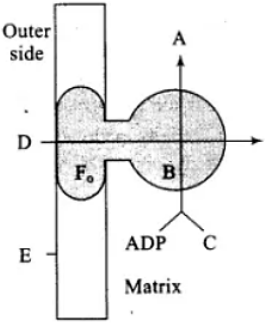
Given below is a diagram showing ATP synthesis during aerobic respiration, replace the symbols A, B, C, D and E by appropriate terms given in the box.

Image
F1, Particle, Pi, 2H+, Inner mitochondrial membrane, ATP, Fo particle, ADP
Give comparative depscription in detail about striated, unstriated and cardiac muscles.
Describe the hormones of the heart, kidney, and gastrointestinal tract.