Question
Write down four general characters of phylum Echinodermata. Give two examples.

Answer

  1. Simple animals may be a star like, spherical or elongated.
  2. Body is triploblastic, coelomate, unsegmented and radially symmetrical.
  3. Body lacks head but has oral and aboral surfaces. Oral surface of the body has five radial areas called ambulacra.
  4. Body wall is covered with spiny hard calcareous (calcium carbonate) plates (ossicles) that forms a rigid or flexible endoskeleton.
Example: Echinus (sea urchin) and Asterias (star fish).

Need a full question paper?

Generate a complete, print-ready paper with questions like this in minutes — across 16+ boards, with answer keys.
Start Generating Free

Similar questions

Describe an experiment to show that sound cannot pass through vacuum.
Write down four characteristics of Ctenophora and give two examples.
Describe the structure of a nerve cell.
How will you separate a mixture containing kerosene and petrol (difference in their boiling points is more than $25^\circ\ C$), which are miscible with each other?
Distinguish between Nonchordata and Chordata.
An element $X$ forms the following compounds with hydrogen, carbon and oxygen:
$H_2X, CX_2, XO_2, XO_3$
When a beam of sunlight enters a room through a window, we can see tiny particles $X$ suspended in a gas (or rather a mixture of gases) $Y$ which are moving rapidly in a very haphazard manner.
  1. What could particles $X$ be?
  2. Name the gas (or mixture of gases) $Y$.
  3. What is the phenomenon exhibited by particles $X$ known as?
  4. What is causing the movement of particles $X$?
  5. What conclusion does the existence of this phenomenon give us about the nature of matter?
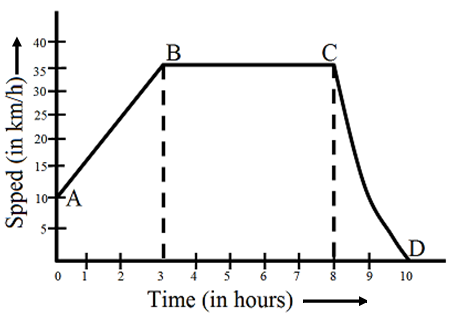
The graph given alongside shows how the speed of a car changes with time:
  1. What is the initial speed of the car?
  2. What is the maximum speed attained by the car?
  3. Which part of the graph shows zero acceleration
  4. Which part of the graph shows varying retardation?
  5. Find the distance travelled in first $8$ hours.
A ball of mass $200\ g$ falls from a height of $5$ metres. What is its kinetic energy when it just reaches the ground? $(8 = 9.8m/s).$
Compute the difference in masses of $10^3$ moles each of magnesium atoms and magnesium ions. (Mass of an electron $=9.1 \times 10^{-}$ ${ }^{31} kg$ )