Question
Write down the difference between forward bias and reverse bias of $p-n$ junction diode.

Answer

Forward BiasReverse Bias
$p$ - type semiconductor of $p-n$ junction is connected to positive terminal and $n$ - type is connected with negative terminal of battery. Such a biasing is called forward biasing.$p$ - type semiconductor of $p-n$ junction is connected to negative terminal and $n$ - type is connected with positive terminal of battery. Such a biasing is called reverse biasing.
In forward bias, the current is due to majority charge carriers.In Reverse bias, the current is due to minority charge carriers.
Current obtained in forward bias is of the order of $m A$.Current obtained in Reverse bias is of the order of $\mu A$.
When diode is connected in forward bias, width of its depletion layer and height of potential barrier reduces.When diode is connected in reverse bias, width of its depletion layer and height of potential barrier increases.
Resistance is of the order of $10 \Omega$ to $100 \Omega$.Resistance is of the order of $10 M \Omega$.

Need a full question paper?

Generate a complete, print-ready paper with questions like this in minutes — across 16+ boards, with answer keys.
Start Generating Free

Similar questions

Write the definition of electric current and ampere $(A)$ and different units of electric current.
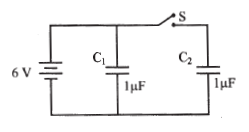
Figure shows two identical capacitors, $C_1$ and $C_2,$ each of $1 \mu F$ capacitance connected to a battery of $6 V.$ Initially switch $'S\ '$ is closed. After sometime $'S\ '$ is left open and dielectric slabs of dielectric constant $K = 3$ are inserted to fill completely the space between the plates of the two capacitors. How will the $(i)$ charge and $(ii)$ potential difference between the plates of the capacitors be affected after the slabs are inserted?
The length and the radius of a cylinder measured with a slide callipers are found to be 4.54cm and 1.75cm respectively. Calculate the volume of the cylinder.
Given a uniform electric field $\overrightarrow{\text{E}} = 2 \times 10^3\ \hat{i}\  N/C$ find the flux of this field through a square of side $20 \ cm,$ whose plane is parallel to the $y-z$ plane. What would be the flux through the same square, if the plane makes an angle of $30^{\circ}$ with the$ x-$axis?
Find the dimensions of:
  1. Electric field E,
  2. Magnetic field B and
  3. Magnetic permeability $\mu_0.$
The relevant equations are$\text{F = qE, F = qvB,}$ and $\text{B}=\frac{\mu_0\text{I}}{2\pi\alpha};$
where F is force, q is charge, v is speed, I is current, and a is distance.
Two resistances are connected in parralel in the ratio of 3: 4. Compare the results of the heat generated in them.
The peak power consumed by a resistive coil, when connected to an AC source, is 80W. Find the energy consumed by the coil in 100 seconds, which is many times larger than the time period of the source.
A convex lens of diameter 8.0cm is used to focus a parallel beam of light of wavelength 620nm. If the light be focused at a distance of 20cm from the lens, what would be the radius of the central bright spot formed?
The potential difference between cathode and target of a X-ray tube is 30 kV. Calculate (a) minimum wavelength of emitted X-rays, (b) momentum of X-ray photon.
$50m^3$ of saturated vapour is cooled down from $30^\circ C$ to $20^\circ C.$ Find the mass of the water condensed. The absolute humidity of saturated water vapour is $30\ gm^{-3}$ at $30^\circ C$ and $16\ gm^{-3}$ at $20^\circ C.$