Question
Write down the difference between $SN^1$ and $SN^2$ reaction.

Answer

$SN^2$ Reaction $SN^1$ Reaction
$\rightarrow SN^2$ reaction means it is bimolecular nucleophilic substitution reaction. $\rightarrow SN^1$ reaction means it is unimolecular nucleophilic substitution reaction.
$\rightarrow$ The rate of $SN^2$ reaction depends on the concentration of Substrate and Nucleophiles both. Rate $= K [S]^1. [Nu]^1$ $\rightarrow$ The rate of $SN^1$ reaction depends on the concentration of Substrate on Rate $= K [S]^1$
$\rightarrow SN^2$ reaction follow second order kinetics. $\rightarrow SN^1$ reaction follows first order kinetics.
$\rightarrow$ The reaction of chloromethane and hydroxide ion gives methanol and chloride ion is example of $SN^2$ reaction​​​​​​​
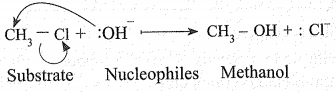
Image
$\rightarrow$ The reaction of tert $-$ butyl bromide with hydroxide ion gives tert $-$ butyl alcohol is example of $SN^1$ reaction.
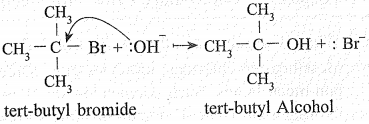
Image
$\rightarrow SN^2$ reaction complete in a single step without formation of an intermediate $\rightarrow SN^1$ reaction complete in twosteps. Step $1$ : Formation of carbocation by cleavage of $CX$ in haloalkane
Step $2$ : Attack of nucleophiles on carbocation to form product.
Image Image
$\rightarrow SN^2$ reaction shows inversion of configuration. $\rightarrow SN^1$ reaction shows reacemic mixture.

Need a full question paper?

Generate a complete, print-ready paper with questions like this in minutes — across 16+ boards, with answer keys.

Start Generating Free

Similar questions

The activation energy for the reaction,
$\ce{2 HI(g) \rightarrow H2 + I2(g)}$ is $209.5\ kJ\ mol^{–1}$ at $581K$.
Calculate the fraction of molecules of reactants having energy equal to or greater than activation energy?
A first order reaction takes 20 minutes for 25% decomposition. Calculate the time when 75% of the reaction will be completed. (Given : log 2 = 0·3010, log 3 = 0·4771, log 4 = 0·6021)
How much charge is required for the following reductions:
$i.\ 1\ mol$ of $Al ^{3+}$ to $Al$ ?
$ii.\ 1\ mol$ of $Cu ^{2+}$ to $Cu$ ?
$iii.\ 1\ mol$ of $MnO _4^{-}$ to $Mn ^{2+}$ ?
Write the structures of main products when benzene diazonium chloride reacts with the following reagents$:$
  1. $\ce{CuCN}$
  2. $\ce{CH_3CH_2OH}$
  3. $\ce{KI}$
Given that $\Lambda^{0}_{\text{m}}(\text{HCl})=426\text{ S cm}^2\text{mol}^{-1},\Lambda^{0}_{\text{m}}(\text{NaCl})\\=126\text{ S cm}^2\text{mol}^{-1}$
$\Lambda^{0}_{\text{m}}(\text{CH}_3\text{COONa})=91\text{ S cm}^2\text{mol}^{-1}$
A $5\%$ solution $($by mass$)$ of cane sugar in water has freezing point of $271K.$ Calculate the freezing point of $5\%$ glucose in water if freezing point of pure water is $273.15\ K.$
Calculate the potential of hydrogen electrode in contact with a solution whose PH is 10.
  1. Write the name of two monosaccharides obtained on hydrolysis of lactose sugar.
  2. Why Vitamin C cannot be stored in our body?
  3. What is the difference between a nucleoside and nucleotide?
How do the oxides of transition elements in lower oxidation states differ from those in higher oxidation state in the nature of metal$-$oxygen bonding and why?
Distinguish between methanoic acid and ethanoic acid?