Question
Write down the difference between vacuum tube (valve) and semiconductors.

Answer

 Vacuum tubeSemiconductor
1Devices and instruments made of vacuum tube are bulky in size.Devices/instruments made of semiconductor are comparatively small (compact) in size.
2They consume high power and operate at high voltages $(\sim 100 V$.)They consume low power and operate at low voltages.
3They have limited life and low reliability.They have long life and high reliability.
4Controlled flow of electrons is obtained by varying the voltage between its different electrodes.Controlled flow of electrons can be obtained by small applied voltage (or other simple excitations like light/ heat.)

Need a full question paper?

Generate a complete, print-ready paper with questions like this in minutes — across 16+ boards, with answer keys.
Start Generating Free

Similar questions

Answer the following question:
Ray optics is based on the assumption that light travels in a straight line. Diffraction effects (observed when light propagates through small apertures/slits or around small obstacles) disprove this assumption. Yet the ray optics assumption is so commonly used in understanding location and several other properties of images in optical instruments. What is the justification?
Give the mass number and atomic number of elements on the right hand side of the decay process.
$^{220}_{86}\text{Ru}\ \ \rightarrow\ \ \text{Po}\ \ +\ \ \text{He}$
A parallel beam of light of wavelength 500 nm falls on a narrow slit and the resulting diffraction pattern is observed on a screen 1 m away. It is observed that the first minimum is at a distance of 2.5 mm from the centre of the screen. Find the width of the slit.
A string is wrapped over the edge of a uniform disc and the free end is fixed with the ceiling. The disc moves down, unwinding the string. Find the downward acceleration of the disc.
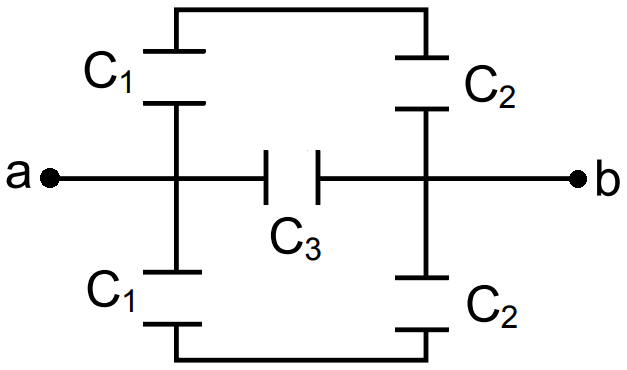
Find the equivalent capacitance of the syatem shown in figure between the points a and b.

Answer the following question:
As you have learnt in the text, the principle of linear superposition of wave displacement is basic to understanding intensity distributions in diffraction and interference patterns. What is the justification of this principle?
A metal sphere of radius 1mm and mass 50mg falls vertically in glycerine. Find:
  1. The viscous force exerted by the glycerine on the sphere when the speed of the sphere is 1cm/s.
  2. The hydrostatic force exerted by the glycerine on the sphere and.
  3. The terminal velocity with which the sphere will move down without acceleration. Density of glycerine = 1260kg/m3 and its coefficient of viscosity at room temperature = 8.0 poise.
Find the maximum kinetic energy of the photoelectrons ejected when light of wavelength 350nm is incident on a cesium surface. Work function of cesium = 1.9eV
A spherical shell is heated. The volume change according to the equation $\text{V}_\theta=\text{V}_\theta(1+\gamma\theta)$. Does the volume refer to the volume enclosed by the shell or the volume of the material making up the shell?
State the underlying principle of a cyclotron. Write briefly how this machine is used to accelerate charged particles to high energies.