Question
Write down the difference between vacuum tube (valve) and semiconductors.

Answer

 Vacuum tubeSemiconductor
1Devices and instruments made of vacuum tube are bulky in size.Devices/instruments made of semiconductor are comparatively small (compact) in size.
2They consume high power and operate at high voltages $(\sim 100 V$.)They consume low power and operate at low voltages.
3They have limited life and low reliability.They have long life and high reliability.
4Controlled flow of electrons is obtained by varying the voltage between its different electrodes.Controlled flow of electrons can be obtained by small applied voltage (or other simple excitations like light/ heat.)

Need a full question paper?

Generate a complete, print-ready paper with questions like this in minutes — across 16+ boards, with answer keys.
Start Generating Free

Similar questions

A plane electromagnetic wave travels in vacuum along z-direction. What can you say about the directions of its electric and magnetic field vectors? If the frequency of the wave is 30 MHz, what is its wavelength?
An electric field $\vec{\text{E}}=\vec{\text{i}}\text{Ax}$ exists in the space, where A= 10Vm-2. Take the potential at (10m, 20m) to be zero. Find the potential at the origin.
Write the number of significant digits in:
  1. 1001
  2. 100.1
  3. 100.10
  4. 0.001001
The refractive index of a material changes by 0.014 as the colour of the light changes from red to violet. A rectangular slab of height 2.00cm made of this material is placed on a newspaper. When viewed normally in yellow light, the letters appear 1.32cm below the top surface of the slab. Calculate the dispersive power of the material.
Obtain the de Broglie wavelength of a neutron of kinetic energy 150 eV. As you have seen in Exercise 11.31, an electron beam of this energy is suitable for crystal diffraction experiments. Would a neutron beam of the same energy be equally suitable? Explain. (mn = 1.675 × 10–27 kg).
Using the curve for the binding energy per nucleon as a function of mass number A, state clearly how the release in energy in the processes of nuclear fission and nuclea fusion can be explained.
Given: Wavelength of light in mercury is $5.5 \times 10^{-5} cm$.
i. Calculate its frequency and period.
ii. What is the wavelength of the light in the glass, if the refractive index of glass is 1.5 ?
Using the formula for the radius of $n ^{\text {th }}$ orbit $r_n=\frac{n^2 h^2 \varepsilon_0}{\pi m e^2}$ derive an expression for the total energy of electron in $n^{\text {th }}$ Bohr's orbit.
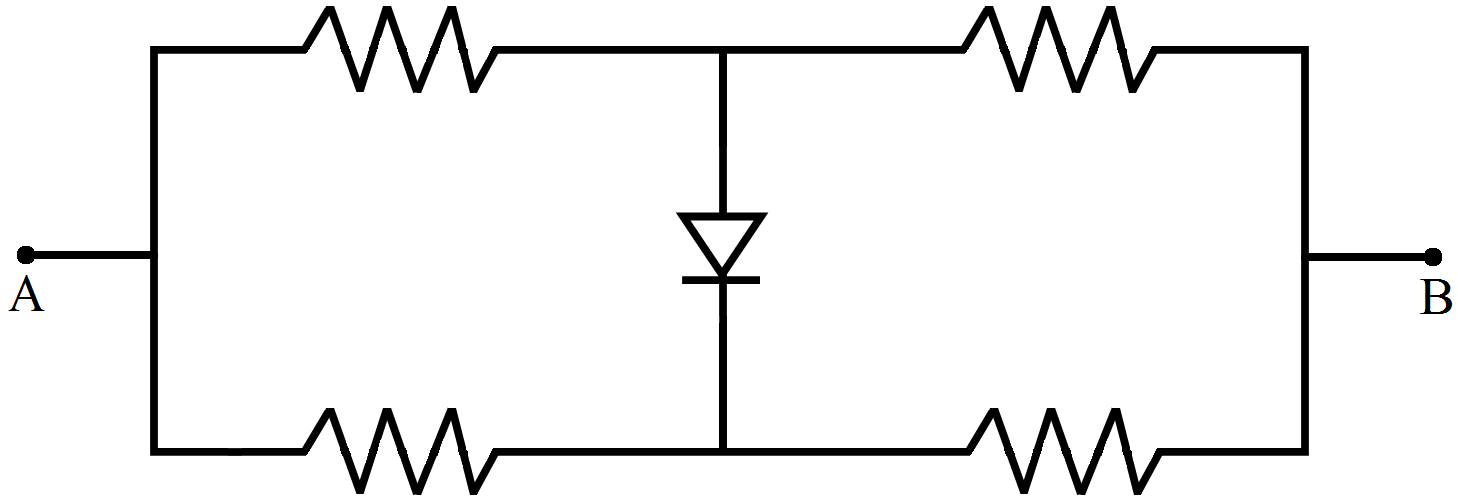
Each of the resistances shown in figure. has a value of $20\Omega.$ Find the equivalent resistance between A and B. Does it depend on whether the point A or B is at higher potential?

A uniformly charged conducting sphere of 2.4 m diameter has a surface charge density of 80.0 μC/m2.
  1. Find the charge on the sphere.
  2. What is the total electric flux leaving the surface of the sphere?