Question
Write down the equation of electric potential for a point $-$ outside the spherical shell $-$ on the surface of a spherical shell and $-$ inside the spherical shell.
Answer

$\rightarrow $ Generally, for a spherical shell, the electric field for a point outside the surface of shell is such that the entire charge of shell can be considered as concentrated at its centre.
$\rightarrow $ The value of electric potential that we get for a point outside the surface of shell is also got $($derived$)$ in a similar way.
$V =\frac{1}{4 \pi \varepsilon_0} \cdot \frac{q}{r}(r \geq R )$
Where, $q -$ total electric charge on the shell
$R -$ radius of the shell
$r -$ the distance of the point from the centre of the shell.
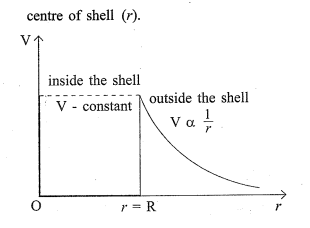
$\rightarrow $ The electric field inside the shell is zero, therefore potential inside remains constant.
$\rightarrow $ Because as there is no electric field inside, the work done in taking the charge from one point to the other is zero.
$\therefore \text { In } W =q \Delta V ,$
$\text { because } W =0$
$\therefore \Delta V =0$
$\therefore V =\text { constant }$
and that value of potential is same as the value on the surface of shell.
$\therefore V =\frac{1}{4 \pi \varepsilon_0} \cdot \frac{q}{ R } \quad(\because r \leq R )$
$\rightarrow $ Below figure $($graph$)$ shows the variation of electric potential $( V )$ versus distance from the
Image

Need a full question paper?

Generate a complete, print-ready paper with questions like this in minutes — across 16+ boards, with answer keys.

Start Generating Free

Similar questions

Two point electric charges of unknown magnitude and sign are placed at some distance ‘d’ apart. The electric field intensity is zero at a point, not between the charges but on the line joining them.
Write two essential conditions for this to happen.
Define self-inductance of a coil. Show that magnetic energy required to build up the current I in a coil of self inductance L is given by $\frac{1}{2}\text{LI}^{2}.$
  1. An electrostatic field line is a continuous curve. That is, a field line cannot have sudden breaks. Why not?
  2. Explain why two field lines never cross each other at any point?
Which of the following can act as a source of electromagnetic waves:
  1. A charge moving with a constant velocity.
  2. A charge moving in a circular orbit.
  3. A charge at rest.
Give reason.
Two magnetic poles, one of which is $10$ times as strong as the other, exert on each other a force equal to $9.604\ mN$ , when placed $10 \ cm$ apart in air. Find the strength of the two poles.
The decay constant of $\text{ }^{197}_{80}\text{Hg} ($electron capture to $\text{ }^{197}_{79}\text{Au})$ is $1.8 \times 10^{-4} S^{-1}.$
  1. What is the half-life$?$
  2. What is the average-life$?$
  3. How much time will it take to convert $25\%$ of this isotope of mercury into gold$?$
Give the SI unit and definition of electric charge and also write down the smaller unit.
Light falls from glass $(\mu=1.5)$ to air. Find the angle of incidence for which the angle of deviation is 90°.
Two convex lenses of same focal length but of aperture $A_1$ and $A_2 (A_2 < A_1),$ are used as the objective lenses in two astronomical telescopes having identical eyepieces. What is the ratio of their resolving power? Which telescope will you prefer and why? Give reason.
Write the difference between polar and non-polar dieelctric.