Question
Write down the $\text{IUPAC}$ name for the following complex and indicate the oxidation state, electronic configuration and coordination number. Also give stereochemistry and magnetic moment of the complex:
$\ce{K[Cr(H_2O)_2(C_2O_4)_2].3H_2O}$

Answer

$\ce{K[Cr(H_2O)_2(C_2O_4)_2].3H_2O}$
Potassium diaquadioxalatochromate $(III)$ trihydrate.
Oxidation state of chromium $= 3$
Electronic configuration:$ 3d^3 : t_{2g}^3$
Coordination number $= 6$
Shape: octahedral
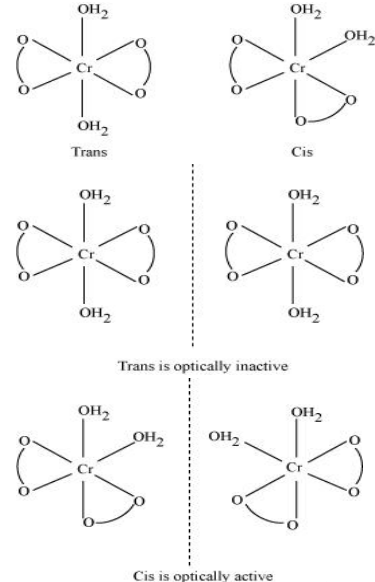
Stereochemistry:

Magnetic moment, µ = $\sqrt{\text{n}(\text{n}+2)}$
$=\sqrt{3(3+2)}$
$=\sqrt{15}$
$=\text{~}4\text{BM}$

Need a full question paper?

Generate a complete, print-ready paper with questions like this in minutes — across 16+ boards, with answer keys.

Start Generating Free

Similar questions

  1. Deficiency of which vitamin causes night $-$ blindness?
  2. Name the base that is found in nucleotide of $\text{RNA}$ only.
  3. Glucose on reaction with $\ce{HI}$ gives $n\ -$ hexane. What does it suggest about the structure of glucose?
Using Raoult’s law explain how the total vapour pressure over the solution is related to mole fraction of components in the following solutions.
$CHCl_3(l)$ and $CH_2Cl_2(l)$
Write chemical reaction to affect the following transformation.
(ii) Acetone to propane
Explain the following:
Haloalkanes react with KCN to form alkyl cyanides as main product while AgCN forms isocyanides as the major product.
Suggest the most important type of intermolecular attractive interaction in the following pairs.
(i) n-hexane and n-octane
(ii) I2 and CCl4
(iii) NaClO4, and water
(iv) methanol and acetone
(v) acetonitrile (CH3CN) and acetone (C3H6O).
$(A), (B)$ and $(C)$ are three non-cyclic functional isomers of a carbonyl compound with molecular formula $C_4H_8O$. Isomers $(A)$ and $(C)$ give positive Tollens’ test whereas isomer $(B)$ does not give Tollens’ test but gives positive Iodoform test. Isomers $(A)$ and $(B)$ on reduction with $Zn(Hg)$/ conc. $HCl$ give the same product $(D)$.
  1. Write the structures of $(A), (B), (C)$ and $(D)$.
  2. Out of $(A), (B)$ and $(C)$ isomers, which one is least reactive towards addition of $HCN?$
Various isomeric haloalkanes with the general formula $\ce{{C_4H_9CI}}$ undergo hydrolysis reaction. Among them, compound $"A "$ is the most reactive through $\ce{S_N^1}$ mechanism. Identify $"A "$ citing the reason for your choice. Write the mechanism for the reaction.
An alkene $'A\ ’ (Mol$. formula $C_5H_{10})$ on ozonolysis gives a mixture of two compounds $'B\ ’$ and $'C\ ’$. Compound $'B\ ’$ gives positive Fehling\ $’s$ test and also forms iodoform on treatment with $I_2$ and $NaOH$. Compound $'C\ ’$ does not give Fehling\ $’s$ test but forms iodoform. Identify the compounds $A, B$ and $C$. Write the reaction for ozonolysis and formation of iodoform from $B$ and $C.$
What are enantiomers? Draw the structures of the possible enantiomers of 3-methylpent-1-ene.
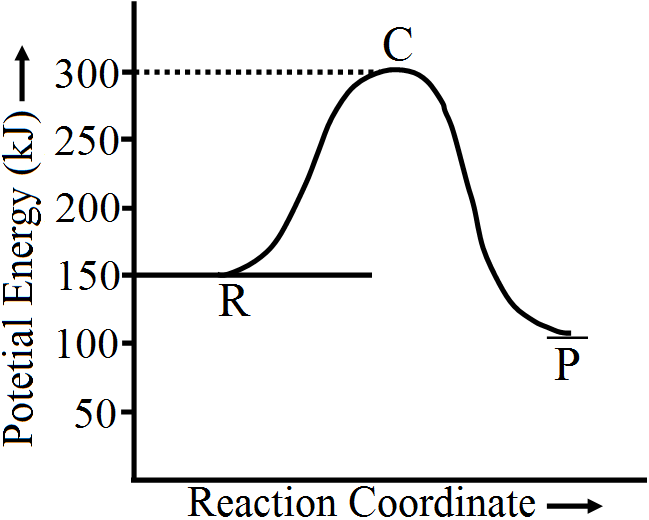
Answer the following questions on the basis of the given plot of potential energy vs reaction coordinate$:$
  1. What is the threshold energy for the reaction?
  2. What is the activation energy for forward reaction?
  3. What is the activation energy for backward reaction?
  4. What is enthalpy change for the forward reaction?