Question
Write electrode reaction when hydrogen acts as:
  1. Cathode.
  2. Anode.

Answer

  1. At Cathode: $2\text{H}^+\text{(aq)}+2\text{e}^-\xrightarrow{ \ \ \ \ \ \ \ }\text{H}_2\text{(g)}$

  2. At Anode: $\text{H}_2\text{(g)}\xrightarrow{ \ \ \ \ \ }2\text{H}^+\text{(aq)}+2\text{e}^-$

Need a full question paper?

Generate a complete, print-ready paper with questions like this in minutes — across 16+ boards, with answer keys.
Start Generating Free

Similar questions

Why does electronegativity value increases across a period and decreases down period?
In a reaction
A + B2 → AB2
Identify the limiting reagent, if any, in the following reaction mixtures.
100 atoms of A + 100 molecules of B.
A sample of drinking water was found to be severely contaminated with chloroform, CHCl3, supposed to be carcinogenic in nature. The level of contamination was 15ppm (by mass).
Determine the molality of chloroform in the water sample.
Similar to electron diffraction, neutron diffraction microscope is also used for the determination of the structure of molecules. If the wavelength used here is 800 pm , calculate the characteristic velocity associated with the neutron.
Write the electronic configuration of ${ }_9 F^{19},{ }_{16} S^{32}$ and ${ }_{18} Ar ^{38}$ and then point out the element with
i. maximum nuclear charge.
ii. minimum number of neutrons.
iii. maximum number of unpaired electrons.
What is normality and formality? Explain.
Do they depend on temperature?
“Stability of carbocations depends upon the electron releasing inductive effect of groups adjacent to positively charged carbon atom involvement of neighbouring groups in hyperconjugation and resonance.”
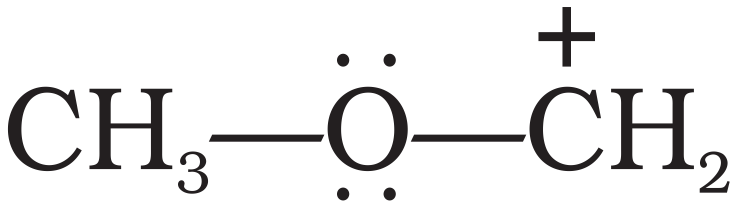
Draw the possible resonance structures for  and predict which of the structures is more stable. Give reason for your answer.
Empirical formula of a compound X (molar mass 78g mol-1) is CH. Write its molecular formula.
1m3 of C2H4 at STP Is burnt in oxygen, according to the thermochemical reaction:

$\text{C}_2\text{H}_4(\text{g})+3\text{O}_2(\text{g})\overrightarrow{\ \ \ \ \ \ \ }\ 2\text{CO}_2(\text{g})+2\text{H}_2\text{O(l)};$ $\Delta\text{H}=-1410\text{kJ mol}^{-1}$

Assuming 70% efficiency, determine how much of useful heat is evolved in the reaction.