Question
Write Faraday's laws of electromagnetic induction.

Answer

Faraday's Laws of electromagnetic induction :
(1) Whenever there is a change in the magnetic flux linked with a coil, emf is induced in the coil. This emf is called induced emf and it lasts so long as the change in the flux is taking place. When the coil circuit is closed an electric current flows through the circuit corresponding to induced emf and is known as induced current. This phenomenon is called electromagnetic induction.
(2) The induced emf is equal to the negative rate of change of magnetic flux.
If $\Delta\Phi$ be the change in magnetic flux linked with a circuit in time interval $\Delta t$ then the induced emf in the circuit according to second law is given by:
$e=-(\frac{\Delta\Phi}{\Delta t})$ ...(1)
Under the condition: lim $\Delta t \rightarrow 0$ equation (1) in its differential form can be expressed as follows:
$e=-(\frac{d\Phi}{dt})$ ...(2)
The (-ve) sign indicates that the induced emf opposes the change in magnetic flux.

Need a full question paper?

Generate a complete, print-ready paper with questions like this in minutes — across 16+ boards, with answer keys.
Start Generating Free

Similar questions

Explain internal reflection and total internal reflection and also derive the necessary formula for it.
A coil of cross $-$ sectional area A lies in a uniform magnetic field $B$ with its plane perpendicular to the field. In this position the normal to the coil makes an angle of $0^\circ$ with the field. The coil rotates at a uniform rate to complete one rotation in time $T$. Find the average induced emf in the coil during the interval when the coil rotates:
$i$. from $0^{\circ}$ to $90^{\circ}$ position
$ii$. from $90^{\circ}$ to $180^{\circ}$ position
$iii$. from $180^{\circ}$ to $270^{\circ}$ and
$iv$. from $270^{\circ}$ to $360^{\circ}$
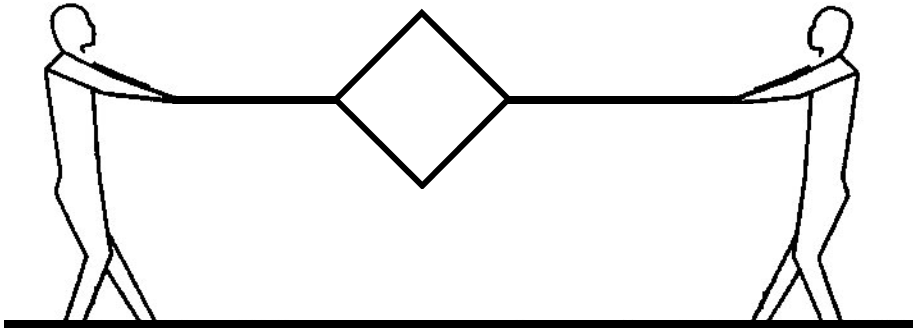
Figure shows a metallic square frame of edge a in a vertical plane. A uniform magnetic field B exists in the space in a direction perpendicular to the plane of the figure. Two boys pull the opposite corners of the square to deform it into a rhombus. They start pulling the corners at t = 0 and displace the corners at a uniform speed u.
  1. Find the induced emf in the frame at the instant when the angles at these corners reduce to 60°.
  2. Find the induced current in the frame at this instant if the total resistance of the frame is R.
  3. Find the total charge which flows through a side of the frame by the time the square is deformed into a straight line.
Draw the circuit diagram of a common emitter amplifier using $n-p-n$ transistor. What is the phase differnece between the input signal and output voltage? State two reasons why a common emitter amplifier is preferred to a common base amplifier.

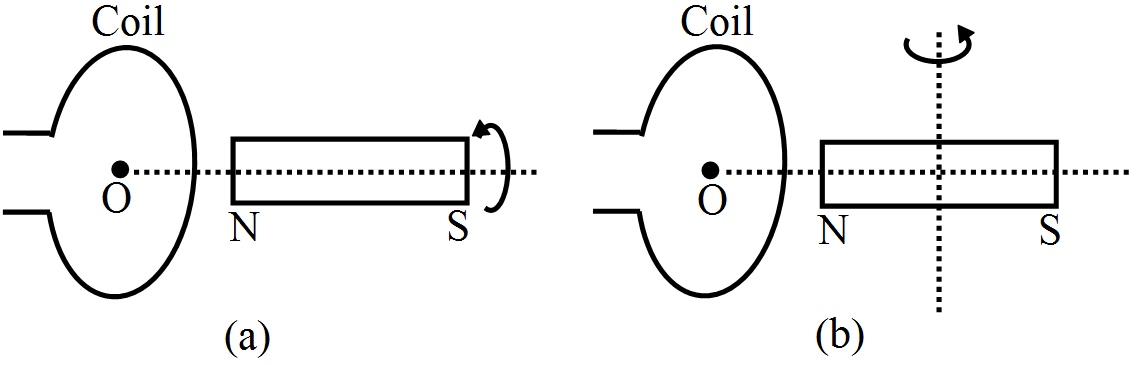
A cylindrical bar magnet is kept along the axis of a circular coil and near it as shown in figure. Will there be any induced emf at the terminals of the coil, when the magnet is rotated:
  1. About its own axis.
  2. About an axis perpendicular to the length of the magnet?
The band gap between the valence and the conduction bands in zinc oxide (ZnO) is 3.2eV. Suppose an electron in the conduction band combines with a hole in the valence band and the excess energy is released in the form of electromagnetic radiation. Find the maximum wavelength that can be emitted in this process.
A $600 pF$ capacitor is charged by a $200 V$ supply. It is then disconnected from the supply and is connected to another uncharged $300 pF$ capacitor. Calculate how much electrostatic energy is lost in the process. What is the source of energy loss?
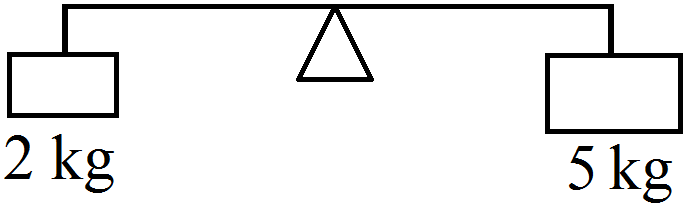
A light rod of length 1m is pivoted at its centre and two masses of 5kg and 2kg are hung from the ends as shown in figure. Find the initial angular acceleration of the rod assuming that it was horizontal in the beginning.
An object of size $3.0 \ cm$ is placed $14 \ cm$ in front of a concave lens of focal length $21 \ cm$. Describe the image produced by the lens. What happens if the object is moved further away from the lens?
Define the current sensitivity of a galvanometer. Write its $S.I.$ unit.
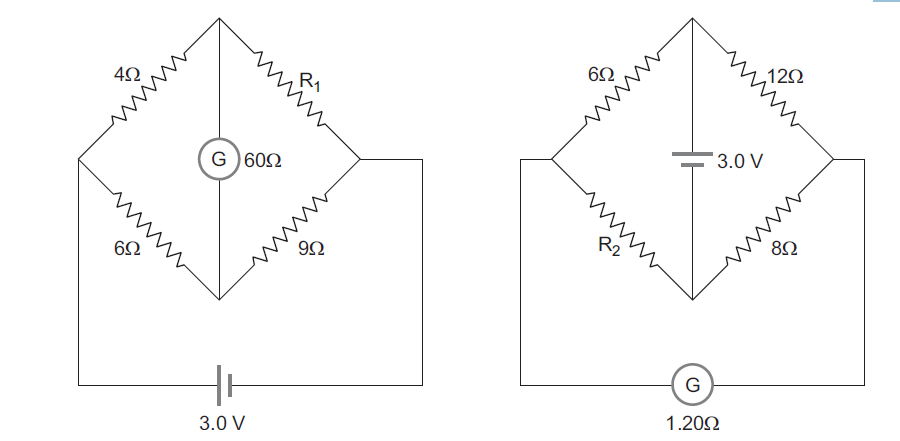
Figure shows two circuits each having a galvanometer and a battery of $3 V. $ When the galvanometers in each arrangement do not show any deflection, obtain the ratio $R_{1 }/ R_2.$