Question
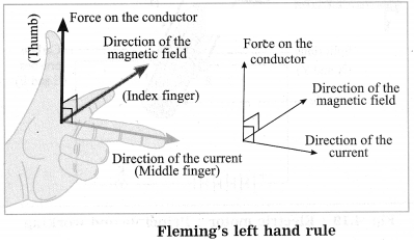
Write Fleming’s left hand rule.
Answer

Fleming’s left hand rule: The left hand thumb, index finger, and the middle finger are stretched so as to be perpendicular to each other. If the index finger is in the direction of the magnetic field, and the middle finger points in the direction of the current, then the direction of the thumb in the direction of the force on the conductor.
Image

[Note: A magnetic field exerts a force on a current-carrying conductor. Electric current is the time rate of flow of electric charge. Thus, a magnetic field exerts a force on a moving charge. This property is used to accelerate charged particles such as protons, deuterons and alpha particles, as well as electrons, to very high energies. A machine used for this purpose is called a charged particle accelerator. It may be linear or circular in design and very big in size. Such high energy particles are used to study the structure of matter. ]

Need a full question paper?

Generate a complete, print-ready paper with questions like this in minutes — across 16+ boards, with answer keys.
Start Generating Free

Similar questions

How is hydrogen molecule formed?
An object 60cm from a lens gives a virtual image at a distance of 20cm in front of the lens. What is the focal length of the lens? Is the lens converging or diverging? Give reasons for your answer.
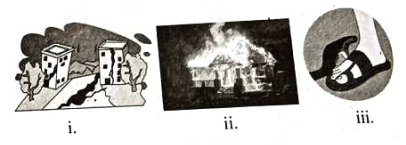
The following are some pictures of disasters. Which precautions would you take during these disasters?
Image
Did Dobereiner’s triads also exist in the columns of Newlands’ law of octaves? Explain your answer.
How does the resistance of a wire change when:
  1. Its length is tripled?
  2. Its diameter is tripled?
  3. Its material is changed to one whose resistivity is three times?
Observe the following figures and complete the table.
Choose the correct option from the bracket and complete the stanza.
(colour blind, actual, conical, light-sensitive, rodlike, colours)
The retina in our eyes is made up of many _______ cells. These cells are shaped like a rod and like a cone. The _______ cells respond to the intensity of light and give information about the brightness or dimness of the object to the brain. The _______ cells respond to the colour and give information about the colour of the object to the brain. Brain processes all the information received and we see the _______ image of the object. Rod like cells respond to the faint light also but ______ cells do not. Some people lack conical cells responding to certain colours. These persons cannot recognize those colours or cannot distinguish between different ______. These persons are said to be ______.
Three 2V cells are connected in series and used as a battery in a circuit.
  1. What is the p.d. at the terminals of the battery?
  2. How many joules of electrical energy does 1C gain on passing through
  1. One cell.
  2. All three cells?
Draw a neat labelled diagram. : Refraction of light passing through a glass slab.
Define heredity. Explain the mechanism of hereditary changes.