Question
Write formula for Bohr's frequency.

Answer

Frequency of emitted radiation of electron of atom to jump from outer orbit to inner orbit is $v$.
$E=h \nu=E_2-E_1$
Here, $E _1=$ Total energy of electron in inner orbit.
$E _2=$ Total energy of electron in outer orbit.

Need a full question paper?

Generate a complete, print-ready paper with questions like this in minutes — across 16+ boards, with answer keys.
Start Generating Free

Similar questions

If we cover the lower half of the reflecting surface of a concave mirror with some opaque (nonreflective) material, then what effect will this have on the image formed by the mirror of an object situated in front of the mirror?
A proton beam is going from east to west. Is there an electric current? If yes, in what direction?
What are $V-1$ characteristics of a $p-n$ junction?
Find the average frictional force needed to stop a car weighing 500kg in a distance of 25m if the initial speed is 72km/ h.
A car moving at 40km/h is to be stopped by applying brakes in the next 4.0m. If the car weighs 2000kg, what average force must be applied on it?
An ideal gas is taken from an initial state i to a final state f in such a way that the ratio of the pressure to the absolute temperature remains constant. What will be the work done by the gas?
Derive an expression for the work done in rotating a dipole from the angle $\theta_{0}$ to $\theta_{1}$ in a uniform electric field E.
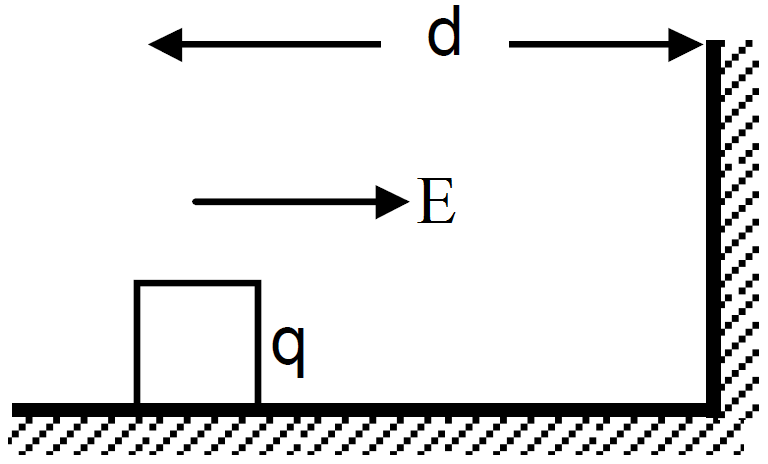
A block of mass m containing a net positive charge q is placed on a smooth horizontal table which terminates in a vertical wall as shown in figure. The distance of the block from the wall is d. A horizontal electric field E towards right is switched on. Assuming elastic collisions (if any) find the time period of the resulting oscillatory motion. Is it a simple harmonic motion?
A proton and an alpha particle having the same kinetic energy are, in turn, passed through a region of the uniform magnetic field, acting normal to the plane of the paper and travel in circular paths. Deduce the ratio of the radii of the circular paths described by them.
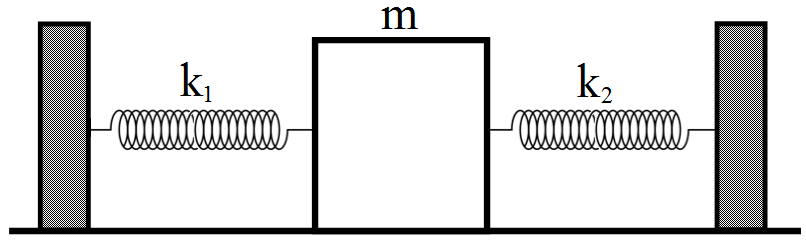
Both the springs shown in figure are unstretched. If the block is displaced by a distance x and released, what will be the initial acceleration?