Question
Write formula for the following compound:

Iron(III) sulphate.

Answer

Iron(III) sulphate:
Fe2(SO4)3

Need a full question paper?

Generate a complete, print-ready paper with questions like this in minutes — across 16+ boards, with answer keys.

Start Generating Free

Similar questions

Calculate the mass per cent of different elements present in sodium sulphate $Na _2 SO _4$.
Use molecular orbital theory to explain why the $Be _2$ molecule does not exist.
Consider the following equilibrium:
$\text{CO}_2(\text{g})+\text{C (graphite)}\rightleftharpoons2\text{CO}(\text{g})$
Write the equilibrium expression for Kc and calculate its units.
The first $(\Delta_{1}\text{H}_{1})$ and the second $(\Delta_{1}\text{H}_{1})$ionization enthalpies (in kJ mol–1) and the $(\Delta_{1}\text{H}_{1})$ electron gain enthalpy (in kJ mol–1) of a few elements are given below:
Elements $\Delta\text{H}_{1}$ $\Delta{\text{H}}_{2}$ $\Delta_{\text{eg}}\text{H}$
I 520 7300 -60
II 419 3051 -48
III 1681 3374 -328
IV 1008 1846 -295
V 2372 5251 +48
VI 738 1451 -40
Which of the above elements is likely to be:
The metal which can form a predominantly stable covalent halide of the formula MX (X=halogen)?
Predict if the solutions of the following salts are neutral, acidic or basic: $NaCl , KBr , NaCN , NH _4 NO _3, NaNO _2$ and KF
Glycine is an a-amino acid. It exists in the form of Zwitter ion as +NH3CH2COO-
Write the formula of its
  1. Conjugate acid.
  2. Conjugate base.
When would the wavelength associated with an electron be equal to the wavelength associated with a proton? Mass of electron = 9.1095 × 10⁻²⁸g; Mass of proton = 1.6725 × 10⁻²⁴g.

OR

Calculate the velocity condition for the wavelength associated with a moving electron to be equal to the wavelength associated with a moving proton.

(Mass of electron = 9.11 × 10-48g; Mass of proton = 1.67 × 10⁻²⁴g; h = 6.6 × 10⁻³⁴Js; J = kg/ m2s-2).
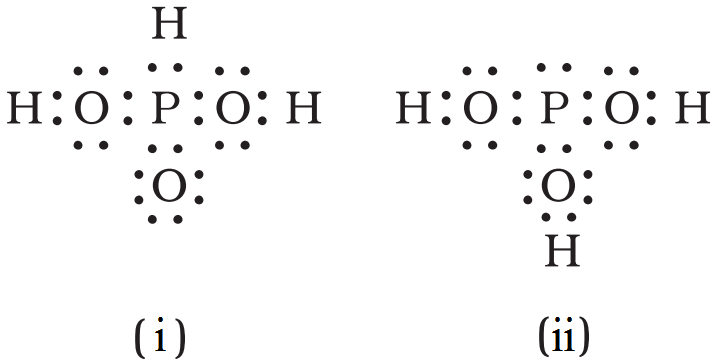
(a) Name one element in which the number of $s$ electrons is equal to the numbers of p-electrons.
(b) Tell the number of radial nodes in 1 s and 2 s orbitals.
H3 PO3 can be represented by structures 1 and 2 shown below. Can these two structures be taken as the canonical forms of the resonance hybrid representing H3 PO3? If not, give reasons for the same.

Write the contribution of Lothar-Meyer in classification of elements.