Question
Write four characteristic properties of p-block elements.

Answer

General characteristics of p-block elements:
  1. The general electronic configuration of p-block elements is $\mathrm{ns}^2 \mathrm{~np}^{1-6}$.
  2. These elements include metals and non-metals with a few semi metals (Metalloids)
  3. Most of them form covalent compounds.
  4. These elements possess relatively higher ionisation energy and the value tends to increase along the period but decrease down the group.
  5. Most of the elements show negative (except some metals) as well as positive oxidation states (except Fluorine).
  6. One of the familiar characteristic of p-block elements is to show inert pair effect i.e. the tendency of being less availability for ns electron in bonding. The inert pair effect increases down the group with the increase in atomic number.

Need a full question paper?

Generate a complete, print-ready paper with questions like this in minutes — across 16+ boards, with answer keys.
Start Generating Free

Similar questions

Balance the following redox reactions by ion-electron method: $\mathrm{MnO}_4^{}{-}(\mathrm{aq})+\mathrm{SO}_2(\mathrm{g}) \rightarrow \mathrm{Mn}^{2+}(\mathrm{aq})+\mathrm{HSO}_4^{}{-}(\mathrm{aq})$ (in acidic solution).
Calculate the percentage of copper in a sample of $\mathrm{CuCl}_2$.
(Atomic mass of $\mathrm{Cu}=63.5 \mathrm{u}, \mathrm{Cl}=35.5 \mathrm{u}$ )
An ionic hydride of groups has sufficiently covalent character. It is used to form hydrides of other elements of group 13 which are useful reducing agent. Write the formula this hydride and its reaction with $\mathrm{B}_2 \mathrm{H}_6$ and $\mathrm{AlCl}_3$.
Comment on the thermodynamic stability of NO(g), given$\frac{1}{2}\text{N}_2(\text{g}) + \frac{1}{2}\text{O}_2(\text{g})\xrightarrow{ \ \ \ \ \ \ } \text{NO}_{(\text{g})} \ ; \ \Delta_{\text{r}}\text{H}^\ominus=90\text{kJ} \ \text{mol}^{-1}$
$\text{NO}_2(\text{g}) + \frac{1}{2}\text{O}_2(\text{g})\xrightarrow{ \ \ \ \ \ \ } \text{NO}_2(\text{g}) \ ; \ \Delta_{\text{r}}\text{H}^\ominus=-74\text{kJ} \ \text{mol}^{-1}$
The average velocity at $T_1 \mathrm{~K}$ and most probable velocity at $T_2{ }^{\circ} \mathrm{C}$ of CO , gas is $9.0 \times 10^4 \mathrm{~cm} \mathrm{~s}^{-1}$. Calculate the value of $\mathrm{T}_1$ and $\mathrm{T}_2$.

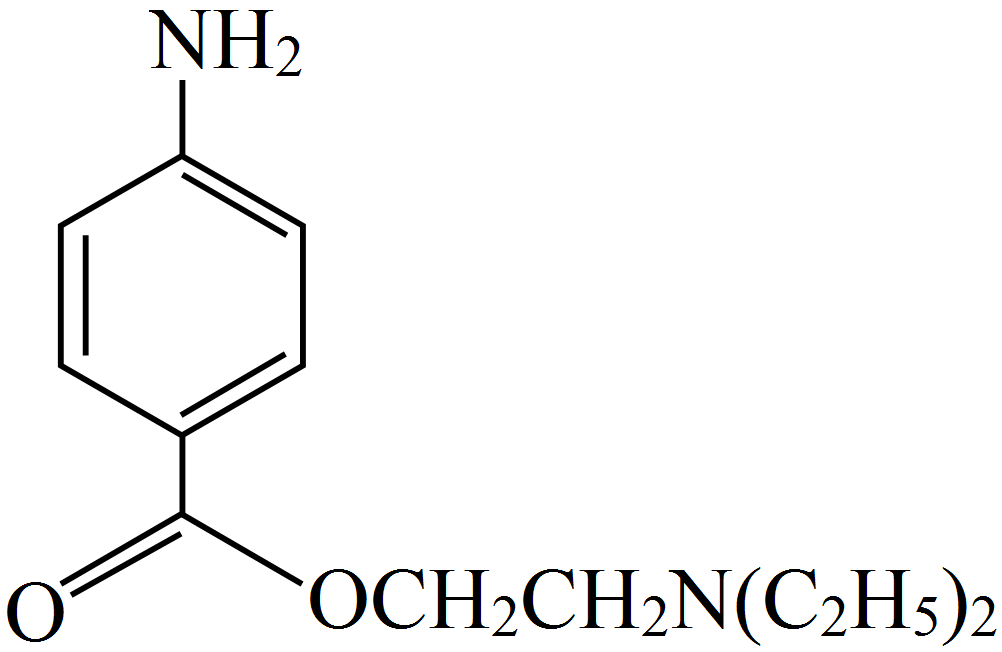
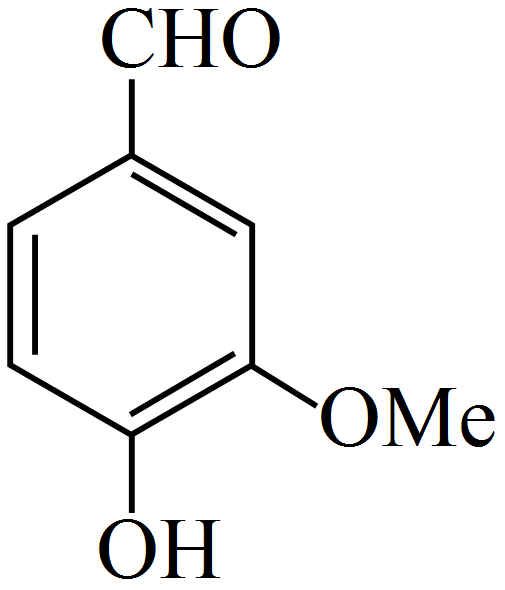
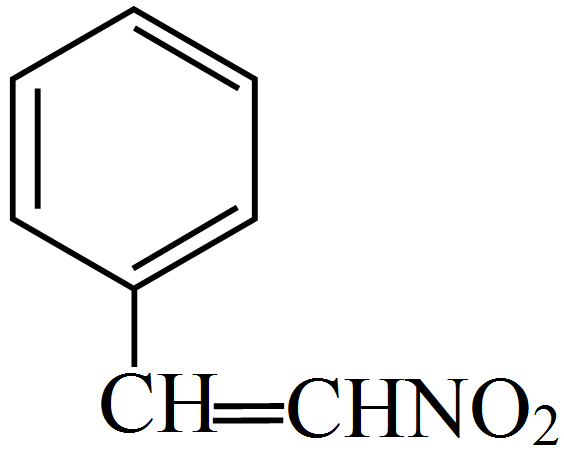
Identify the functional groups in the following compounds.
  1.  
  1.  
  1.  
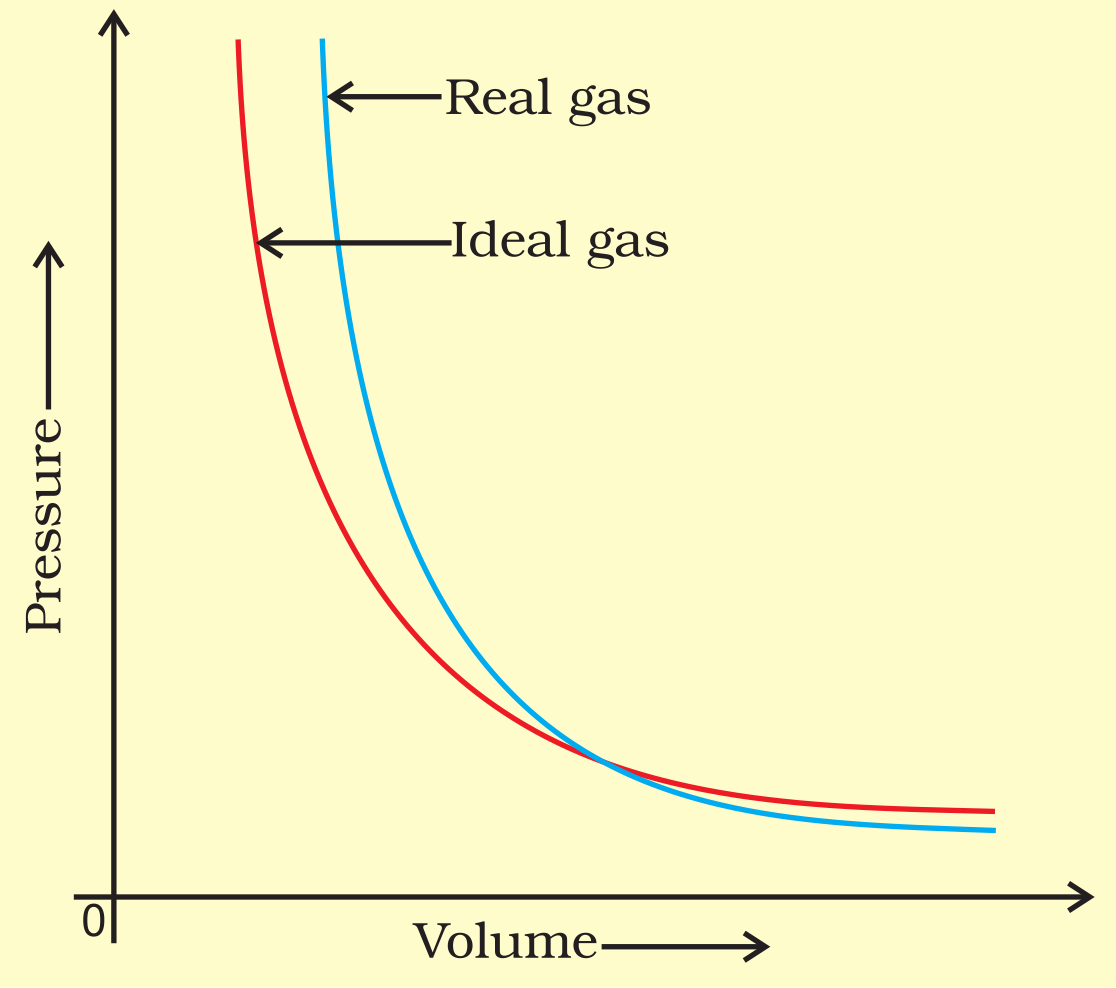
Pressure versus volume graph for a real gas and an ideal gas are shown in Fig. Answer the following questions on the basis of this graph.
  1. Interpret the behaviour of real gas with respect to ideal gas at low pressure.
  2. Interpret the behaviour of real gas with respect to ideal gas at high pressure.
  3. Mark the pressure and volume by drawing a line at the point where real gas behaves as an ideal gas.
Give the structures of A and B.
Prove that the excluded volume 'b' is four times the actual volume of the gas molecules.
Write a relation between $\Delta\text{G}$ and Q and define the meaning of each term and answer the following:
  1. Why a reaction proceeds forward when Q < K and no net reaction occurs when Q = K.
  2. Explain the effect of increase in pressure in terms of reaction quotient Q. for the reaction: $\text{CO(g)}+\text{3H}_2\text{(g)}\rightleftharpoons\text{CH}_4\text{(g)}+\text{H}_2\text{O(g)}$