Question
Write Gauss's law and explain.

Answer

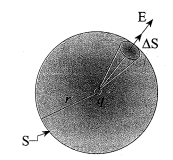
Image

→ Let us consider the total flux through a sphere of radius $r$, which encloses a point charge $q$ at its centre. Divide the sphere into small area elements, as shown in fig.
→ The flux through an area element $\Delta S$ is
$\Delta \phi=\overrightarrow{ E } \cdot \Delta \overrightarrow{ S }=\frac{q}{4 \pi \varepsilon_0 r^2} \hat{r} \cdot \overrightarrow{\Delta S }$
→ The unit vector $\hat{r}$ is along the radius vector from the centre to the area element.
→ Now, since the normal to a sphere at every point is along the radius vector at that point, the area element $\Delta S$ and $\hat{r}$ have the same direction.
Therefore,
$\Delta \phi=\frac{q}{4 \pi \varepsilon_0 r^2} \Delta S$
→ The total flux through the sphere is obtained by adding up flux through all the different area elements:
→ Now S, the total area of the sphere, equals $4 \pi r^2$. Thus,
$\phi=\frac{q}{4 \pi \varepsilon_0 r^2} \times 4 \pi r^2=\frac{q}{\varepsilon_0}$
→ Equation (1) is a simple illustration of a general result of electrostatics called Gauss's law.
→ "The total electric flux associated with a closed surface is equal to the ratio of total enclosed charge and $\varepsilon_0$."
$\therefore \phi=\int \overrightarrow{ E } \cdot d \overrightarrow{ S }=\frac{\sum q}{\varepsilon_0}$
$\phi=\sum_{\text {avl } \Delta S } \frac{q}{4 \pi \varepsilon_0 r^2} \Delta S$
→ Since each area element of the sphere is at the same distance $r$ from the charge,
$\phi=\frac{q}{4 \pi \varepsilon_0 r^2} \sum_{\text {all } \Delta S } \Delta S =\frac{q}{4 \pi \varepsilon_0 r^2} S$

Need a full question paper?

Generate a complete, print-ready paper with questions like this in minutes — across 16+ boards, with answer keys.
Start Generating Free

Similar questions

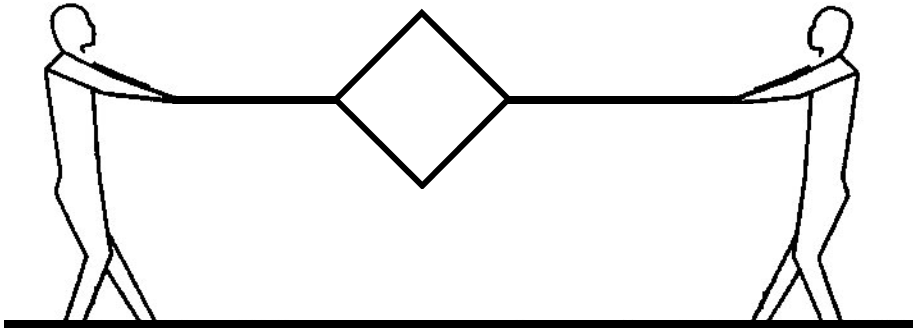
Figure shows a metallic square frame of edge a in a vertical plane. A uniform magnetic field B exists in the space in a direction perpendicular to the plane of the figure. Two boys pull the opposite corners of the square to deform it into a rhombus. They start pulling the corners at t = 0 and displace the corners at a uniform speed u.
  1. Find the induced emf in the frame at the instant when the angles at these corners reduce to 60°.
  2. Find the induced current in the frame at this instant if the total resistance of the frame is R.
  3. Find the total charge which flows through a side of the frame by the time the square is deformed into a straight line.
Explain the construction of compound microscope with the help of figure and derive the equation of magnification.
Calculate the energy that can be obtained from $1\ kg$ of water through the fusion reaction
$^2H + ^2H \rightarrow ^3H + p.$
Assume that $1.5 \times 10^{-2}\%$ of natural water is heavy water $D_2O ($by number of molecules$)$ and all the deuterium is used for fusion.
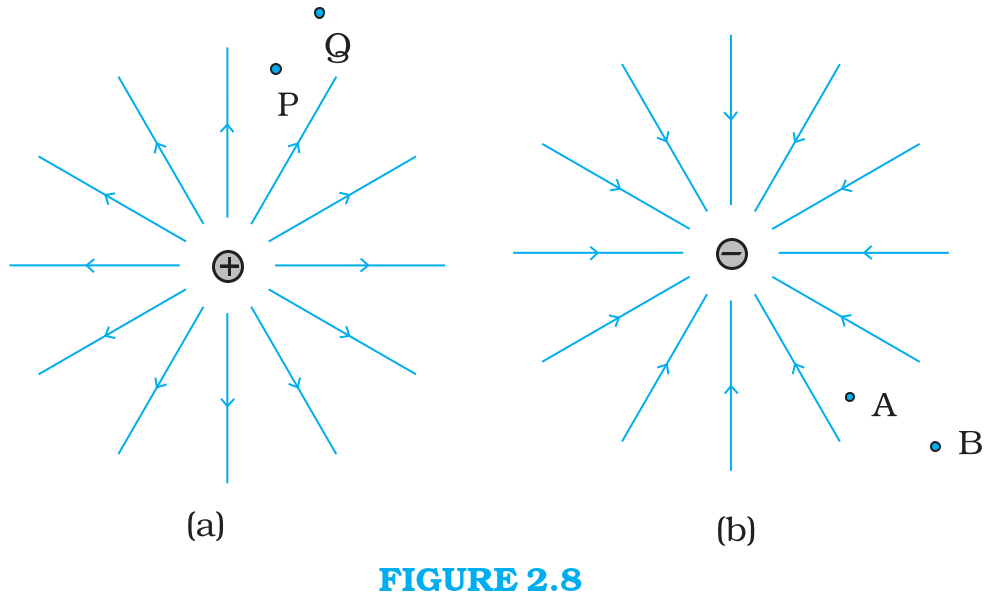
Figures 2.8 (a) and (b) show the field lines of a positive and negative point charge respectively.
Image
(a) Give the signs of the potential difference $V_{ P }-V_{ Q } ; V_{ B }-V_{ A }$.
(b) Give the sign of the potential energy difference of a small negative charge between the points $O$ and $P ; A$ and $B$.
(c) Give the sign of the work done by the field in moving a small positive charge from $Q$ to $P$.
(d) Give the sign of the work done by the external agency in moving a small negative charge from $B$ to $A$.
(e) Does the kinetic energy of a small negative charge increase or decrease in going from $B$ to $A$ ?
Answer the following questions:
  1. In a double slit experiment using light of wavelength $600 \ nm$, the angular width of the fringe formed on a distant screen is $0.1^o$. Find the spacing between the two slits.
  2. Light of wavelength $5000 \mathring A$ . Propagating in air gets partly reflected from the surface of water. How will the wavelengths and frequencies of the reflected and refracted light be affected?
A conducting sphere of radius 10 cm has an unknown charge. If the electric field 20 cm from the centre of the sphere is $1.5 \times 10^3 N / C$ and directed radially inward, what is the net charge on the sphere?
The temperature and the relative humidity are $300K$ and $ 20\%$ in a room of volume $50m^3.$ The floor is washed with water, $500g$ of water sticking on the floor. Assuming no communication with the surrounding, find the relative humidity when the floor dries. The changes in temperature and pressure may be neglected. Saturation vapour pressure at $300K = 3.3kPa.$
Let AE denote the energy gap between the valence band and the conduction band. The population of conduction electrons (and of the holes) is roughly proportional to $\text{e}^{\frac{-\Delta\text{E}}{2\text{kT}}}.$ Find the ratio of the concentration of condu.ction electrons in diamond to that in silicon at room temperature 300K. $\Delta\text{E}$ for silicon is 1.1eV and for diamond is 6.0eV. How many conduction electrons are likely to be in one cubic metre of diamond?
Calculate the energy that can be obtained from $1\ kg$ of water through the fusion reaction
$^2H + ^2H \rightarrow ^3H + p.$
Assume that $1.5 \times 10^{-2}\%$ of natural water is heavy water $D_2O ($by number of molecules$)$ and all the deuterium is used for fusion.
A monochromatic light source of intensity $6\ mW$ emits $8 \times 10^{16}$ photons per second. This light ejects photoelectrons from a metal surface. The stopping potential for this setup is $2.0V.$ Calculate the work function of the metal.