Question
Write Gauss's law and explain.

Answer

Image

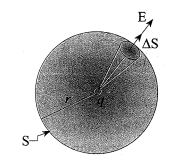
→ Let us consider the total flux through a sphere of radius $r$, which encloses a point charge $q$ at its centre. Divide the sphere into small area elements, as shown in fig.
→ The flux through an area element $\Delta S$ is
$\Delta \phi=\overrightarrow{ E } \cdot \Delta \overrightarrow{ S }=\frac{q}{4 \pi \varepsilon_0 r^2} \hat{r} \cdot \overrightarrow{\Delta S }$
→ The unit vector $\hat{r}$ is along the radius vector from the centre to the area element.
→ Now, since the normal to a sphere at every point is along the radius vector at that point, the area element $\Delta S$ and $\hat{r}$ have the same direction.
Therefore,
$\Delta \phi=\frac{q}{4 \pi \varepsilon_0 r^2} \Delta S$
→ The total flux through the sphere is obtained by adding up flux through all the different area elements:
→ Now S, the total area of the sphere, equals $4 \pi r^2$. Thus,
$\phi=\frac{q}{4 \pi \varepsilon_0 r^2} \times 4 \pi r^2=\frac{q}{\varepsilon_0}$
→ Equation (1) is a simple illustration of a general result of electrostatics called Gauss's law.
→ "The total electric flux associated with a closed surface is equal to the ratio of total enclosed charge and $\varepsilon_0$."
$\therefore \phi=\int \overrightarrow{ E } \cdot d \overrightarrow{ S }=\frac{\sum q}{\varepsilon_0}$
$\phi=\sum_{\text {avl } \Delta S } \frac{q}{4 \pi \varepsilon_0 r^2} \Delta S$
→ Since each area element of the sphere is at the same distance $r$ from the charge,
$\phi=\frac{q}{4 \pi \varepsilon_0 r^2} \sum_{\text {all } \Delta S } \Delta S =\frac{q}{4 \pi \varepsilon_0 r^2} S$

Need a full question paper?

Generate a complete, print-ready paper with questions like this in minutes — across 16+ boards, with answer keys.

Start Generating Free

Similar questions

A straight, long wire carries a current of 20A. Another wire carrying equal current is placed parallel to it. If the. force acting on a length of 10cm of the second wire is 2 ×10⁻⁵N, what is the separation between them?
The following table gives the output of a two input logic gate.
  1. Identify the logic gate and draw its logic symbol.
  2. If the output of this gate is fed as input to a NOT gate, name the new logic gate so formed.
A
B
Y
0
0
1
1
0
1
0
1
1
1
1
0
(a) The radii of curvature of the faces of a double convex lens are 10 cm and 15 cm . Its focal length is 12 cm . What is the refractive index of glass?
(b) A convex lens has 15 cm focal length in air. What is focal length in water? (Refractive index of air-water 1.33 and Refractive index of air-glass $=1.5$ )
Answer the following question:

  1. Write the truth table of the following gate.

  1. What will be the values of inputs A and B for the Boolean expression.

$\text{A}\bar{+}\text{B}).(\text{A}\bar{.}\text{B})=1$
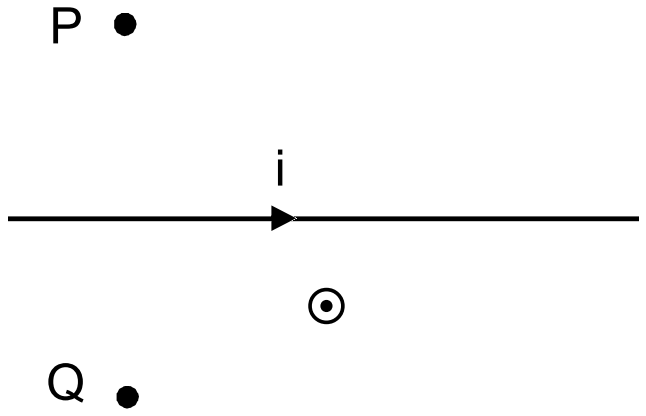
A long, straight wire carrying a current of 1.0A is placed horizontally in a uniform magnetic field B = 1.0 × 10⁻⁵T pointing vertically upward figure. Find the magnitude of the resultant magnetic field at the points Pand Q, both situated at a distance of 2.0cm from the wire in the same horizontal plane.

The work function of a metal is 2.5 x 10 -19J.
  1. Find the threshold frequency for photoelectric emission.
  2. If the metal is exposed to a light beam of frequency 6.0 x 10⁻¹⁴ Hz, what will be the stopping potential?
In a pure semiconductor, the number of conduction electrons is 6 × 10¹⁹ per cubic metre. How many holes are there in a sample of size 1cm × 1cm × 1mm?
Figure shows a smooth track, a part of which is a circle of radius R. A block of mass m is pushed against a spring of spring constant k fixed at the left end and is then released. Find the initial compression of the spring so that the block presses the track with a force mg when it reaches the point P, where the radius of the track is horizontal.
  1. Three photo diodes D1 , D2 and D3 are made of semiconductors having band gaps of 2.5eV, 2eV and 3eV respectively. Which of them will not be able to detect light of wavelength 600nm?
  2. Why photodiodes are required to operate in reverse bias? Explain.
An electric bulb, connected to a make and break power supply, switches off and on every second in its rest frame. What is the frequency of its switching off and on as seen from a spaceship travelling at a speed 0.8c?