Question
Write main differences between the properties of white phosphorus and red phosphorus.

Answer

White phosphorus Red phosphorus
It is a soft and waxy solid.
It possesses a garlic smell
It is a hard and crystalline solid, without any smell.
It is poisonous.
It is non-poisonous.
It is insoluble in water but soluble in carbon
disulphide.
It is insoluble in both water and carbon disulphide.
It undergoes spontaneous
combustion in air.
It is relatively less reactive.
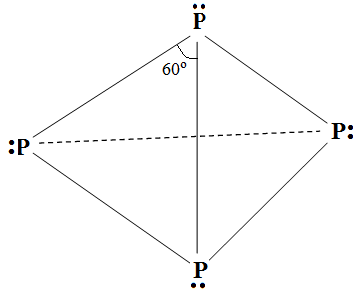
In both solid and vapour
states, it exists as a $P_4$
molecule.
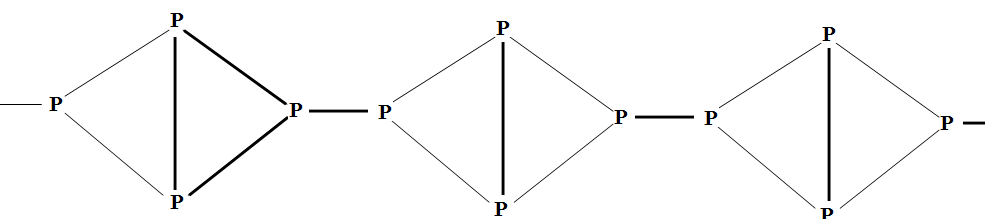
It exists as a chain of tetrahedral $P_4$ units.
Need a full question paper?

Generate a complete, print-ready paper with questions like this in minutes — across 16+ boards, with answer keys.

Start Generating Free

Similar questions

Explain giving reason:
The transition metals generally form coloured compounds.
Explain isocyanide test for primary amines.
What are chiral objects? Indicate the presence of centre of chirality, if any, in the molecules of 3-bromopent-1-ene.
For $M^{2+}/M$ and $M^{3+}/M^{2+}$ systems the values for some metals are as follows:
$Cr^{2+}/Cr$ $- 0.9 V$ $Cr^3/Cr^{2+}$ $- 0.4 V$
$Mn^{2+}/Mn$ $- 1.2 V$ $Mn^{3+}/Mn^{2+}$ $+ 1.5 V$
$Fe^{2+}/Fe$ $- 0.4 V$ $Fe^{3+}/Fe^{2+}$ $+ 0.8 V$
Use this data to comment upon:
  1. The stability of $Fe^{3+}$ in acid solution as compared to that of $Cr^{3+}$ or $Mn^{3+}.$
  2. The ease with which iron can be oxidised as compared to a similar process for either chromium or manganese metal.
Which of the following is an appropriate set of reactants for the preparation of $1-$methoxy$-4-$nitrobenzene and why?
  1.  
  1.  
If $6 \times 10^{20}$ electron are used in reduction of an ion to form an atom, then find the equivalent of the ion.
Explain the following:
Generally sulphide ores are converted into oxides before reduction.
For the decomposition of azoisopropane to hexane and nitrogen at $543$ K, the following data are obtained.
t (sec) P(mm of Hg)
$0$ $35.0$
$360$ $54.0$
$720$ $63.0$
Calculate the rate constant.
Complete the following reaction equations:
  1. $C_6H_5N_2Cl + H_3PO_2 + H_2O\rightarrow$
  2. $C_6H_5NH_2 + Br_2 (aq.) \rightarrow$
Calculate the degree of dissociation $(\alpha)$ of acetic acid if its molar conductivity $(\wedge_m)$ is $39.05\ S\ cm^2\ mol^{–1}.$
Given $\lambda^0(H^+) = 349.6\ S\ cm^2\ mol^{–1}$ and $\lambda^0(CH_3COO^–) = 40.9\ S\ cm^2\ mol^{–1}$